



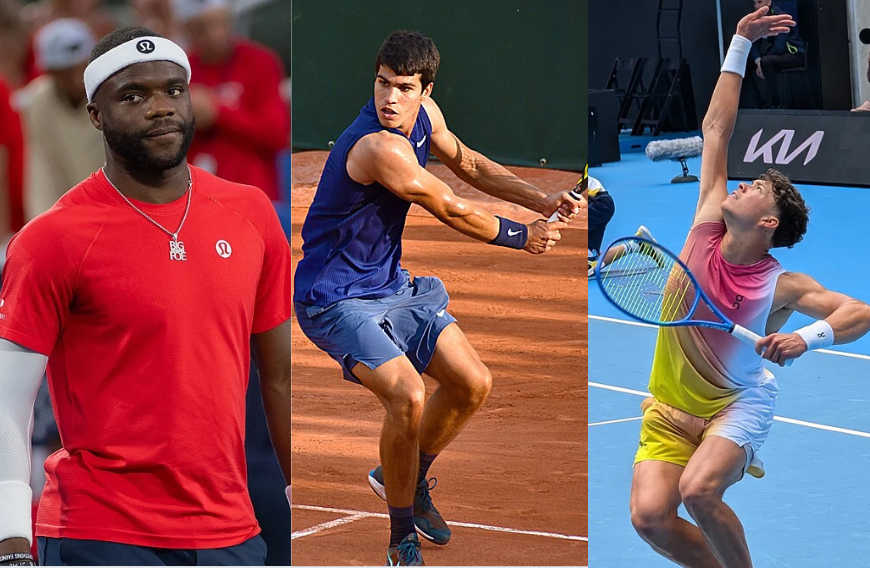
For anyone who watched tennis at the 2026 US Open Tuesday night, it was difficult not to come away with the feeling that the sport has ascended to another level of physical and mental intensity.
What we witnessed was not simply great tennis, but an extraordinary display of endurance, determination and resilience, with virtually every point becoming a battle and every player refusing to leave even an ounce of energy untapped as Ben Shelton defeated Carlos Alcaraz in the quarterfinals in the “win of his life”
For American tennis, the moment may be even more significant because it feels as though a new generation has finally decided that it is ready to take on the best in the world. Not since Andy Roddick has American men’s tennis had this kind of collection of talent emerging simultaneously, with Ben Shelton, Taylor Fritz, Frances Tiafoe, Alex Michelsen and others demonstrating that American tennis is no longer dependent on a single player to carry its hopes. There is now a depth of talent that suggests something more fundamental is changing.
At the center of that change is Carlos Alcaraz, whose influence on the sport extends well beyond the matches he wins. Alcaraz has become a standard against which the next generation measures itself, and that may be one of the most important forces driving the evolution of the game. Every player who wants to compete for Grand Slams eventually has to confront the same question: What will it take to beat Alcaraz?
That question forces players to become better.
READ: Sreedhar Potarazu | The Alcaraz Principles: A model to see the world differently (February 2, 2026)
They have to become stronger physically, more disciplined tactically and more resilient mentally. They have to develop the ability to sustain extraordinary levels of concentration deep into matches when their bodies are exhausted and their opponents are searching for even the smallest opening. Alcaraz has raised the bar, and the players chasing him have little choice but to raise their own games in response.
It is the classic phenomenon of a rising tide lifting all ships, except that in this case the tide is being created by competition. The better Alcaraz becomes, the more everyone else has to improve if they want to challenge him, and as more players reach that level, the entire sport becomes more competitive.
Tuesday night provided perhaps the clearest illustration of that phenomenon.
Frances Tiafoe battled back from two sets down against Alex Michelsen in an extraordinary five set match, while Ben Shelton eventually defeated Alcaraz in another five-set marathon.
Shelton’s victory required him to withstand the immense physical and psychological demands of playing one of the most formidable competitors in the sport, while Alcaraz continued fighting even as the match stretched deep into the night.
What made the evening so compelling was not simply who won. It was the determination displayed by virtually everyone on the court. Tiafoe refused to allow a two-set deficit to define the outcome. Michelsen demonstrated that he belongs on that stage. Shelton demonstrated that he could withstand the pressure of playing Alcaraz and ultimately find a way to win. Even in defeat, Alcaraz demonstrated why the standard he has established is so difficult to reach.
This is what makes the current generation of American tennis players particularly interesting. They are not developing in isolation. They are developing in an environment in which the world’s best players are forcing them to confront the limits of their own abilities, and Alcaraz may be the clearest representation of that challenge.
The effect is not unlike what happens in science, technology or business when an individual or organization changes the definition of what is possible. Once a new standard is established, everyone operating in that environment has to reconsider what they previously believed was sufficient. What once seemed exceptional gradually becomes the minimum required to compete.
That appears to be happening in tennis.
The modern game requires an extraordinary integration of physical ability, vision, anticipation, strategy, emotional control and decision making. Players are processing information in fractions of a second while simultaneously managing fatigue, pressure and the consequences of every decision. The difference between winning and losing increasingly comes down to what a player can do when the body is exhausted and the mind is under enormous stress.
That is why the word that best describes this US Open may be grit.
The players are not merely hitting the ball harder. They are extending rallies when they are exhausted, recovering between points when their legs are heavy, changing tactics when their original strategy is no longer working and continuing to believe in a comeback when the odds appear to be moving decisively against them.
READ: Sreedhar Potarazu | What’s the point? Lessons from Scottie Scheffler and Carlos Alcaraz on what really matters (July 23, 2025)
American tennis appears to be embracing that reality.
Shelton’s rise, Tiafoe’s resilience, Michelsen’s emergence and Fritz’s continued presence at the highest levels are not isolated stories. Together they represent a generation that increasingly believes it can compete with the best players in the world rather than simply admire them.
And perhaps, Alcaraz deserves some of the credit.
When everyone wants to beat you, you have already changed the game.
Alcaraz has become the player everyone wants to measure themselves against even after his four months off and that pursuit is forcing the players around him to become better versions of themselves. The remarkable thing is that the effect extends beyond a single rivalry. It is raising the expectations of an entire generation.
There are still the semifinals and finals to come, so the ultimate story of this US Open has not yet been written. But whatever happens from here, the tournament has already provided a remarkable glimpse into where men’s tennis is heading.
American tennis is rising to the occasion, and Alcaraz may be one of the reasons why.
The more extraordinary the standard becomes, the more extraordinary the response has to be. That is the beauty of competition, and perhaps the most fascinating thing we are witnessing at this US Open is not simply who will win the championship, but how much better everyone has become because they believe they have to beat Carlos Alcaraz to get there.