



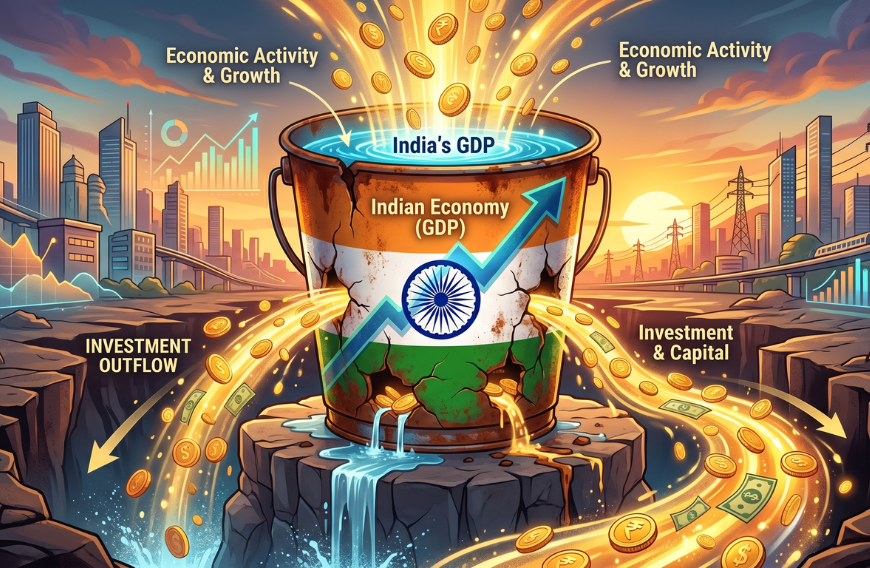
In 2016, the government canceled the country’s cash overnight. Black money, it said. Bring the hidden economy into the banks.
A great part of India does not live in banks. The woman selling vegetables from a stretch of pavement, the tailor in the room behind the shop, the man paid in notes at dusk — they did not have an account waiting, and the new notes did not arrive in time. Some queued and came through. Many did not.
Shutters that had opened for years stayed down. The customers did not disappear. They walked a short way to a firm that already had a ledger, a GST number, a machine for cards.
That firm’s sales rose. In the official accounts, that rise is growth.
The stall is not in the accounts. It was never in them. There was no invoice when it stood, and there is none for its going. So a printed economy can expand while a way of feeding a household ends. Both can be true. Only one will show.
A government counts an economy to learn whether people are getting through the month. The number is also how authority shows that it is working. A good print blesses the story. A bad print endangers it. Over time the instrument is trained on what can bless.
Much of what the country produces, and most of what it does for wages, still happens off those books. The state cannot enumerate that life every quarter, so it measures the registered sector and treats the rest as its shadow. For years the two moved together.
The cancelled notes, GST and the pandemic broke the pairing. GST made the registered firm almost perfectly visible. Every invoice is a trace. For the small trader it was a language he could not speak and could not hire someone to speak. He closed, or he stepped further into cash, where he is invisible again.
Registered output rose. The accounts called that India.
READ: Satish Jha | TOnce Equilibrium Breaks (September 2, 2026)
In February 2026 the past was recalculated — new base year, new methods. One result was not theatre. The economy came out smaller: about eleven trillion rupees lighter than under the old series.
Growth for 2023–24 fell from 9.2 per cent to 7.2 per cent. Other years were raised. Honest statistics revise the past. The cut was announced as cleanliness. The budget continued to be written to the new print. The story of a country in steady ascent was not withdrawn. It was reprinted.
To know whether production grew, or only prices did, prices have to be stripped out. That stripping is the deflator. In one recent quarter the manufacturing deflator turned negative. The sentence was waved as scandal and as wonder. It is arithmetic.
When the things a factory buys rise faster in price than the things it sells, the factory is squeezed. In today’s rupees the value it adds grows slowly. In last year’s rupees that value can look larger. The gap between the two can fall below zero even when the goods on the floor have not cheapened. The ministry has said this. The sum is right.
It cannot tell you whether the squeeze is a firm becoming keener, or a small supplier falling out of the invoice chain and taking a household’s income with him.
You can calculate without error and still be facing the wrong life.
The labour survey works in the same light. Youth unemployment, on the official series, fell from 10.9 per cent in 2022 to 9.9 per cent in 2025. The figure is official.
One version of the survey looks across the year. Another asks only whether you worked an hour in the reference week. An hour counts. A wretched hour counts. Unpaid help in a family shop can count.
Most of the country still works without a contract. Unemployment can fall on paper while people collect more scraps of work for less money. The survey can see that a body moved. It cannot see whether the movement bought a meal.
A transfer arrives in an account. The screen records that money travelled. It does not record whether the wage behind that account is still paid. A highway is entered as miles. No official series is required to ask whether the district can put a load on the road.
READ: Satish Jha | The AI divide: How America compounds leverage while India risks cognitive atrophy (September 1, 2026)
Firms that meet a payroll already live in that gap. Orders thin while the government print speaks of expansion. They watch two-wheelers, diesel, freight, tractors, and what rural banks actually advance. It is a rough ledger. It is often the one on which a shipment is decided. Capital follows it.
Government follows the other.
In November 2025, the IMF gave India’s national accounts a C: worn structure, weak price tools, a slight hold on the unregistered economy.
In March 2026 Arvind Subramanian, Abhishek Anand and Josh Felman estimated that growth from 2012 to 2023 ran nearer 4 to 4.5 per cent a year than 6, and that the level of real GDP was overstated by about 22 per cent, consumption by about 31. The papers are open to attack. They are not gossip.
They reached rooms in which policy can be altered. It was not altered. A methodological improvement was declared. The quarter still appears. The budget is still written to it.
A state that requires a rising figure in order to look legitimate will not gladly keep a rod that reports loss where no invoice runs. It will count what can be invoiced.
A closed stall will appear, if it appears at all, as someone else’s formal growth. Work will be defined widely enough for joblessness to ease. Transfers will hold the consumption line. Roads and plants will be asked to prove demand.
READ: Satish Jha | When the cure becomes the disease (August 30, 2026)
The instrument is not idle. It produces a story on schedule. It converts a grave objection into a file about method. It is not required to ask whether the story describes the country that eats. It is required to ask whether the story can be issued again.
There will be further improvements. The Fund will be mentioned. Last year’s numbers will be rewritten.
Four things will not follow. There will be no durable public account of how much informal work the shock years destroyed. There will be no downward revision allowed to inhabit the decade rather than the press note. The budget will not be recast on that revision. Those who need the story will not say that for a large number of households transformation was the end of a living that had never been written down.
Those four would endanger the story. They will not be undertaken.
Official series have already reported strain: rural real wages going nowhere for long stretches; two-wheelers and diesel refusing to travel with headline GDP. Those series were published. Course did not change. The strain was put through the machine again until it matched the tale.
The quarter will close. The budget will pass. What needs a government stamp will use the official number. What needs a crate moved, a rupee lent, or a person hired will use the other.