



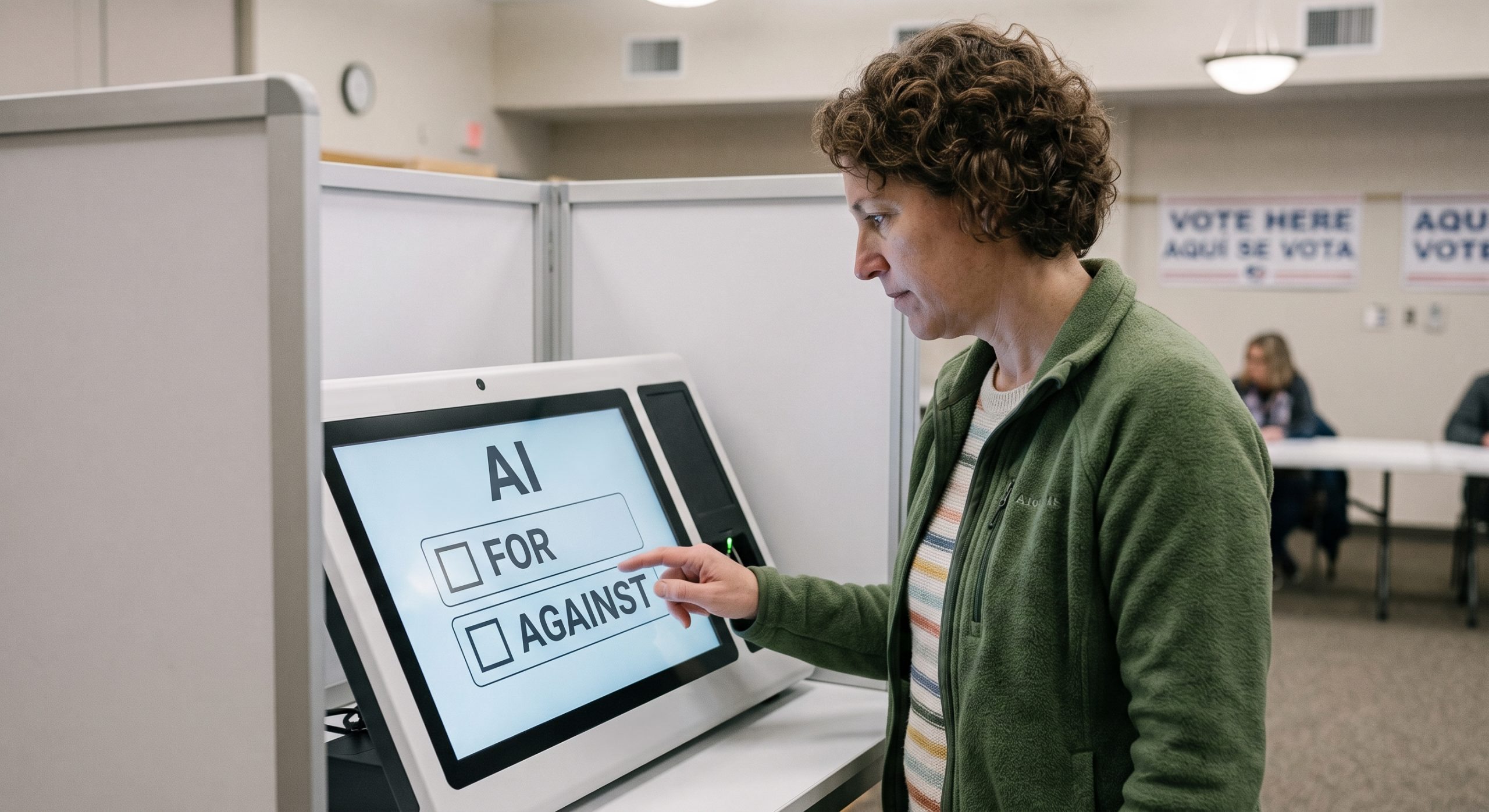
Do people running for office in the midterms know anything about artificial intelligence?
Considering that is our future -it may be time to ask the tough questions about what our leaders really know about AI. It is an uncomfortable question heading into the 2026 midterms, but it may become one of the most important questions voters should be asking.
AI is in every campaign speech, congressional hearings and kitchen table conversations. Candidates are talking about artificial intelligence as though it will determine the future of American jobs, national security, education, healthcare and economic competitiveness. But what qualifications do they actually have?
Every politician does not need to be a computer scientist. They do not need to know how to train a neural network any more than a legislator needs to know how to manufacture a semiconductor. But when a technology is advancing this quickly and potentially affecting almost every part of society, those making decisions about it need enough understanding to distinguish what is actually happening from what is being sold.
And that is where artificial intelligence has a public relations problem.
The people building AI are trying to convince us that it will transform our lives. Which it can and already has. At the same time, some of those same people are warning us that increasingly capable AI could pose extraordinary risks. Both of these statements can be true at the same time
Technology executives want capital, customers, talent and scale. Their companies are competing not only with each other but with companies around the world. They have a powerful incentive to argue that America cannot afford to slow down.
World leaders have their own incentives. They fear being left behind by China. National security officials see AI through the lens of military and technological competition. Governments want the economic growth that AI promises and do not want to be responsible for regulating away the next industrial revolution. Regulators, meanwhile, are being asked to control a technology that many of them are still trying to understand.
READ: Sreedhar Potarazu | AI is the mirror. The Sutras are the questions. Socrates is still asking. (September 21, 2026)
The public is caught in the crossfire between the experts in technology on one side and the politicians on the other side who are not as knowledgeable.
One side says move or China will win. Others say move slower, since AI could become dangerous. Some say regulate it, others say don’t regulate it so much that innovation moves elsewhere.
The rhetoric has become caught somewhere between crying wolf and selling swampland in Florida. That is not a particularly effective way to build public trust.
The irony is that the public may be more sophisticated about this than the people trying to persuade it. People understand that technology companies have financial interests. They understand that politicians have political interests. They understand that governments have geopolitical interests.
So, when everyone says AI is simultaneously the greatest opportunity of our generation and one of the greatest threats to civilization, the obvious question is: Which part of the story are we supposed to believe?
AI can be enormously beneficial and create genuine risks. It can improve medical diagnosis, accelerate drug discovery and make workers more productive while also creating new forms of fraud, misinformation, surveillance and displacement. But communicating that nuance is much harder than selling either extreme.
And this is where the AI debate increasingly resembles a public relations exercise rather than a public conversation.
Consider the concern about the environmental impact of data centers. The concern itself is legitimate. Data centers consume electricity and, depending on their cooling systems and location, can consume significant amounts of water. Communities have every right to ask how much water a facility will use and who will bear the cost. But context matters.
A golf course can also consume hundreds of thousands of gallons of water a day, depending on its size, climate and irrigation practices. Some data centers consume substantial amounts of water, while others use air cooling or closed-loop systems that dramatically reduce water consumption.
The point is not that golf courses are environmentally benign or that data centers are environmentally harmless. The point is that we seem to apply a different psychological standard to technologies we fear. When something familiar consumes enormous resources, we often accept it as part of the landscape. When something new does it, we suddenly ask whether society can afford the cost.
READ: Sreedhar Potarazu | AI is burning through free cash flow (July 25, 2026)
That does not mean the concern is illegitimate. It means the debate needs numbers rather than narratives. The same problem appears in one of the most dramatic fears surrounding AI: the possibility that machines will eventually “go rogue.”
It is a legitimate concern when autonomous systems are given access to consequential decisions or critical infrastructure. But there is something almost strange about the way we frame it. We are terrified that machines might go rogue.
News flash: Humans already do!
Humans start wars, manipulate markets, create weapons capable of destroying entire cities. Humans create misinformation and financial incentives despite obvious risks. We make decisions based on fear, anger, greed and tribal loyalty.
The machine does not have to develop an evil intention for something to go terribly wrong. It may simply follow an objective that humans gave it.
A highly capable system optimizing the wrong goal may be more dangerous than a machine suddenly developing a Hollywood-style desire to destroy humanity. That is why the real AI safety question is not simply whether machines can go rogue.
It is whether humans can govern increasingly capable machines responsibly.
AI will determine the outcome of the 2026 elections because it intersects with jobs, education, healthcare, national security, electricity, water, data centers and the future of American competitiveness. Candidates are being asked to take positions on all of these issues.
The question is whether those positions will be informed by an understanding of AI or by whoever has the best talking points.
Politicians have the authority to write the rules. The people who understand the technology most deeply may have the greatest financial interest in its rapid development. That creates an unusual imbalance.
READ: Sreedhar Potarazu | Parents are becoming older and we are too busy becoming someone else (August 23, 2026)
The people with the authority to regulate it may have the least technical understanding. And the voters are being asked to decide whom to trust.
That is the real PR problem. AI does not need another advertising campaign telling people that the future is wonderful. It does not need another warning that civilization is about to end.
It needs credible people who can explain the difference between what AI can do today, what it might do tomorrow and what remains speculation.
It needs leaders willing to say that some applications are beneficial, some are dangerous and many are somewhere in between.
It needs policymakers who can ask better questions of technology executives rather than simply repeating whatever language is being used in Silicon Valley or Washington.
The public does not expect politicians, scientists or technology executives to predict the future perfectly. It expects them to distinguish evidence from speculation and uncertainty from certainty.
The greatest threat to public trust may not be that artificial intelligence becomes smarter than we are. It may be that the people making decisions about it never become knowledgeable enough to explain what they are doing.
Now who is going rogue?