



For decades, Indian Americans have paid a premium to settle in low-crime neighborhoods and sought out top-ranked school districts, believing these choices would offer their families greater safety and security. But the foiled mass shooting plot at Chicago’s Balaji temple, located in a diverse suburb, and the suspect’s arrest in a community served by a highly regarded school district have shaken that sense of security, leaving the community grappling with a disturbing question: Can even the safest neighborhoods protect them from hate-fueled violence?
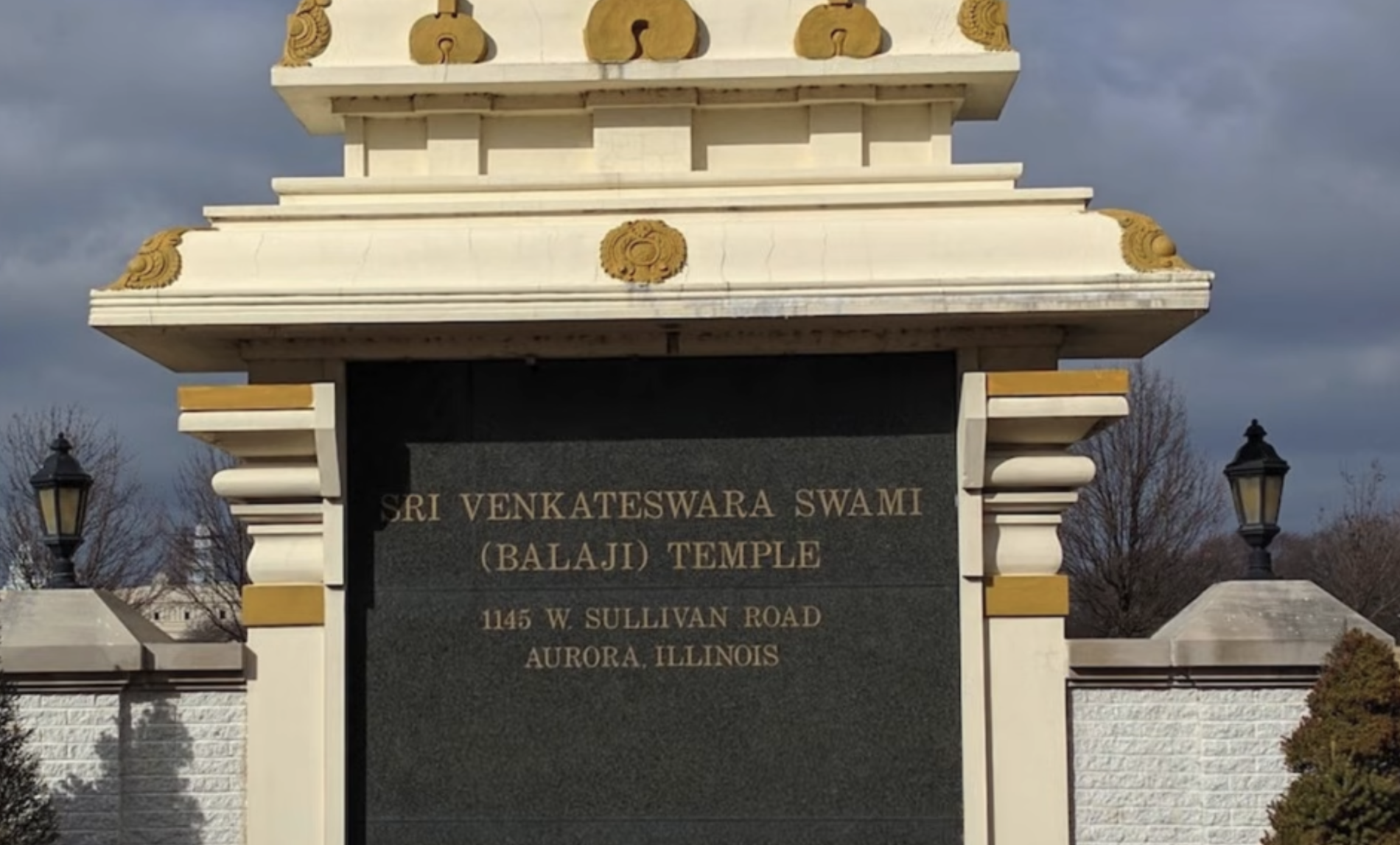
For the Kumar family, who live in Aurora, Illinois, news that a 19-year-old had been arrested in connection with an alleged mass shooting plot targeting a Hindu place of worship in the area came as a personal shock. The visibly shaken family said that whenever their elderly parents visit from India, the first place they take them is the Sri Venkateswara Swami Balaji Temple.
“To hear about an alleged plan that could have turned far deadlier, considering the suspect was found in possession of an AR style rifle, several loaded magazines and 300 rounds of rifle ammunition, is something that is enough to imagine the catastrophe that could have unfolded. I could barely concentrate at work today. It feels that the danger has almost come knocking on our doorstep now,” said Harish Kumar.
READ: 19-year-old arrested over alleged mass shooting plot targeting Chicago-area Hindu temple
(October 14, 2026)
The suspect, 19-year-old Alexandros Paporakis of Palatine, was arrested on Sunday, Oct. 11, after authorities received information about concerning communications related to the alleged plot. He appeared for a detention hearing at the Cook County Third Municipal District Courthouse in Rolling Meadows on Wednesday, Oct. 14, where a judge ordered him detained. His next court appearance is scheduled for Oct. 30.
On a Facebook page for the Indian American community in Chicago, which has more than 100,000 members, dozens of posts are shared every day, covering everything from visa issues and layoffs to inquiries about the best school districts. Since the news broke, however, conversations have centered on the incident, with people expressing both shock and vulnerability.
An anonymous member wrote, “I am now scared to send my kids to school as they attend the same school district. It has become impossible to judge if we are safe, even though we live in a highly livable ranked neighborhood.”
Built in 1985, the Sri Venkateswara Swami Temple, popularly known as the Balaji temple, is one of the largest temples in the Chicago area. On the day the alleged attack was being planned, Congressman Raja Krishnamoorthi, who represents Illinois’ 8th Congressional District, was at the temple with his family. He issued a statement saying, “My family and I were worshipping at our Hindu temple in Aurora on Sunday when a white supremacist attempted a mass shooting targeting Indian Americans. I’m grateful to those who helped prevent a tragedy, but we must come together to confront the hatred that put so many innocent lives at risk.”
Krishnamoorthi will join Cook County Board President Toni Preckwinkle, other members of Congress, state and local officials, and civil rights advocates in Chicago on Friday, Oct. 16, for a press conference condemning anti-Indian hatred and white supremacist violence following the alleged shooting plot at the temple. The press conference is scheduled for 10 a.m. local time at 118 N. Clark St., fourth floor, in Chicago.
For many Indians in America, the alleged plot to carry out a mass shooting at a Hindu temple has heightened fears in an environment that already feels increasingly hostile toward Indian Americans. The fact that such an incident was allegedly planned in a cosmopolitan and racially diverse city like Chicago has also brought an uncomfortable reality to the fore: as xenophobia rises, no place can be considered safe.
“Balaji temple is like our safe space, we go there on every big or small occasion – during festivals, when we bought a new car, when kids did well in exams and sometimes on a random Saturday to partake from the mandir prasadam,” said Nita Sri. “I am unsettled thinking that now I will be scared to go to the temple.”
Civil rights activists say the thwarted mass shooting plot exposes the dangers of escalating anti-South Asian hate and anti-immigrant political rhetoric. Manjusha Kulkarni, co-founder of Stop AAPI Hate and executive director of AAPI Equity Alliance, said, “We are horrified by reports that a 19-year-old man is accused of planning a mass shooting targeting a Chicago-area Hindu temple during Navratri, a festival that should be a time for celebration and unity, not terror and hate. We are grateful this violent plot was thwarted and that no one was hurt – but it doesn’t erase the fear Hindu, Indian, and South Asian people feel after years of escalating hate. Reports indicate the suspect planned the attack for two years and wrote a manifesto with white supremacist views and references to violence against Indian people. This is exactly what we feared, after years of documenting escalating hate against South Asian communities under the Trump administration.”
READ: Ohio Hindu temple hit by brick attack while priests, devotees were inside (October 3, 2026)
The incident has also prompted discussions in offline spaces and online forums about whether the community’s practice of buying homes in family-friendly, low-crime neighborhoods, often at a higher cost, still offers the security families seek. Some are questioning whether educated, well-established Indians have increasingly become targets despite living in neighborhoods they consider safe.
Manju Shah, a resident of Palatine, a suburb west of Chicago, said, “The schools in the area are very well-ranked and that is why you find a large concentration of Indians in this area. But sadly, the factors that once made a neighborhood safe are now changing. Now white supremacists see our jobs and our houses as a threat.”
Kulkarni said rhetoric targeting work visas and portraying educated Indians as job snatchers may have contributed to growing anti-Indian racism. She said, “Trump and his political allies have continued to push xenophobic policies and rhetoric that cast Indian people as a ‘demographic threat’ – from JD Vance calling Indian H-1B workers ‘indentured servants’, to Bo French calling South Asian students a ‘problem’. This narrative echoes the ‘Great Replacement’ conspiracy theory, which has a history of inspiring violent threats, targeted attacks, and mass shootings. In fact, our research partners found that Bo French’s posts prompted calls for violence against Indian communities online, including saying they deserved to be shot, as well as calls to vandalize Hindu temples and statues. And just last month, a Sikh truck driver was stabbed in Wyoming, days after the DHS published an outrageously racist social media post depicting a Sikh truck driver. Now, we are hearing about this horrific attempted attack against Hindu people.”
While the Indian community heaved a sigh of relief that the mass shooting attempt was thwarted and authorities moved swiftly to arrest the suspect, the incident also prompted some to reflect on how members of the community are perceived by the wider public.
An Indian H-1B visa holder, speaking on condition of anonymity, said, “At a time when a tragedy of such a big magnitude has been averted, some people still have not learnt. In Fremont, California, some Indians danced outside a theatre showing a Rajnikanth movie, with a larger than life poster of Rajnikant. It is public nuisance such as this that has got so much bad rap and people see us as defaulters.”
Others, however, argued that no amount of harmless or unconventional behavior by individual community members should be used as an excuse to blame an entire community.
For now, the alleged plot has shaken local residents and elected officials, leaving the Hindu community grappling with fear and uncertainty about its safety.
The case has heightened anxieties as Hindu Americans mark Navaratri, a season when temples become gathering places for families and communities. It also follows the vandalism of the Shree Swaminarayan Vadtal Dham Hindu Mandir in Richmond Heights, Ohio, just two weeks earlier.
State Rep. Nabeela Syed, who is running for the Illinois State Senate in the 26th District, said, “It is terrifying to think that this community was one jammed rifle away from tragedy. I know that for many, walking through the doors of their temple will feel different now. That fear is real, and no one should ever have to carry it simply for practicing their faith.”
(Some names in the story have been changed at the request of those quoted.)