



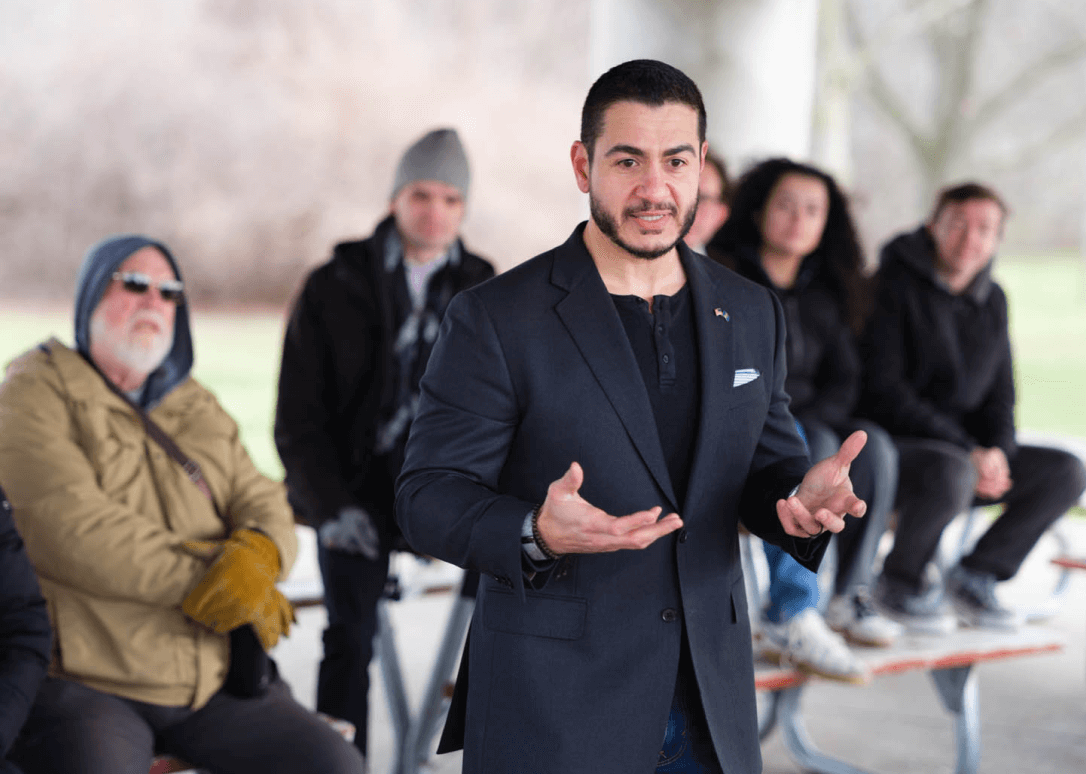
Democrat Abdul El-Sayed is facing intensified attacks over his faith, family background and past political statements as he campaigns against Republican Mike Rogers for Michigan’s open U.S. Senate seat ahead of the Nov. 3 election.
The contest has drawn national attention as both candidates seek support in a closely watched race that could influence control of the Senate. El-Sayed, a former public health official, has emphasized healthcare access and reducing living costs, while Rogers has questioned his opponent’s political positions and alleged connections to Islamist groups.
READ: Abdul El-Sayed faces Medicare for All, citizenship attacks (October 7, 2026)
Recent polls have shown El-Sayed ahead of Rogers by varying margins. A Mitchell Research & Communications poll conducted Oct. 26-27 found El-Sayed leading 51% to 44% among 636 likely voters, according to CBS Detroit. The survey had a margin of error of plus or minus 3.9 percentage points.
Other surveys have shown a narrower contest, underscoring differences across pollsters and survey methods. The RealClearPolitics average of polls from Sept. 28 through Oct. 27 put El-Sayed ahead by 3.2 percentage points. The race remains closely watched as voters prepare to choose a successor to retiring Democratic Sen. Gary Peters.
Attacks over faith and family background
Republican campaign messaging has increasingly focused on El-Sayed’s Muslim faith and alleged connections to the Muslim Brotherhood. El-Sayed has denied having any affiliation with the organization, while his campaign has described the accusations as politically motivated attacks intended to distract voters from policy issues.
President Donald Trump has also targeted El-Sayed during campaign appearances. Reuters reported Wednesday that Trump had used inflammatory language to describe the Democratic candidate, prompting criticism from civil rights advocates.
The NAACP condemned the rhetoric surrounding the race. Its president, Derrick Johnson, described the attacks as racist and divisive, according to Reuters.
Rogers has cited a 2012 letter signed by El-Sayed and other Egyptian Americans in support of then-Egyptian President Mohamed Morsi, who was backed by the Muslim Brotherhood. Reuters reported that the letter called for changes to Egypt’s media and security services. The El-Sayed campaign did not immediately respond to Reuters’ inquiry about the letter.
El-Sayed has repeatedly rejected allegations that he is connected to the Muslim Brotherhood. In comments reported by CBS News on Oct. 29, he said he had never been a member of the organization and would never join it.
CBS News also examined questions surrounding El-Sayed’s family history, including his mother’s past employment at an organization that was later shut down by U.S. authorities over its provision of support to terrorist groups. CBS News reported that El-Sayed’s mother was not accused of wrongdoing in the case. El-Sayed has said he was not raised by his mother and has denied having ties to the Muslim Brotherhood.
The allegations involving relatives do not establish that El-Sayed himself has any connection to the organization.
Campaign debate extends to social media
The Michigan contest has also generated online debate, with supporters and critics sharing campaign statements, past photographs and claims about the candidates’ political affiliations.
A claim circulating on social media alleges that a substantial share of online accounts reposting content supportive of El-Sayed are based outside the United States. Such claims have fueled allegations of possible manipulation, but the figures should not be treated as proof of coordinated foreign interference without independently verifiable research establishing the accounts’ locations, authenticity and activity.
The online controversy has added another dimension to a campaign already shaped by arguments over immigration, national security, religious identity and the direction of the Democratic Party.
Both campaigns have sought to use the final days before Election Day to reinforce their messages and mobilize voters, including in Wayne County and the wider Detroit metropolitan area.
Healthcare and the economy remain central issues
El-Sayed has built his campaign around an economic agenda that includes Medicare for All, lowering household costs and expanding the social safety net. He has sought to present healthcare access and affordability as central concerns for working-class families.
READ: Abdul El-Sayed hits back at Trump’s ‘jihadist’ remarks, defends Muslim faith in Senate campaign (October 19, 2026)
Rogers, a former congressman and FBI agent, has presented himself as a conservative focused on manufacturing, economic costs and border security. His campaign has argued that El-Sayed’s progressive policy positions fall outside the political mainstream.
The race also carries significance for the Democratic Party’s progressive wing. Reuters reported that El-Sayed’s performance could influence perceptions of the movement’s appeal in a battleground state that Trump carried in the 2024 presidential election.
If elected, El-Sayed would become the first Muslim U.S. senator. His candidacy has consequently drawn attention beyond Michigan, with the campaign becoming a national debate over religious identity, political representation and the boundaries of campaign rhetoric.