



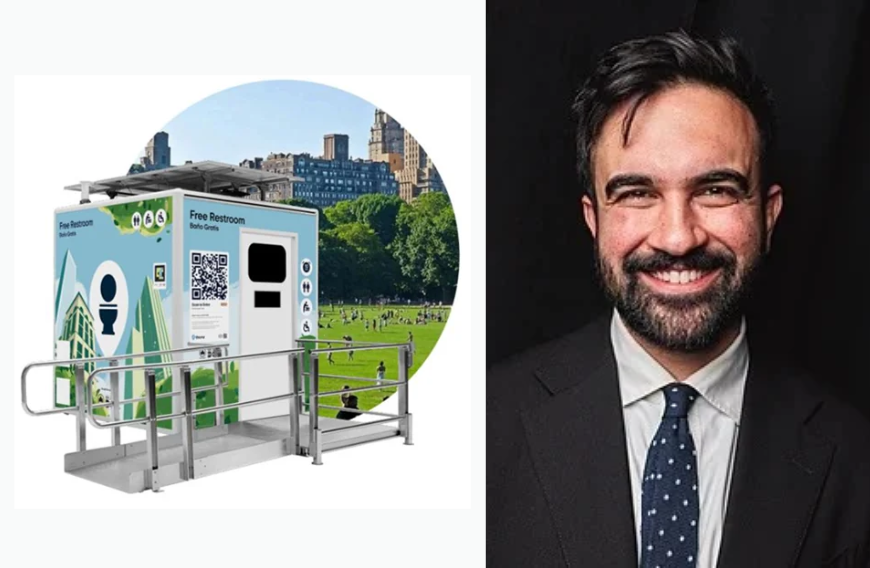
New York City Mayor Zohran Kwame Mamdani has found an unusual addition to his administration’s list of public infrastructure projects: toilets. And they are already earning a nickname of their own, with some New Yorkers calling the city’s new high-tech public restrooms the “Mamdani toilets.”
The facilities have now received an unexpected review from The Wall Street Journal, whose journalist spent a day visiting the new bathrooms across the city to find out whether they live up to the promise of providing clean, accessible public facilities. The verdict? They were remarkably tidy.
In a report published on Nov. 19, the WSJ journalist described the experience of visiting the modular bathrooms, speaking to New Yorkers who had used them and examining how the technology works to keep the facilities clean. The journalist found that the bathrooms were generally well-maintained, with users also expressing satisfaction with their condition.
The 17 bathrooms, which have been rolled out across all five boroughs over the past two months, have collectively recorded nearly 40,000 visits, according to the report.
The company behind the facilities, Washington, D.C.-based Throne Labs, uses a combination of technology and user accountability to prevent the bathrooms from becoming the kind of neglected public facilities New Yorkers have long complained about.
READ: Mayor Mamdani celebrates Diwali in New York, calls for unity and rejection of hate (November 18, 2026)
The system is particularly interesting. Visitors using the Throne app are asked to rate the bathroom based on its cleanliness and smell. The feedback helps the company identify whether someone has left the facility in poor condition. Users who repeatedly damage or leave the bathrooms in an unacceptable state can receive warnings and eventually lose access through their accounts.
As Jessica Heinzelman, co-founder and chief operating officer of Throne, explained to the WSJ, a small percentage of users can ruin public facilities for everyone else.
“One of the big reasons why cities don’t have more public restrooms is that about 1% of people will ruin it for the other 99%,” she said.
The company also sends workers to inspect the facilities after every 10 to 15 uses, or when a negative user rating signals that a bathroom needs attention. Even the interiors have been designed with maintenance in mind, including wallpaper that can be replaced easily and background music intended to discourage people from lingering.
So, what does a ‘Mamdani toilet’ actually look like?
These are not the traditional portable toilets people might associate with public parks or outdoor events. The modular units come with flushing toilets, running-water sinks, touchless entry, climate control and baby-changing stations. They are also ADA-accessible and do not need conventional water, electricity or sewer connections to operate.
One of the facilities at Staten Island’s North Shore Esplanade stands out because it is the only public toilet within a 15-minute walk, according to the WSJ. Visitors can access it by scanning a QR code, sending a text message, using the Throne app or obtaining an entry card through the city and local businesses.
READ: ‘Best deal’: Zohran Mamdani wants your $5, $15 or $50 to put more socialists in US government (November 20, 2026)
The bathrooms are free to use and operate daily from 7 a.m. to 10 p.m local time. However, getting inside requires users to complete one of these access steps, making the experience a little more complicated for people without smartphones.
The city is paying approximately $225,000 per bathroom under the arrangement described by the WSJ, including cleaning and maintenance. The report contrasts this with earlier public restroom projects that reportedly cost the city around $3 million apiece.
Throne’s self-contained design is one of the reasons the company can deploy the units without the expensive construction and utility connections associated with permanent public toilets.
How did Mamdani’s toilet become a talking point?
Mamdani first announced a $4 million modular public bathroom pilot in January. In June, the New York City Economic Development Corporation selected Throne Labs through a competitive bidding process to supply, install and maintain 17 units across the five boroughs.
The installation was announced in September as part of the mayor’s effort to address the city’s shortage of accessible public bathrooms, particularly in busy public spaces where finding a restroom can be difficult.
READ: Mamdani advances worker protections, NYC carriage ban (November 19, 2026)
“Too many New Yorkers know what it’s like to have nowhere to go while they’re on the go,” Mamdani said while announcing the initiative.
The facilities have since developed a following of their own. One bathroom in Astoria, Queens, is listed on Google Maps under the name “Mamdani toilet” and has received a 4.9-star rating.
Fletcher Wilson, co-founder and CEO of Throne Labs, also joined the conversation on LinkedIn around World Toilet Day, sharing the WSJ article and celebrating the review.
“Happy World Toilet Day to all of those who celebrate (publicly or privately). Nothing makes for a great WTD like a respected WSJ journalist sitting on a Throne toilet,” Wilson wrote.
For Mamdani, the project is about more than an unusual addition to the city’s streetscape. It addresses a basic urban problem that affects commuters, delivery workers, parents, older adults and people with disabilities.
Whether the pilot will eventually lead to a wider network of public bathrooms remains to be seen. But for now, New York’s newest public facilities appear to have passed an important test: people can actually use them without walking into a mess.