


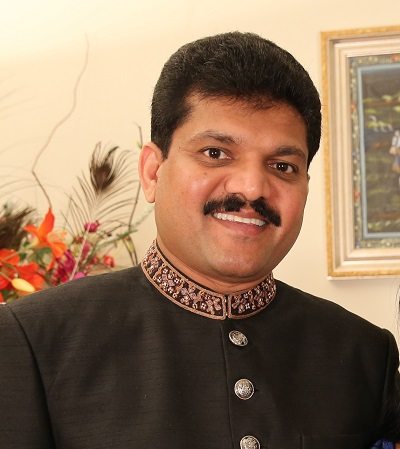
The Indian American producer says story was the backbone of the Malayalam blockbuster.
AB Wire
Suresh Raj is the producer of Ennu Ninte Moideen, which has become one of the biggest blockbusters in the history of Malayalam film industry. The Maryland resident started the film under the banner of Newton Movies and produced it along with four Indian American friends.
He has been involved in the entertainment industry for over 25 years, having hosted various stage events in the United States, Canada and India. He also served as the president of the Kerala Cultural Society of Metropolitan Washington for two years.
Raj, an IT professional who works as an Executive Vice President of an information technology company in the Washington, DC, area, is married to Anita Raj, and has two daughters, Shilpa (21) and Sneha (17 years).
He spoke to the American Bazaar recently about the film. Here is the edited version of the interview:
Why do you think Ennu Ninte Moideen became such a big hit?
I believe the movie became a hit because of the hard work and good teamwork. We had built a dream team and everyone worked hard, but fundamentally we had a good real life story, and the story along with the cast and the technical team played a key role. The stars — Prithviraj, Parvathy, Sai Kumar, Bala and Tovino — did a good job. The director did a good job. Jomon T. John’s camera was pretty good. Background score by Gopi Sunder was good. So, all the factors played a key role in the success of the movie. And obviously, we had a great story. That was important.
RELATED:
Ennu Ninte Moideen review: mind boggling saga of true love
Malayalam hit film Ennu Ninte Moideen releasing in theaters in the US, Canada on October 9
Indian American singer Shilpa Raj’s debut Malayalam song Sharadambaram becomes a super hit
You said elsewhere that the moment you read the story, you loved it…
I liked the story very much and I wanted the movie to be successful commercially. So we discussed certain aspects [that] today’s movie watchers [love]. We can make ten movies from the same story. Right? And people do not have to like [all of them]. I watched and analyzed a lot of movies in Hindi, Malayalam and English. So, I made a lot of suggestions with the director Vimal, who was also the scriptwriter.
We discussed what will work in this film. We wanted people to go and watch the movie and understand the love story.
So we built it in a way, with technical excellence, so that people will enjoy watching the story. They will also like the movie, too. And obviously, the director played a key role in putting everyone together from the creative side. He was the captain of the creative team. It was a successful team effort; we built a good team and it was a hard work of the entire team.
Did you expect the film to become a mega hit?
We always wanted, and hoped, the movie to be among the top three [box office hits]. I even told some of my friends that — I put all my experience, connections and relationships into this movie, all finance everything — I told my friends that, if this movie doesn’t come in the top three all-time collections, I won’t produce anymore movies. You know it doesn’t make any sense to go into a field and do something when you cannot contribute and do [justice to it]. Again, it was a successful teamwork of everyone that made the movie this successful. And, obviously the story was the backbone.
Do you think the success of Ennu Ninte Moideen will inspire more and more Indian Americans to get involved in Indian films?
I think this will definitely inspire a lot of NRIs to make good movies. Again, the movie business is a very high risk business because you have less control on the creative work. So any NRI who wants to get into should deeply believe in the story before they do it.
If they believe in the story, and they think the story has a chance, then they should go for it. But again, at end of the day, the story carries the whole movie, and if people like the story they will go and watch it multiple times.
One of your daughters had a nice role in the film; another sang a song that became a super hit. How was it like working with your daughters?
Actually it’s not easy because, you know, they think because they are my daughters, it should be easy for them. But they [were] treated as anyone else. For them, they thought everything will be quick and everyone will wait for them. But nothing happens like that — right? — in real life and especially when they are newcomers. My both daughters acted. The younger one had a bigger role and elder one had a little role, but elder one did sing a duet with the legendary singer P. Jayachandran.  The music was composed by Pandit Ramesh Narayan. So it was a good experience for them, mainly working in India, Kerala, gave them a different exposure. They studied here in the US. They never have done anything back in Kerala other than just visiting. So this gave them a good working experience. They can now decide, if they are going into entertainment field, whether they wanted to do in Malayalam, Hindi or English. They have done some screening here, they have done some auditions, and they have acted in small TV serials in the USA.
What is your next project?
We haven’t decided on the next project. We are taking it very seriously and carefully. We have got so many calls, at least over 25 to 30 stories to discuss. But I don’t have that much time to go through all these stories. A lot of capable people have approached, but we are taking it very, very carefully. Plus I want to take a break. I had been involved in this project for three years, traveled eight times to India and one time to London to meet Prithviraj during his shoot of another movie.
Obviously, we would like to do a good story that is based in the US, in Malayalam; then the next level would be a Hindi project. I always wanted to do a Hindi movie badly. But Hindi, since its big scale, I wanted to do Malayalam first so you can learn and get experience. But my passion is to do Hindi. Hindi has a wide reach. You can screen in 5,000 theaters on the opening day. When you do something, and more people see it — just for the thrill of it, I want to do Hindi.