




M.R. Rangaswami doesn’t believe in thinking small. His vision has always been grand and global, evident from the moment he founded Indiaspora 13 years ago and organized the first-ever Indian American inaugural ball during President Obama’s second inauguration. Since then, he and Indiaspora have hosted dozens of high-profile events across the United States, India, and other parts of the world.
However, none have been as ambitious as the Forum for Good, held in the United Arab Emirates from February 23 to 26.
From the outset, Rangaswami envisioned it as a “Davos for the Indian Diaspora,” a global gathering akin to the World Economic Forum — one that would harness the power of diaspora leaders in business, technology, politics, and academia to shape agendas and drive meaningful change for India’s benefit.
READ: Inaugural Indiaspora Forum For Good 2025 opens to drive positive international change (February 25, 2025)
Many of the participants who flew into the UAE from different parts of the world agreed that the event delivered on that vision. “It’s a wonderful event—I almost feel like [it’s] a miniature version of Davos,” said Himanshu Shah, a Raleigh, N.C.-based investor and a member of the event host committee.
Shah, the Chairman of the pharmaceutical company Marius, has been part of Indiaspora for five years. “It’s a great platform for… Indians living all around the world,” he said. “And there really have not been that many platforms like this on a global scale. So, I’d really like to see this event take place every year.”
“They have done a remarkable job of bringing everybody together from different parts of the world, [from] 35 countries,” said tennis great Vijay Amritraj, an Indian American. “It’s very hard to put these things together. It is a herculean task.”
Speaking to The American Bazaar on the final day of the event in Abu Dhabi, Rangaswami said more than 500 delegates from over 35 countries participated in the Forum, representing both nations where the Indian diaspora has a significant presence and those where it does not.
“It’s not just the usual countries you’d expect, like India, the UAE, and the US, but 30 other countries, including places like Greece, Belgium, South Africa, and Suriname—places you wouldn’t typically expect to see a large number of participants from,” he said.
Rangaswami was pleased with the response the Forum received, particularly highlighting the diverse backgrounds of the delegates. The Indiaspora founder said he was struck by the unexpected and dynamic mix of professionals in attendance, which went beyond traditional industry gatherings. Noting that he met professionals as diverse as a drone manufacturer, an architect, an AI startup founder, a climate scientist, a doctor, and a lawyer, he said this diversity enriched the experience, allowing for unique cross-disciplinary conversations and collaborations.
The speakers — government leaders, entrepreneurs, and visionaries — brought a distinctly global outlook. A wide array of topics shaping the future of India and its diaspora were explored.
READ:Indiaspora Forum For Good 2025 to drive positive international change (February 19, 2025)
Sessions like “100 Ways to Change the World” and “DNA of the Diaspora” underscored the diaspora’s expanding influence in business, politics, and culture, while “The Sky is the Limit” examined opportunities for collective action. Investment-focused panels, including “Show Me The Money” and “Big Big Checks,” highlighted India’s rapid economic growth and the increasing role of global investors in key sectors. Additionally, discussions on private equity and venture capital explored the financial strategies fueling India’s innovation landscape.
Technology and innovation were central themes, with sessions like “Will AI Eat the World?” and “AI Dominance: David vs. Goliath” dissecting artificial intelligence’s transformative power and its impact on industry. “Extreme Innovation” showcased breakthroughs in healthcare, climate, and engineering, while “Tech for the Public Good” highlighted India’s leadership in digital public infrastructure. (Separately, an AI Summit was held on February 26 at Dubai’s Museum of the Future.)
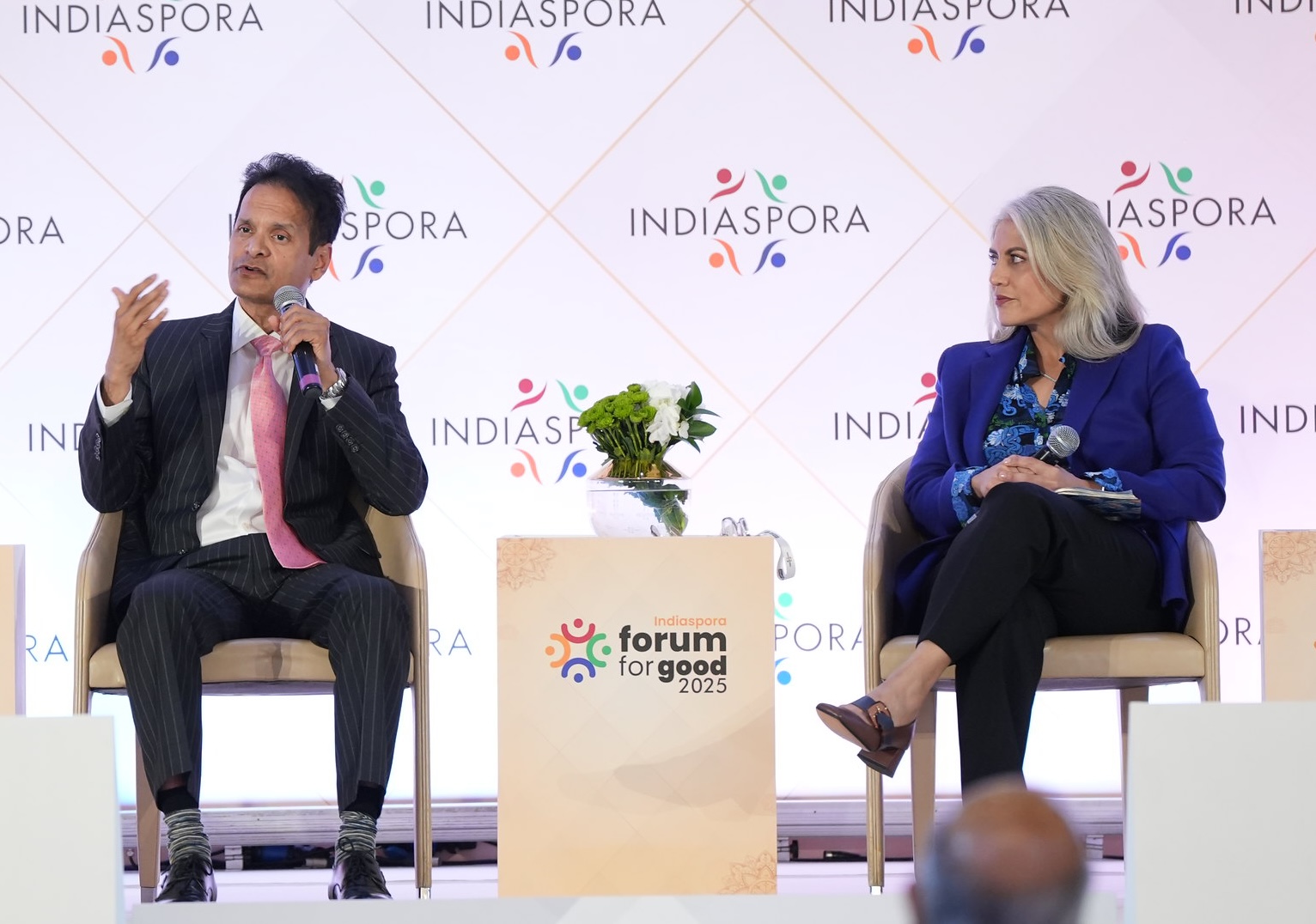
Other discussions, such as “The Bionic Indian” and “The Silicon Valley Operating System,” examined the convergence of medicine, technology, and entrepreneurship. Beyond business and tech, the forum celebrated Indian arts, literature, language, and sports, with sessions on Sanskrit, contemporary Indian art, and the broader cultural landscape, emphasizing the importance of preservation and global influence.
More than a year in the making
For Rangaswami, the real value of the Forum extended beyond the official agenda. He emphasized that while structured discussions were important, the true impact lay in the connections forged and the insights exchanged among attendees. “The agenda is one thing. But the meetings you have, the people you meet, the relationships you build, and what you take back—I think that’s the surprise,” he said.
Rangaswami said the idea for such an ambitious event originated more than a year ago when India hosted the G20 summit. Indiaspora held an event in New Delhi on the sidelines of the summit at the behest of India’s Ministry of External Affairs. “All of a sudden, we had 300 people, leaders from 26 countries,” he said. “That surprised us. We thought we’d maybe get people from five or six countries. That gave us the motivation to say, ‘Hey, can we do something even bigger and better than what we did at G20?’ Plus, I’d attended Davos a couple of times and seen what happens when you bring people together. So, that was what led us to think of this.”
READ: Indiaspora summit in Dubai spotlights AI’s breakneck evolution (February 28, 2025)
The choice of the UAE as the venue for the inaugural Forum for Good was an obvious one. A major factor was the country’s unparalleled global connectivity, making it an accessible destination for attendees from around the world. “In terms of global connectivity, if you look at the United Arab Emirates — Dubai [and] Abu Dhabi — they are very well connected around the world in terms of flights. It makes it easy for busy people to travel,” said Sanjeev Joshipura, Executive Director of Indiaspora. “If you look at the globe… the UAE kind of sits in the middle. Whether you are coming from Australia, Singapore, England, the USA, or India — which is very close by — it’s an ideal location.”
This strategic positioning reinforced the forum’s truly global scope, making it a natural gathering point for participants from across continents.
Another crucial factor was the enthusiastic response from stakeholders within the UAE.
The presence of two high-profile ministers on the roster of speakers — Minister of Tolerance and Coexistence Sheikh Nahayan Mabarak Al Nahyan and Minister of State for Foreign Trade Dr. Thani bin Ahmed Al Zeyoudi — was a testimony to that.
Joshipura also highlighted the strong interest from the local business and philanthropic communities, as well as the support from government entities. “We found a lot of interest among the business community, the philanthropic community, Indian diaspora leaders, and the government here to have this kind of event,” he stated.
A third factor was the infrastructure, which Rangaswami described as “amazing.”
Organizing an event of this scale — especially outside one’s home country — comes with significant challenges, even with all the ingredients the UAE provided, including the presence of a large Indian diaspora. (Nearly four in 10 residents of the country are Indian nationals.)
READ: Next frontier of AI: Explainability, ethics, and the future of intelligent systems (February 4, 2025)
Rangaswami compared the effort to childbirth. “I can’t pretend I know what a woman goes through to have a baby, but this was a nine-month project for us and the team. So, it was a huge effort. It’s almost like giving birth, except, you know, it’s a conference. It’s a forum.”
The Indiaspora founder credited his team for making it happen. “Our team is not that big—maybe 15 to 20 people at best. So, it’s a small group that pulled all this together. And like I call it, we have a small but mighty team of people who worked 24/7 to make this happen.”