



Dr. Bhatt’s message is clear: AI holds immense promise, but its success hinges on agility, equitable design, and adaptive regulation
By Soumoshree Mukherjee
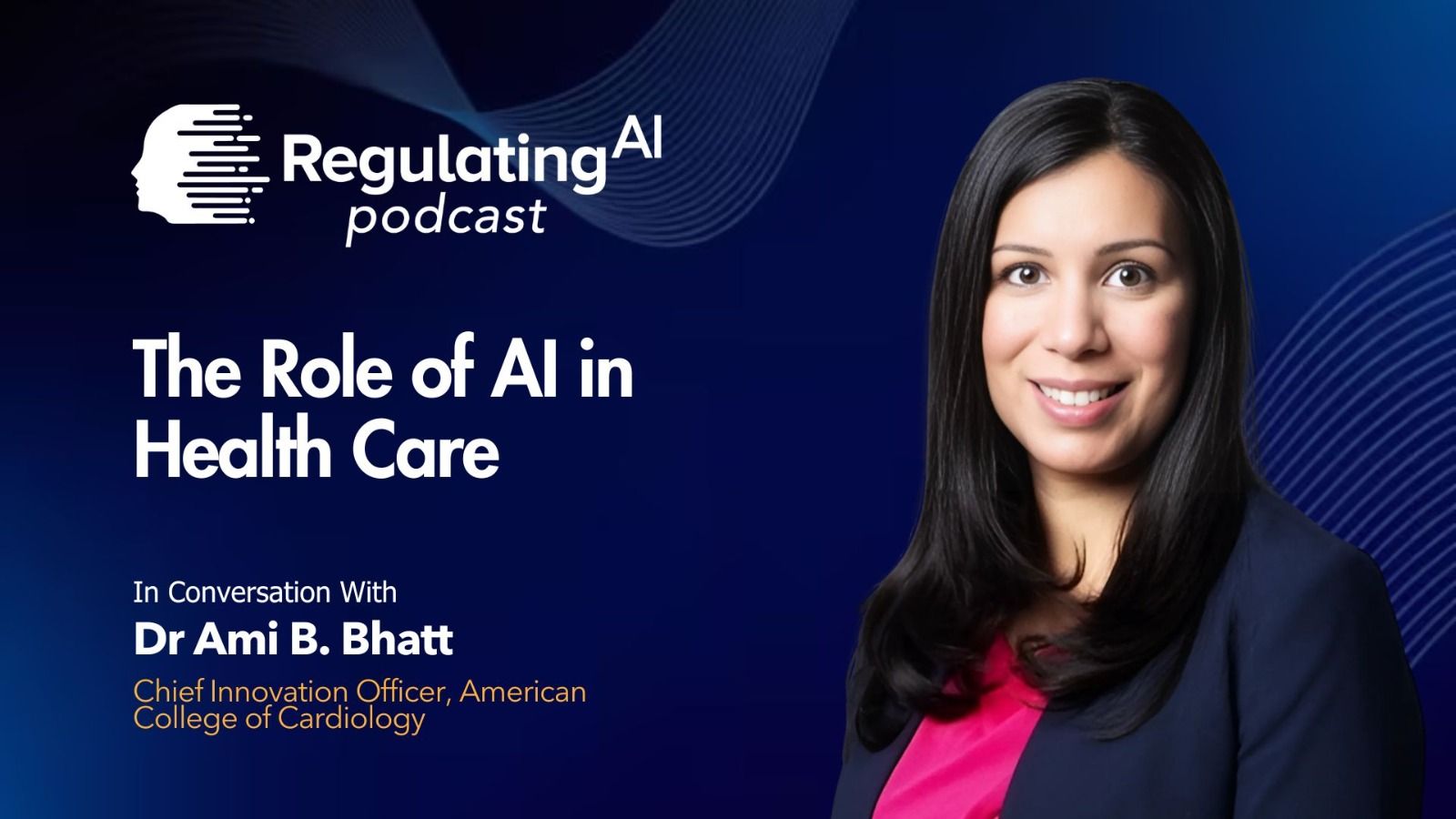
In a compelling episode of the “Regulating AI” podcast, Dr. Ami Bhatt, chief innovation officer at the American College of Cardiology, delves into the evolving landscape of artificial intelligence (AI) in healthcare. Drawing from over two decades of clinical experience, Dr. Bhatt offers a nuanced perspective on the integration of AI into medical practice, emphasizing both its potential and the imperative for thoughtful regulation. In a world where medical knowledge doubles at a dizzying pace, Dr. Bhatt’s message is clear: AI holds immense promise, but its success hinges on agility, equitable design, and adaptive regulation.
The data deluge and AI’s promise
Dr. Bhatt recalls her early days in cardiology, when patient data was manageable and consultations relied on a clinician’s recall. Today, the landscape is unrecognizable. Electronic health records, wearable devices, and research papers flood clinicians with information, making it nearly impossible to synthesize insights during a 15-minute patient visit. “AI is only a tool in healthcare,” Bhatt asserts, emphasizing its ability to process vast datasets and easing administrative work.
In cardiology, AI is already a game-changer. Generative AI summarizes complex medical literature, clinical decision support systems suggest tailored treatments, and advanced imaging algorithms enhance diagnostic accuracy. Beyond the clinic, AI streamlines administrative tasks, freeing clinicians to focus on what matters most: patients. Yet, Bhatt warns, no AI system works seamlessly out-of-the-box. Every clinical setting is unique, she says, urging companies to adopt agile, iterative approaches to adapt AI to local nuances, from data inputs to user needs.
Agility and equity in AI design
For Bhatt, agility is non-negotiable. Companies that iterate quickly not only scale faster but also ease the burden on clinicians grappling with burnout and workforce shortages. It’s a kindness to clinicians to move fast and adapt, she notes, highlighting the need for systems that evolve with real-world feedback. This agility is particularly critical in telemedicine, where Bhatt envisions AI powering remote monitoring and risk prediction to manage chronic diseases like cardiovascular conditions in patients’ homes.
READ: RegulatingAI, Indianness podcasts among Shorty Awards finalists (April 29, 2025)
Equity is equally paramount. Bhatt addresses concerns that AI, often dominated by Silicon Valley and English-language models, risks sidelining diverse populations. She champions inclusive AI that supports multiple languages—citing a U.S. company offering enterprise AI in English, Hindi, and Spanish—as a model for global accessibility. Low- and middle-income countries (LMICs), with their burgeoning digital infrastructure, are poised to leapfrog traditional systems, innovating in digital health and AI. “There’s a lot of learning that can happen from low- and middle-income countries (LMICs) making progress, especially with their large middle class in digital health,” Bhatt says, pointing to their ability to deliver care efficiently despite resource constraints.
Regulation as scaffolding
Regulation, often seen as a barrier, is reframed by Bhatt as “scaffolding” for safe innovation. She advocates for global guidelines, drawing on frameworks like the World Heart Federation’s digital health stance, while stressing that governance must be hyper-local, tailored to individual institutions with robust communication strategies. Organizations like the World Health Organization and National Academy of Medicine are pivotal in shaping these standards, but local execution is key to ensuring safety and trust.
Cybersecurity looms as a pressing concern. Bhatt warns that healthcare, lagging behind other industries, is a “sitting duck” for cyber-attacks like ransom ware. “I think we’re not taking cyber security seriously enough,” she insists, calling for its integration into daily healthcare operations. She also views healthcare data as vital infrastructure, though U.S. interoperability challenges—fragmented systems that don’t communicate—complicate protection efforts.
The human touch and future horizons
Bhatt is optimistic about AI’s ability to strengthen clinician-patient relationships by reducing administrative burdens and even combating loneliness through sympathetic AI interfaces. However, she cautions against over-reliance, noting that unregulated AI risks eroding trust if patients anthropomorphize chatbots over clinicians. For now, humans remain essential in clinical care, particularly for nuanced decision-making, though administrative tasks may soon be fully automated. Looking ahead, Bhatt is excited about human-AI interaction studies and cyber security advancements. She also emphasizes sustainability, urging the industry to consider AI’s environmental impact. Her advice to policymakers is poignant: craft regulations that foster innovation while ensuring safety, holding AI to metrics that demonstrably improve outcomes.
Dr. Bhatt’s vision is one of balance—leveraging AI’s power while preserving the human connection at healthcare’s core. As she guides the field forward, her call for agility, equity, and thoughtful regulation resonates as a blueprint for a healthier, more inclusive future.
For a deeper exploration of Dr. Bhatt’s perspectives on AI in healthcare, listen to the full podcast episode here: