



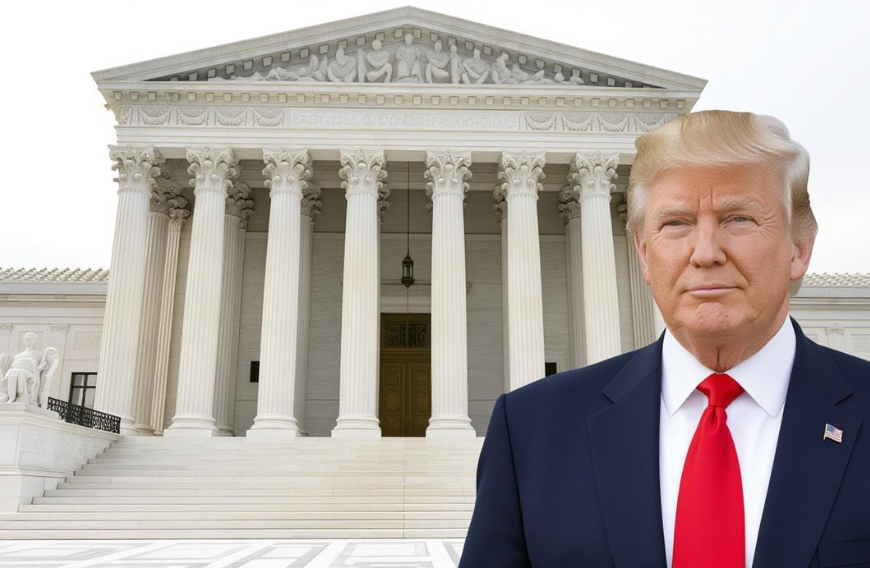
President Donald Trump is turning to the Republican majority U.S. Supreme Court to rule in his favour while considering his tariffs.
Trump has reportedly asked the Supreme Court to overturn a lower court decision that found many of his sweeping tariffs were illegal.
In late August, the U.S. Court of Appeals for the Federal Circuit ruled that many of former President Trump’s tariffs, specifically those imposed under the International Emergency Economic Powers Act (IEEPA), were unlawful, stating that the law does not authorize the President to impose taxes or tariffs without explicit Congressional approval.
This decision directly challenges a major part of Trump’s trade policy, including a 10% universal tariff and steep country-specific levies on imports from nations like China and Canada. The court cited the “major questions doctrine,” emphasizing that such significant economic decisions require clear authorization from Congress. However, the court placed a temporary stay on its ruling until Oct. 14, 2025, keeping the tariffs in place for now.
READ: Trump’s tariffs to empty pharma shelves, industry warns (
In a petition filed late on Wednesday, the administration asked the justices to quickly intervene to rule that the president has the power to impose such import taxes on foreign nations.
If the Court takes up the case, oral arguments may begin in early November. Notably, tariffs enacted under Section 232 of the Trade Expansion Act, such as those on steel, aluminum, and strategic goods, remain unaffected and legally valid for now. The case is poised to have significant implications, not just for Trump’s trade agenda, but for broader questions of presidential authority and the balance of power between the executive and legislative branches.
If the Supreme Court upholds the appeals court ruling, it could set a major precedent limiting unilateral executive action in economic policy.
“These unlawful tariffs are inflicting serious harm on small businesses and jeopardizing their survival,” said Jeffrey Schwab of Liberty Justice Center. “We hope for a prompt resolution of this case for our clients.”
READ: Trump claims ‘economic disaster’ if tariffs challenged, cites $17 trillion risk (
The ongoing legal battle over President Trump’s tariffs marks a critical moment for both his economic legacy and the future scope of presidential power. The recent ruling by the U.S. Court of Appeals challenges the foundation of Trump’s broader tariff strategy by asserting that the President cannot unilaterally impose import taxes under the IEEPA without clear Congressional approval. If upheld by the Supreme Court, this would severely limit Trump’s—and any future president’s—ability to use emergency powers to enact sweeping trade policies. It would also signal a judicial shift toward reining in executive overreach, particularly in cases involving major economic decisions.
A Supreme Court rejection would not only invalidate large portions of those tariffs but also weaken a key tool he has used to negotiate with foreign nations. Even tariffs that remain in place under other legal provisions could face renewed scrutiny. More broadly, the case may define the limits of presidential trade authority for years to come. Whether seen as necessary protectionism or unlawful overreach, the outcome will leave a lasting impact on U.S. economic policy and governance.
Beyond the legal implications, the case also carries major political weight. Trump’s appeal to a Republican-leaning Supreme Court underscores his strategy to secure judicial backing for his economic agenda. A favorable ruling could restore key tools in his trade arsenal, while a loss could undermine his credibility on economic leadership.