



Story highlights:
- A new survey says over one-third of employees of Indian professionals at Apple, NVIDIA, and Zoho are graduates of India’s Tier-3 colleges, underscoring a growing shift toward skill-based hiring in global tech.
- Tier-3 college alumni make up a significant share of the workforce at top tech companies, including Zoho, Apple, and NVIDIA—challenging long-held assumptions about pedigree and success.
- Only 15% of Tier-3 graduates say their college background strongly boosted their salary, while 74% report it helped only early in their careers or not at all.
- More than half of overseas graduates (53%) also believe their college had little or no impact on their earnings, reinforcing the broader trend toward skills-first evaluations.
Anshul Shah, a bright student from Ahmedabad in the western Indian state of Gujarat, sailed through high school with straight A’s. But when he fell short of securing admission to his dream IIT, the disappointment lingered.
He enrolled instead in a small private college in Maharashtra, one of those institutions in India classified as “Tier 3” schools. During conversations with classmates who had made it into the country’s top engineering institutes, he often worried that his career would stall without a prestigious degree.
That was eight years ago. Today, Shah holds a high-paying role at a global tech conglomerate in Seattle.
“Often when I spend long hours writing codes in this swanky downtown office, where people from around the world would love to spend a day, I can’t believe I landed here from that small engineering college,” he says.
READ: Foreign workers fuel tech industry with 23% coming from India (
When asked whether he credits his rise to his own talent or to the opportunities the U.S. offered him — opportunities unconcerned with an Ivy League or Tier-A pedigree — he reflects for a moment. “I would say it’s a mix of both. If I didn’t get this chance, no matter how talented I was, it would have been difficult for me to prove it. At the same time, I believe the talent acquisition specialists in these conglomerates know how to spot a promising candidate beyond the sheen of an IIT or top tier college.”
Shah’s journey — from being rejected by a top college to landing a coveted role at a global multinational — is far from an isolated story. While a prestigious institute can certainly open doors, recruiters say that every year hundreds of talented candidates from modest academic backgrounds make their way into top corporate teams simply by pursuing their goals with persistence and skill.
A new survey by Blind, the anonymous community app for verified professionals, reinforces this reality.
The findings arrive amid intensifying debate over the Trump administration’s H-1B crackdown, including a proposed $100,000 visa fee that has sent shockwaves through the tech sector.
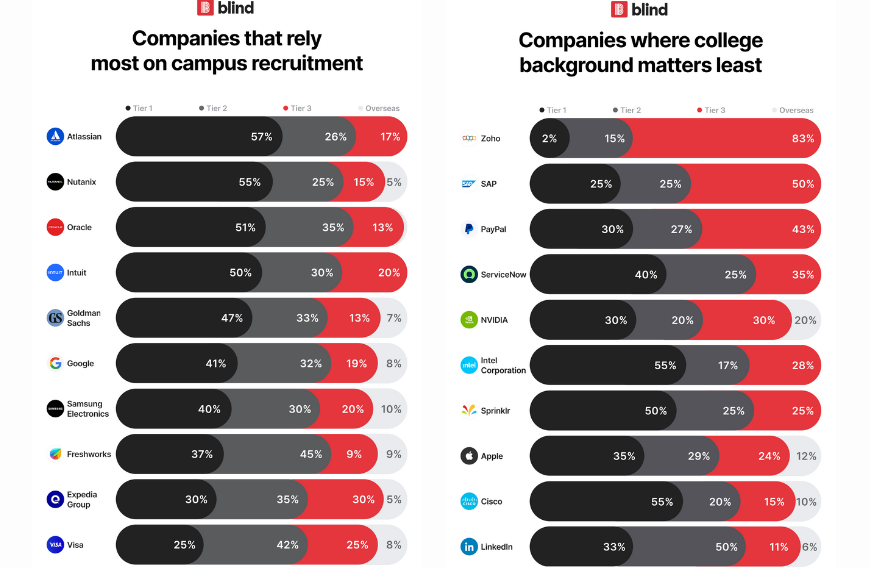
The survey reveals that more than one-third of employees at leading tech firms such as Zoho, Apple, and NVIDIA are graduates of India’s so-called Tier-3 colleges or lesser-known state and private universities—institutions often dismissed as “average.”
According to Blind, colleges were categorized using India’s National Institutional Ranking Framework (NIRF) 2025. Tier 1 included IITs, IISc, and the top IIMs; Tier 2 comprised NITs and leading state universities; and Tier 3 covered other state and private institutions. The survey found that while elite schools still have an edge in finance and consulting, tech firms such as Zoho, Apple, NVIDIA, SAP, and PayPal are increasingly hiring on the strength of demonstrable skills rather than pedigree.
The findings were drawn from detailed responses submitted by more than 1,602 Indian professionals. The survey, conducted between September 17 and 24, points to a quiet but meaningful shift in global hiring — one in which skills increasingly outweigh brand-name degrees. “Companies aren’t just looking at IITs anymore,” wrote one Goldman Sachs employee on Blind. “They’re hunting grads from small towns and Tier-3 colleges. They’re literally betting that with some training, anyone can become a tech rockstar.”
READ: UK, US ink multi-billion dollar tech deals during Trump’s visit; Microsoft pledges $42 billion (
For decades, the prevailing belief across India’s academic circles was that the golden ticket to a high-flying job in Silicon Valley could only be punched within the dorm walls of the country’s most elite institutes—places where admission rates sit in the single digits and securing a seat can feel like winning a lottery, even for top-performing students.
But the new findings offer reassurance to thousands of young students in lesser-known colleges, as well as to Indian engineers in the U.S. who are navigating H-1B renewals, layoffs, and new job searches. For many, this shift also feels deeply personal: it affirms that their success in Silicon Valley is not a fluke—and that top jobs are no longer reserved for a narrow academic elite.
Anushka Singh, another Indian professional now working with a top telecom company, says, “I used to worry my college name would hold me back. But I realize that recruiters care more about what I’ve built. It’s refreshing.”
Even in prestige-driven companies like Goldman Sachs, Visa, and Oracle, nearly one in five respondents came from Tier-3 colleges. While traditional financial firms continue to place weight on pedigree, major tech companies are far more likely to prioritize skills. At firms such as Zoho, Apple, NVIDIA, SAP, and PayPal—where many respondents said college had no influence on their careers—an average of 34% of surveyed employees were Tier-3 graduates.
The trend echoes a Forbes report noting that 90% of global employers now see stronger outcomes when they prioritize skills over degrees. For many Indian professionals abroad, it’s validation that the American dream no longer begins—or ends—with an IIT. The survey also shows that perceptions of pedigree often mirrored respondents’ own backgrounds: while the vast majority of Tier 1 and Tier 2 alumni said campus recruitment shaped their careers more than any other factor, 59% of Tier 3 graduates and 45% of overseas graduates said their college was “no more than another line on a résumé.”
READ: US tech firms hesitant to lease large data centers in India (
“I’ve interviewed hundreds of engineers,” wrote another Blind user, a Salesforce manager. “Yes, IIT grads often perform better, but we’ve hired plenty from small-town colleges who outperform expectations. Talent really is everywhere.”
As global hiring evolves, stories like Ankit Sharma’s are reshaping what success looks like for the Indian diaspora. The next generation of coders in Silicon Valley may not emerge from India’s elite campuses, but from classrooms in Coimbatore, Indore, and Bhubaneswar—armed with persistence, grit, and the growing proof that in today’s tech world, skill still wins.
NOTE: Blind conducted a survey between September 17 and 24, 2025, gathering responses from 1,602 verified Indian professionals through its app to explore how educational background shapes career trajectories. The study categorized colleges into four tiers based on the NIRF 2025 university rankings, where the Indian Institute of Science (IISc) Bengaluru ranked first, followed by Jawaharlal Nehru University (JNU) and the Manipal Academy of Higher Education (MAHE).
- Tier 1: Leading institutions such as the IITs, IISc, top IIMs, and BITS Pilani
- Tier 2: Well-regarded universities like NITs, DTU, and Jadavpur University
- Tier 3: Other state and private universities across India
- Tier 4: International institutions