



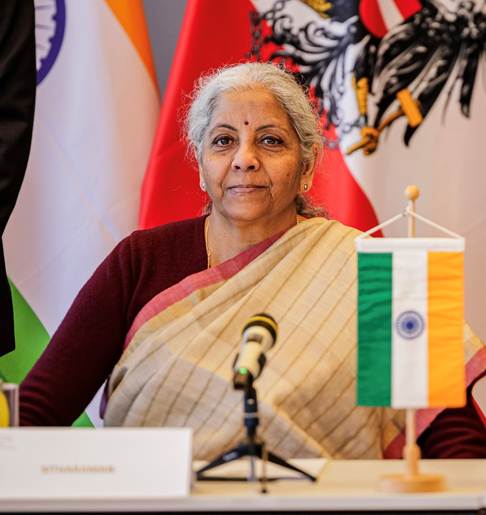
When Nirmala Sitharaman — we both studied at Jawaharlal Nehru University’s Centre for Economic Studies and Planning (CESP) a couple of years apart — rose on February 1, 2026, to present her ninth budget, she entered the record books with ease; what followed, however, revealed the limits of endurance without reinvention.

Her delivery was assured, her command of the brief unmistakable, and her 90‑minute speech moved with the practiced rhythm of someone who has mastered the rituals of budget day. The slogans were familiar — “Viksit Bharat,” “orange economy,” and the standard invocations of resilience and productivity — woven together with the fluency of a veteran.
Sitharaman has travelled far from her 2019 debut with its bahi‑khata symbolism; today she speaks with the confidence of a finance minister who knows every corridor of North Block. Yet the substance beneath that composure remains stubbornly predictable.
READ: Satish Jha | Reclaiming India’s startup soul: From diluted dreams to true technological revolution (January 18, 2026)
The 2026-27 budget is a careful arrangement of familiar ingredients: macro stability, incremental capital expenditure, calibrated fiscal consolidation, and the occasional sharp note like the hike in Securities Transaction Tax. It is a dish competently assembled, but one that avoids bold seasoning. In a moment when India needs structural reinvention, the government has chosen continuity—comfort over courage, steadiness over strategy.
The numbers are tidy enough. Growth is projected at 7 percent, capital expenditure at ₹12.2 lakh crore, the fiscal deficit trimmed to 4.3 percent, and debt‑to‑GDP on a slow glide path toward 50 percent by 2030. After twelve years in office, the NDA can claim an average growth rate of around 6 percent—respectable in a turbulent world.
But this stability conceals a deeper stagnation. India may be the world’s fifth‑largest economy, yet it ranks 143rd in per‑capita income, a gulf that exposes the limits of headline GDP as a measure of national progress. The demographic dividend is slipping, inequality is widening, and joblessness remains the country’s most corrosive economic reality.
Three decades after the 1991 reforms, India still awaits its next structural breakthrough. Successive finance ministers—including Sitharaman—have preferred cautious tinkering to transformative change. This budget, with its ₹53.5 lakh crore outlay and gestures toward manufacturing and AI, offers movement but not momentum.
It sidesteps the central challenges: a weakening rupee, faltering private investment, and a labour market unable to absorb millions of young Indians entering the workforce each year. For the top 1 percent, it is a curiosity; for the 850 million Indians dependent on free rations, it is continuity without uplift.
The government’s employment record illustrates the gap between ambition and delivery. When Narendra Modi first came to power in 2014, he pledged 20 million jobs a year — a bold commitment to harness India’s youthful population. Twelve years later, unemployment remains entrenched, and official statistics mask widespread underemployment in agriculture and informal work.
READ: Satish Jha | Satnavari: From chalkboards to smartboards (February 1, 2026)
The budget’s response is modest: a plan to skill 2 million youths, a fraction of what the economy requires. Manufacturing’s share of GDP remains stuck at 13 percent, private investment has fallen from 35 percent of GDP pre‑2014 to under 30 percent, and various policy shocks, such as demonetization, continue to cast long shadows over small enterprises.
The government’s renewed focus on MSMEs through credit enhancements is welcome, but without regulatory reform and stronger demand, these measures risk becoming cosmetic.
The deeper failure lies in education. India continues to invest in skilling hubs and digital universities while neglecting foundational learning. Rote‑driven classrooms suppress curiosity long before vocational training can compensate. Countries like Finland demonstrate what inquiry‑based education can achieve; India remains several steps behind.
The rupee’s trajectory tells a similar story of drift. In opposition, Modi castigated the UPA for a weakening currency. Today, the rupee has depreciated more than 50 percent against the dollar since 2014, making it Asia’s weakest performer. The budget offers no serious strategy for currency stabilization, relying instead on minor customs duty adjustments.
The contradiction is stark: India aspires to be the world’s third‑largest economy, yet its per‑capita income remains below $3,000—closer to sub‑Saharan Africa than the G7. A depreciating rupee inflates import bills, erodes household purchasing power, and undermines the very middle class the government claims to champion.
The budget’s AI‑driven productivity push sounds futuristic, but in a country where nearly half of graduates are deemed unemployable, it risks becoming a slogan rather than a solution.
Rural India, meanwhile, continues to struggle with low incomes, climate volatility, and chronic indebtedness. Against this backdrop, the budget’s expansion of Kisan Credit Cards to women farmers is well‑intentioned but insufficient.
READ: Satish Jha | Reclaiming India’s startup soul: From diluted dreams to true technological revolution (January 18, 2026)
Credit cannot substitute for structural reform. Without reliable irrigation, market access, and crop diversification, loans risk deepening vulnerability rather than enabling mobility. The budget’s allocations for rural development and new waterways signal ambition, but they echo past schemes that delivered uneven results.
The larger omission is the absence of a coherent strategy to rebuild rural cash flows damaged by demonetization and GST‑related compliance burdens. India needs grassroots agri‑tech, not more debt instruments.
Corporate concentration has become another defining feature of India’s economic landscape. Infrastructure and defense dominate the capital expenditure profile, with seven high‑speed rail corridors and new rare‑earth initiatives. These sectors inevitably benefit large conglomerates, reinforcing patterns of concentration that have become increasingly visible over the past decade.
Private investment’s decline is partly a consequence of this tilt. When tenders and opportunities cluster around a handful of firms, broader entrepreneurial energy is stifled. The budget’s proposal to use REITs for CPSE assets may improve efficiency on paper, but it also risks transferring public wealth into private hands without adequate safeguards. The STT hike is a rare measure that affects speculative capital more than ordinary citizens, but it does little to offset the broader trend of policy favouring the already powerful.
Macro stability remains the government’s strongest suit, and the budget maintains that record. But stability alone cannot deliver inclusive growth. The absence of meaningful tax relief for the middle class, modest adjustments to TCS, and limited health spending—still around 1.5 percent of GDP—reveal a narrow vision of welfare.
Inequality has deepened: the top 1 percent now accounts for 22 percent of national income, up from 10 percent a decade ago. GST’s regressive structure and the lingering effects of demonetization have contributed to this divergence. While exemptions on cancer drugs are humane, they do not compensate for systemic underinvestment in public health and education.
READ: Satitsh Jha | The day the Nobel Peace Prize became a White House souvenir – a masterclass in geopolitical regifting (January 19, 2026)
Sitharaman’s ninth budget is a testament to her discipline and mastery of presentation. But beneath the polished delivery lies a familiar pattern: incrementalism in an era that demands reinvention. India stands at a moment when it could redefine its economic trajectory, yet the budget offers only careful continuity.
The country that once embraced bold reform in 1991 now settles for calibrated adjustments. Stability has its virtues, but without ambition, it risks becoming inertia. India needs a new recipe—one that matches the scale of its aspirations, not the comfort of its routines.