



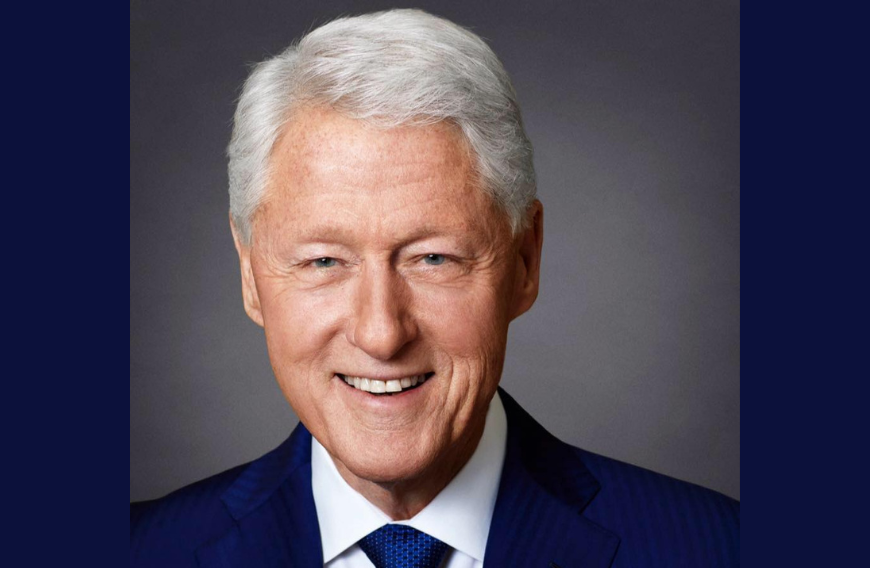
Former president Bill Clinton who has been featured prominently in the Epstein files may soon be clearing the air about his involvement in the infamous case.
Bill Clinton and former Secretary of State Hillary Clinton agreed late Monday to testify in a House investigation into convicted sex offender Jeffrey Epstein, but the Republican leading the probe said an agreement had not yet been finalized.
The development emerged late Monday, just as the committee was preparing to advance contempt of Congress resolutions against both Clintons for previously declining to comply with subpoenas.
Rep. James Comer, the chair of the House Oversight Committee, continued to press for criminal contempt of Congress charges against both Clintons Monday evening for defying a congressional subpoena when attorneys for the Clintons emailed staff for the Oversight panel, saying the pair would accept Comer’s demands and “will appear for depositions on mutually agreeable dates.”
“The Clintons do not get to dictate the terms of lawful subpoenas,” Comer said.
READ: Epstein files name filmmaker Mira Nair, NYC Mayor Zohran Mamdani’s mother (
The investigation itself seeks to examine Epstein’s political and social connections and determine whether any public officials had knowledge of or involvement in his criminal activities, though no allegations of wrongdoing have been formally made against either Clinton.
The former president and secretary of state had resisted the subpoenas for months after the Oversight panel issued subpoenas for their testimony in August as it opened an investigation into Epstein and his associates, as their attorneys tried to argue against the validity of the subpoena.
Taken together, the unfolding situation places the Clintons at a politically sensitive crossroads, where long-standing questions about transparency, accountability, and public trust intersect with renewed congressional scrutiny.
Even without formal allegations, the prospect of sworn testimony ensures that their past associations will once again be examined in a public forum, reinforcing how Epstein’s legacy continues to reverberate through American political life years after his death.
For the Clintons, the stakes seem to be less about immediate legal exposure and more about perception and precedent. Agreeing to testify may be viewed as an effort to draw a line under lingering speculation and demonstrate cooperation with congressional oversight.
READ: Epstein files: The empire of willful blindness (
At the same time, the surrounding uncertainty, including unresolved procedural disputes and the ongoing threat of contempt underscores how contentious and politically charged the process has become.
The episode also reflects a broader shift in how high-profile political figures are treated by congressional investigations. Former presidents and cabinet officials are no longer insulated from aggressive oversight tactics, particularly in an era of heightened polarization and partisan investigations.
This reality carries reputational risks regardless of the outcome, as even cooperation can prolong public attention on controversial associations.
What this means for the Clintons will depend not only on what emerges from testimony, but on how decisively the process is resolved. A clear conclusion could help quiet speculation, while prolonged conflict may extend scrutiny indefinitely.
Either way, the situation illustrates how unresolved questions from the past can continue to shape political narratives long after formal power has been relinquished.