



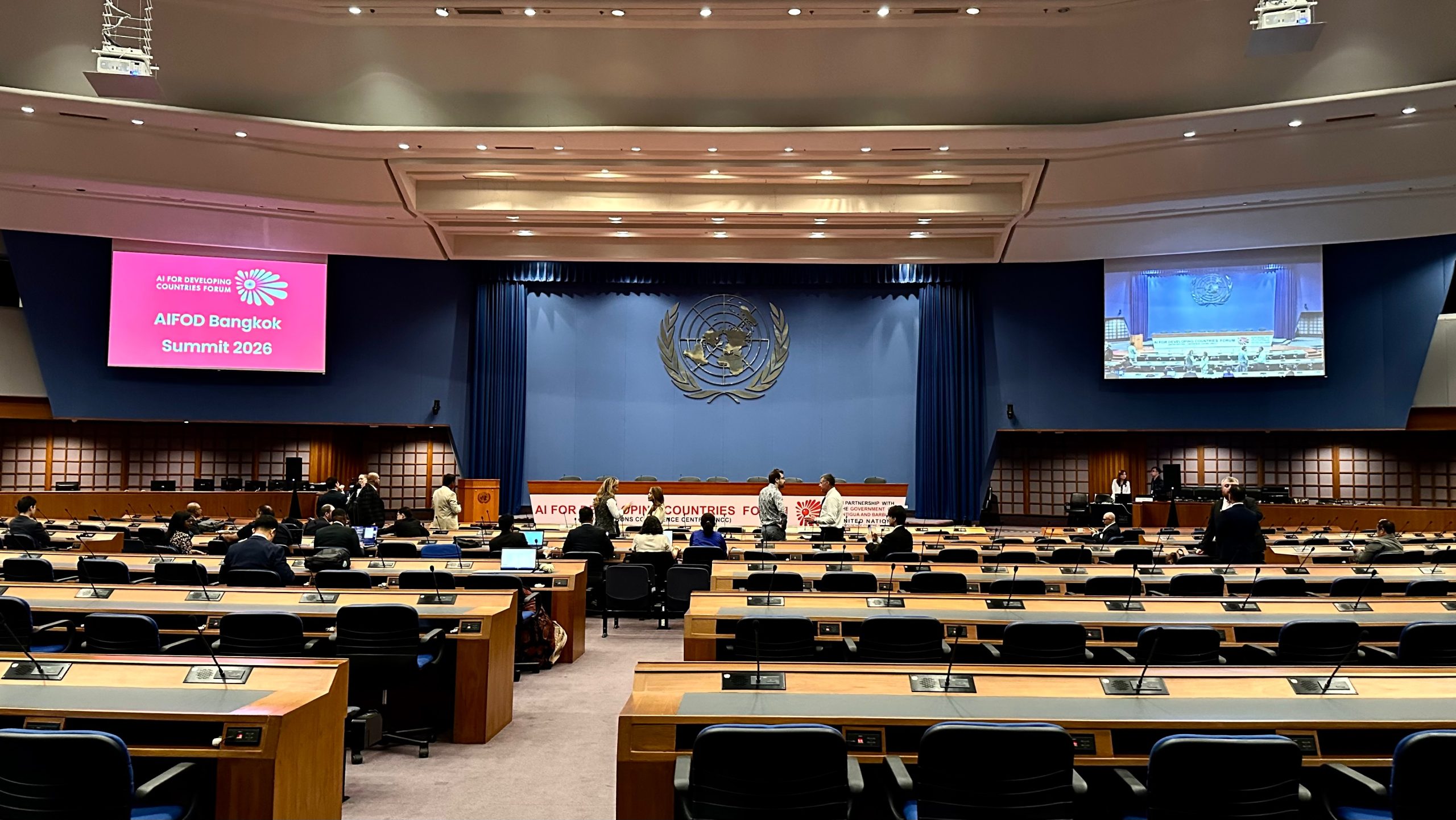
The AI for Development (AIFOD) Summit opened on Tuesday, February 4th at the United Nations ESCAP Hall in Bangkok, bringing together representatives from more than 150 nations for a three-day effort to reshape how artificial intelligence is governed and owned in the developing world.
Framed around the theme “AI for Economic Sovereignty,” the summit marked a decisive push by the Global South to move from being consumers of foreign technology to creators of sovereign AI systems.
The opening day set a forceful tone, beginning with a keynote that rejected the notion that developing nations must wait for inclusion in global AI decision-making. Speakers throughout the day emphasized that the accelerating AI economy risks deepening global inequality unless countries outside high-income blocs are empowered to control their data, infrastructure, and technological direction.
That message carried into a headline panel discussion titled “How Can Developing Countries Build AI That’s Truly Ours?”, which confronted what speakers described as one of the starkest disparities of the digital age. High-income countries represent just 17% of the world’s population but control 87% of AI models, according to figures cited during the session.
Moderating the discussion, Professor Dip Nandi, Associate Dean of Science and Technology at the American International University of Bangladesh, drew on data from the World Bank’s 2025 Digital Progress and Trends Report. He noted that 91% of global venture capital funding flows to high-income countries, which also host 77% of the world’s data centers, while low-income countries account for less than 0.1%.
READ: AAPI’s Cancun Summit spotlights young Indian American physicians (
“We are in many ways data rich but infrastructure poor,” Professor Nandi observed. “India, for example, generates nearly one fifth of the world’s data yet holds only 3% of global data center capacity.”
He warned that the United Nations and World Bank have described the current trajectory as an “era of divergence,” where the AI divide risks becoming permanent unless deliberate action is taken.
Professor Nandi framed AI sovereignty across three dimensions: data sovereignty, economic sovereignty, and cultural sovereignty. “Building AI that is truly our own isn’t about isolation, it’s about sovereignty,” he stated. “It means AI that speaks our languages, reflects our cultural nuances, and solves our specific problems—from climate resilient agriculture in Southeast Asia to maternal health in Sub-Saharan Africa.”
Sebastian Werner, Head of Data and AI Solutions at Thoughtworks, argued that developing nations need not compete directly with large general-purpose models built by global tech giants. Instead, he pointed to domain-specific language models built on open-source foundations as a practical path forward.
“The first step is to start to own and host your models, pre-train and fine-tune them,” Werner said. “Only when you do it yourself do you have even a chance of catching up.”
He also cautioned that data quality and system design are inseparable from questions of fairness. “Only the person who designs such a system has the chance to make sure it’s impartial and not biased,” he said, adding, “There’s an old saying that if you put in garbage, you get garbage out. With large language models, this has turned into garbage in, very confident garbage out.”
Offering a national case study, Sven Soomuste, Founder and CEO of Estonia-based DigiLa, reflected on how a country of 1.1 million people moved 99% of its public services online. “AI is for humans, not the other way around,” he said, stressing that digital trust must be embedded in design, governance, and accountability. He warned that when countries rely on external software without owning core workflows, “AI becomes an import bill, not national capability.”
READ: Inaugural edition of Bengaluru Skill Summit puts India’s workforce transformation in spotlight (
The panel also addressed the economic stakes of AI adoption, with the UN projecting the global AI market will reach nearly $5 trillion within the decade. “The question is, how much of that value will stay within the borders of the countries represented inside this room?” Professor Nandi asked.
The day’s discussions echoed the morning keynote by Tshepo Machethe, who challenged delegates to consider the long-term consequences of inaction. “Will we be remembered as the generation that continued to accept all terms, that exported our birthright and imported our poverty? Or will we be the generation that said enough?” he asked, concluding, “The future of resource trade will be written in code and verified in trust.”
The opening ceremony also featured remarks by the Honourable E.P. Chet Greene, Minister of Foreign Affairs of Antigua and Barbuda, who emphasized the role of Small Island Developing States in shaping AI governance. “The nations of the Caribbean and the broader Global South are not here to observe — we are here to lead,” he said.
As the summit continues through February 6, delegates are expected to move from diagnosis to action, a shift from “Why” to “How”, focusing on strategic frameworks and implementation pathways aimed at ensuring AI becomes a tool for shared prosperity rather than a driver of deeper global division.