



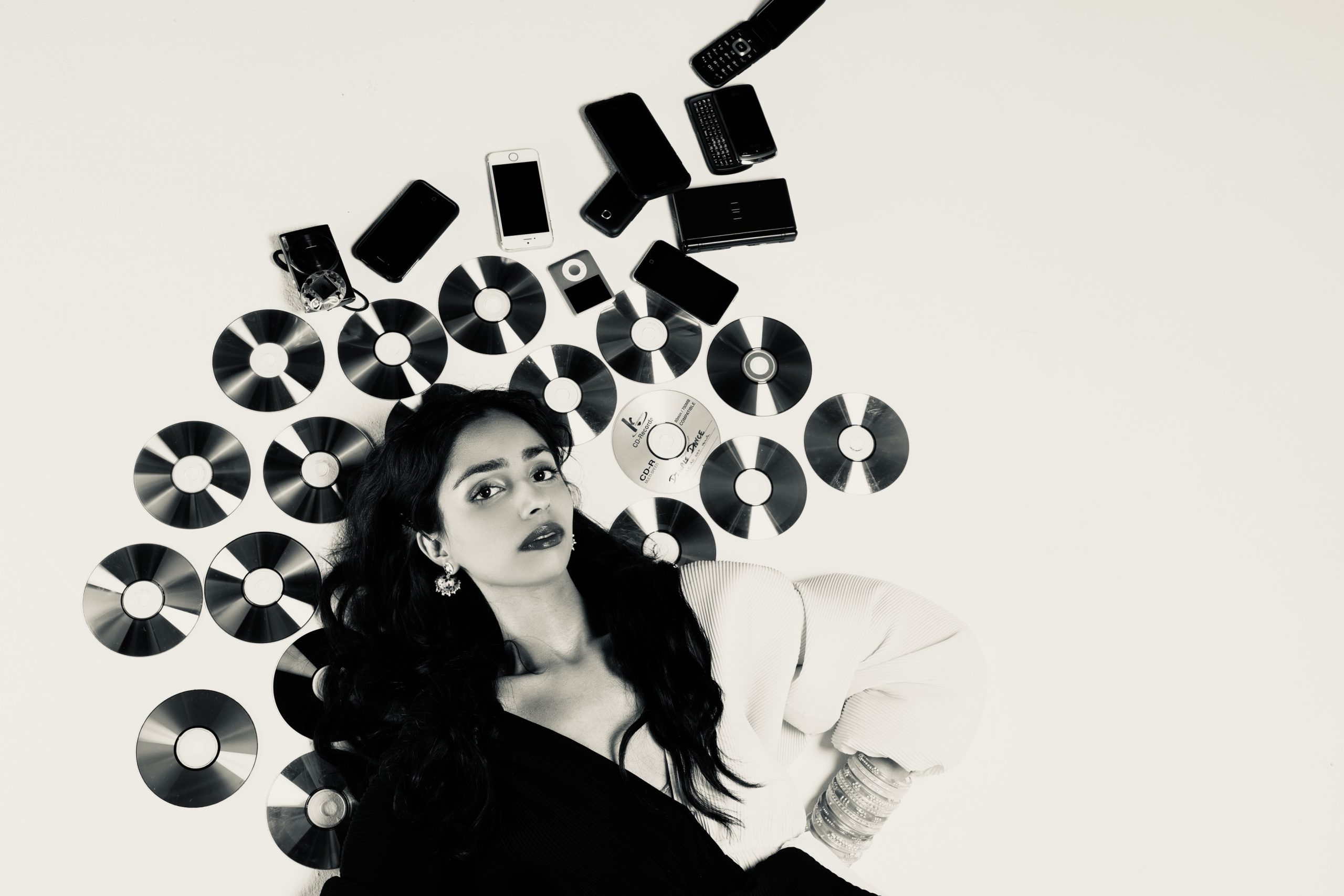
“In South Asian households, achievement is emphasized. We all know the auntie conversations where someone’s child is introduced as a doctor, lawyer, or engineer. Those paths are beautiful and worthy, but they can unintentionally create a hierarchy of what feels secure or impressive,” Malvika says.
While immigrant experiences in America have been documented through many mediums, now an Indian American musician is exploring identity during the digital age through her music.
Malvika, an LA-born artist, is all set to release her new Expanded Play (EP) “Online/IRL” this month. Malvika describes her EP as a unique cinematic pop exploration of identity, visibility, and self-authorship in the digital age.
Through this project, Malvika tackles an unspoken but important tension that exists for a second-generation immigrant. The tension between being seen and truly being. Malvika asks a pertinent question that takes centerstage in her EP: “Do we want to be, or do we want to be seen?”
As a nod to her heritage she blends modern pop with South Asian textures. The result — a thought provoking reflection on how identity, culture, and selfhood exist alongside constant online attention.
The American Bazaar: You describe “Online/IRL” as exploring the tension between being seen and truly being. As a Los Angeles-born artist with Indian roots, how has that tension played out in your personal life — not just online, but within family, community, and cultural expectations?
Malvika: “Online/IRL” began as a question I asked myself when I stepped more fully into my artistry and started detaching from an earlier identity that was closely tied to visibility. I had to confront whether I was living to be seen, or actually living from true alignment.
That tension shows up in immigrant communities in very real ways. In South Asian households, achievement is emphasized; sometimes subtly, sometimes directly. We all know the auntie conversations where someone’s child is introduced as a doctor, lawyer, or engineer. Those paths are beautiful and worthy, but they can unintentionally create a hierarchy of what feels secure or impressive.
It wasn’t effortless with my parents either. They’ve always been close confidants, but I think they’ve understood my career choices only once there was visible proof of success. I’m lucky that with time, my track record built just a little trust.
For me, the deeper shift was choosing alignment before the validation. That’s where the real tension between being and being seen lives; not just online, but within family expectations and our own internal standards.
For many second-generation South Asians, visibility can feel double-edged — pride on one side, pressure on the other. Have you ever felt like you were performing “Indianness” in certain spaces and diluting it in others?
I’ve never consciously tried to perform “Indianness,” but I was aware that sharing that part of myself helped me build community. There’s pride in that, and I don’t see it as pressure, I see it as responsibility. At a certain point, I had to ask myself whether I was sharing culture because it was resonating, or because it was performing well. I didn’t want to reduce something sacred to something strategic.
For me, the most honest expression of my identity (whatever label someone wants to place on it) comes through in my music more than anything else. That’s where I’m not thinking about optics or expectations. I’m just creating from lived experience and having fun while at it.
And what’s been meaningful is seeing the music resonate with people across the world, not just Indians or the diaspora. That reminds me that when you create from something real and specific, it actually becomes universal.
When you ask, “Do we want to be, or do we want to be seen?” is that question personal, generational, or cultural for you? South Asian communities often emphasize achievement and external validation — how did ambition and approval-seeking show up in your early creative life?
All!! It’s personal, generational, and cultural for sure.
In many South Asian households, achievement is woven into the fabric of daily life. It doesn’t always show up as direct pressure, mostly it’s just what gets emphasized. The grades, the job titles, the comparisons at gatherings. You grow up internalizing what earns recognition.
My song High Note really explores that. There’s this idea that if you achieve enough & if you reach the next milestone, you’ll finally feel secure. And for a long time, I operated that way. Even creatively, there was a part of me that wanted the visible markers of success to validate the path.
But at some point, I had to ask myself: am I pursuing this because it fulfills me, or because it looks impressive? Am I creating from conviction, or from the desire to be applauded? What life do I actually want?
These questions changed me. It shifted my focus from chasing highs to choosing alignment… from being “seen as successful” to actually feeling like myself, like Malvika. Basically, coming home to myself.
Tell us about Online/IRL — the concept, the emotional arc, your journey creating it, and what you hope audiences take away from it?
Interestingly, the concept revealed itself after the songs were written. I didn’t sit down with a thesis, I was just trying to understand why I felt the need to make music at this moment in my life.
The early writing collaboration with Julia Ross and Ash Minor helped me articulate my feelings and journal entries more clearly. And Abhishek Singh aka Lionoath produced the entire EP which gave it a cohesive sonic world. It feels like one continuous emotional landscape rather than isolated singles.
I began making this project because I was craving something real. Everything online felt louder and so curated, very attention-grabbing, and I didn’t want to add to that noise. I wanted to create from depth.
If I hope audiences take anything away from Online/irl, it’s the permission to slow down and listen to themselves. To choose alignment over applause. To remember that presence matters more than performance.
You incorporate subtle South Asian sonic elements into cinematic pop. How intentional were you about striking that balance, and how do you avoid tokenizing your own heritage?
It never felt like a balancing act actually, it felt natural.
I’ve been trained in Bharatanatyam since I was very young, so rhythm, repetition, and emotional storytelling were part of my body long before I sat in my closet recording on my mic. When I began making music with my collaborators, those influences weren’t just aesthetic choices, they were foundational.
The instruments and textures I grew up dancing to are simply part of how I understand emotion. So incorporating them wasn’t about representation or strategy. It was about honesty. We were able to build a cohesive sound that felt intentional rather than ornamental.
For me, authenticity removes the question of tokenizing. If it’s truly yours and comes instinctually, it doesn’t feel inserted, it just is who you are translated into sound.