



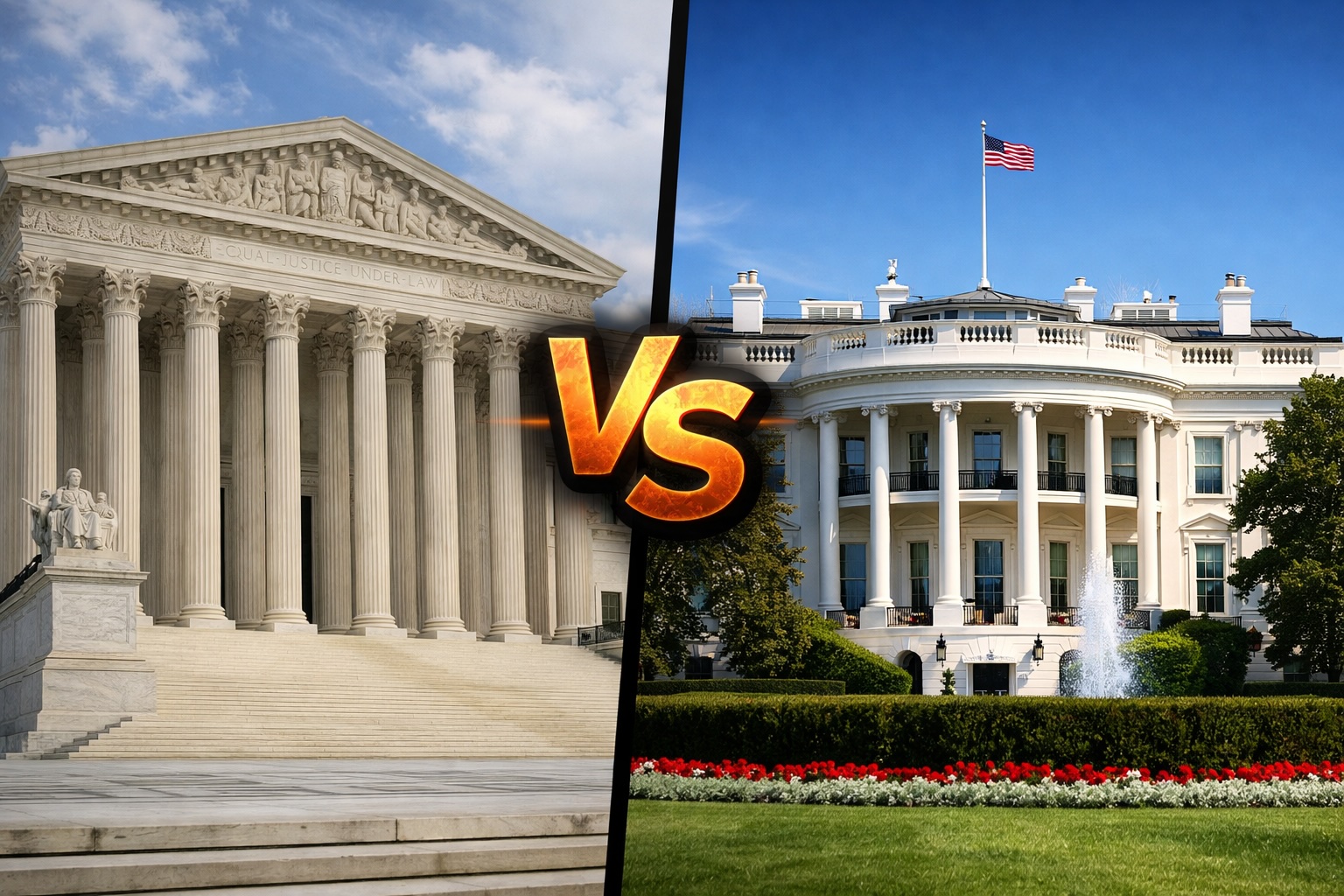
On February 20, 2026, the U.S. Supreme Court struck down Donald Trump’s sweeping tariffs in Learning Resources, Inc. v. Trump. The 6–3 ruling declared that the International Emergency Economic Powers Act (IEEPA) does not authorize tariffs, which are constitutionally reserved for Congress.

This verdict was more than a domestic correction — it was a global signal. In Brussels, it was read as vindication for multilateralism. In New Delhi, it triggered recalibration after a rushed interim deal. In Washington, it exposed the tension among executive ambition, legislative prerogative, and judicial restraint.
Trump’s tariffs, imposed in 2025 under IEEPA, began with a 10% global duty and escalated to 60% on China and 25% on allies. By framing trade deficits as a “national emergency,” Trump stretched a law designed for sanctions against rogue states into a blunt instrument of protectionism. Congress, sidelined, watched its taxation powers being usurped.
The judiciary restored balance, with Chief Justice Roberts affirming that tariffs are taxes reserved for the legislature. Dissenters warned of refund chaos, but the majority underscored constitutional guardrails. The ruling crystallized the enduring triangle: executive overreach, legislative sidelining, judicial correction.
Read more columns by Satish Jha
For Brussels, the ruling was a triumph of rules over unilateralism. The EU had endured 25% tariffs, retaliating with duties on bourbon, motorcycles, and agriculture. The Court’s decision reassured European policymakers that even the strongest executive cannot override law indefinitely. It emboldened Brussels to fortify its internal market and deepen external alliances, reinforcing the WTO as a bulwark. The verdict validated Europe’s insistence that trust—the invisible glue of commerce—depends on rules, not transactional bullying.
In New Delhi, the ruling exposed the risks of haste. India’s government had pledged $100 billion in annual imports, locking in 18% tariffs under Trump’s interim deal. The verdict rendered parts of that deal precarious. Commerce Minister Piyush Goyal studied implications, while opposition leaders lambasted Modi’s government for “surrender.” For India, the path forward is triphasic: short-term agility to honor interim commitments, medium-term reliance on WTO appeals, and long-term diversification through RCEP and BRICS. The lesson is clear: strategic patience, not rushed concessions, anchors resilience.
Markets reacted with volatility. The U.S. average tariff dropped from 16.9% to 9.1%, offering relief but triggering refund liabilities of $160–200 billion. Analysts hailed the ruling as “profound economic relief,” yet warned of litigation headaches.
READ: Satish Jha | The America that forgot itself (February 13, 2026)
The Cato Institute celebrated a victory for the rule of law. But Trump’s immediate pivot—imposing new tariffs under Section 122 of the Trade Act—prolonged uncertainty. Markets whipsawed, underscoring the fragility of investor confidence when governance turns erratic.
Trump’s tariffs were geopolitical gambits as much as economic measures. China retaliated against U.S. soy farmers, Europe fortified its internal market, and India scrambled for balance. Larger players accelerated bloc-building: the EU deepened integration, China expanded Belt and Road, BRICS explored enhancements.
Smaller nations sought plurilateral deals to quarantine chaos. The ruling reshaped the chessboard: unilateralism falters, multilateralism regains ground, alliances become the currency of stability.
The ruling offers a chance to reset U.S. trade policy. Three imperatives stand out:
- Refund swiftly: Streamline Treasury processes to return duties, restoring public trust.
- Target fairly: Use Section 301 for genuine unfair practices, not blanket tariffs.
- Rebuild multilaterally: Reengage the WTO and deepen alliances like USMCA and the Indo-Pacific Framework.
For Brussels, the path is to double down on rules-based reciprocity. For New Delhi, it is to diversify alliances and anchor resilience in plurilateral frameworks. For Washington, it is to restore governance that bows to law, evidence, and diplomacy.
Decades from now, historians may quote this moment as a turning point: when the U.S. judiciary reined in executive overreach, when Brussels and New Delhi recalibrated, and when global markets demanded stability over chaos.
Trump’s attempt to boil the trade ocean left turbulence in its wake, but the SC ruling promises to chart a course back to rule-bound waters. In the vast ocean of trade, steady hands guided by law and logic will outlast storms.