


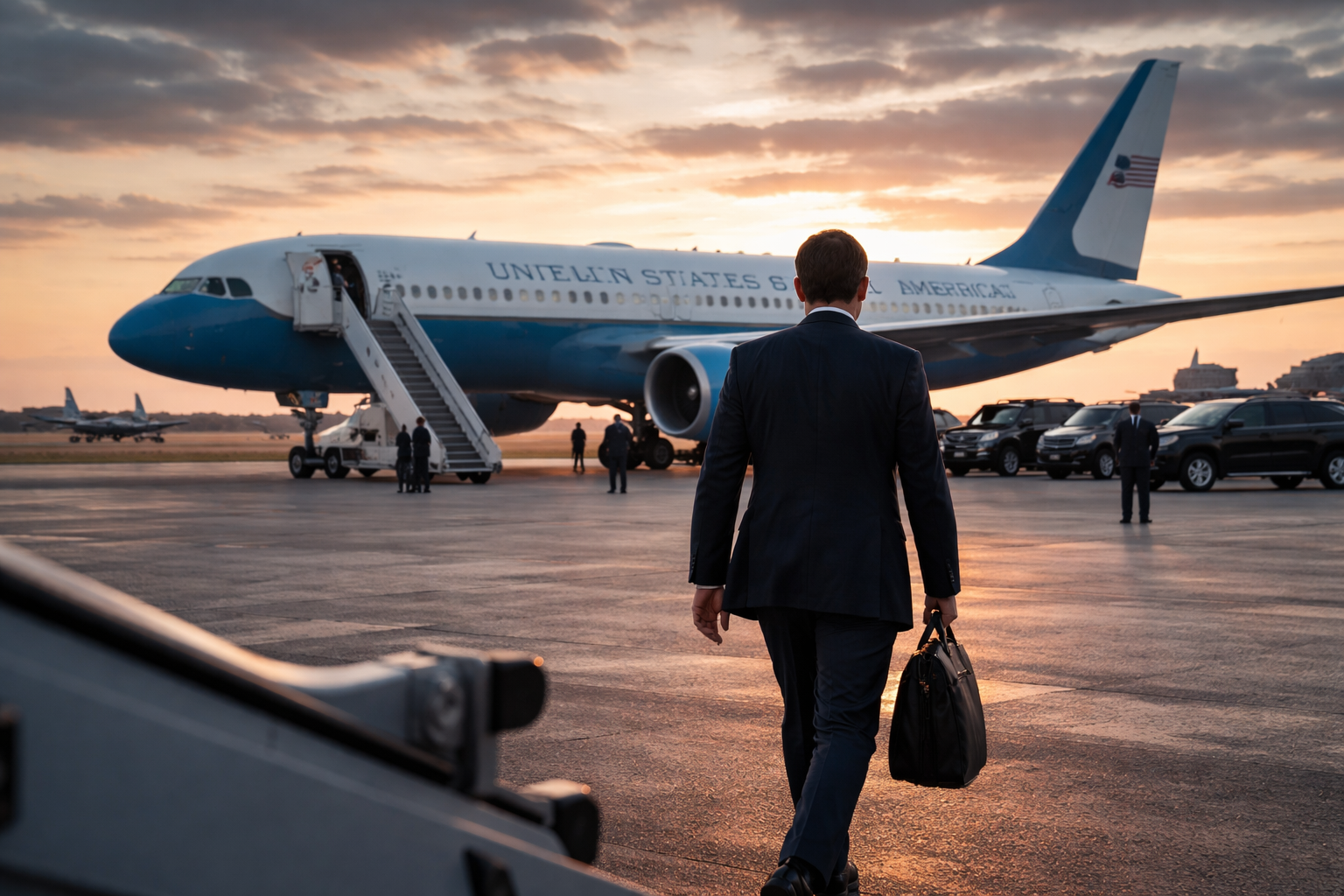
Yesterday morning, Air Force Two lifted off from Joint Base Andrews carrying Vice President JD Vance, Special Envoy Steve Witkoff, and Jared Kushner, bound for Islamabad and the most consequential American diplomatic mission since the 1979 Islamic Revolution. It is not unusual for vice presidents to take on important negotiating roles for the president.
But no vice president has been sent to negotiate a ceasefire or peace in connection with a war the United States was itself involved in starting. That distinction, unprecedented in the modern history of the republic, is the perfect prologue to everything that has gone wrong, and everything that might still go right, in the six weeks since Operation Epic Fury shattered the Middle East.
Before boarding, Vance offered reporters a formulation that was equal parts olive branch and warning. “If the Iranians are willing to negotiate in good faith, we’re certainly willing to extend the open hand. If they’re going to try to play us, then they’re going to find the negotiating team is not that receptive.” It is a sentence that encapsulates the entire architecture of this crisis: the simultaneous offer of partnership and the threat of punishment, the extended hand and the clenched fist, held in the same breath by the same man.
There is a Persian concept, taqdir, the idea that fate arrives not when you summon it, but when it has already decided.
In the early hours of February 28, 2026, fate arrived for the world in the form of American B-2 stealth bombers and Israeli precision munitions descending on Tehran without warning, without congressional approval, and without consultation with a single ally. By dawn, Supreme Leader Ali Khamenei was dead. The Strait of Hormuz, through which roughly 25 percent of the world’s maritime trade in crude oil and petroleum flows, was declared closed. And the world was left to reckon with a war it had not chosen, but could not escape.
On April 8, 2026, Iran and the United States announced a temporary two-week ceasefire. But a ceasefire is not peace. It is a comma in a sentence that has not yet decided how it ends. A fragile ceasefire masks a far more dangerous reality: Iran’s nuclear ambitions unresolved, Lebanon destabilized, terrorism risks rising, and a shadow war between Israel and Iran poised to reignite at any moment.
Today’s talks in Islamabad are the punctuation mark the world is waiting for.
READ: When the U.S.-Israel war against Iran shakes the Gulf, India’s Kerala state feels the shock (April 5, 2026)
In this essay, what I wish to examine is not the mechanics of those negotiations, their technical demands, their nuclear off-ramps, but the extraordinary moral and strategic predicament the war has imposed on the nations that did not start it and cannot end it: Europe, India, and Pakistan. Each has been forced into a posture, toward Trump, toward Iran, toward their own people, that reveals something essential about loyalty, empathy, and self-interest in the modern world. And it is Pakistan, improbable, embattled, perennially underestimated Pakistan, that holds the room where history may turn.
The transactional doctrine
Before we turn our focus on Vance’s plane crossing into Pakistani airspace, we must first discuss another man, the man who sent Vance to Pakistan and the reasons why he sent his vice president on this mission. Let’s say it plainly. Donald Trump’s worldview is transactional in the most elemental sense: allegiance earns favor; hesitation earns punishment; neutrality earns suspicion.
President Trump, who acted unilaterally and created the Iran crisis, is now asking allies to clean it up, and is threatening to punish them if they don’t. When European nations refused to send warships to reopen the Strait of Hormuz, Trump escalated dramatically. “I always knew they were a paper tiger,” Trump lashed out, saying he was strongly considering pulling out of NATO. Secretary of State Marco Rubio warned that if the transatlantic alliance was “just about defending Europe” but not the other way around, that arrangement would “have to be re-examined.”
Since returning to power, President Trump has been consistent with his macro agenda. He imposed tariffs on friends and adversaries with equal indifference. On January 17, 2026, he imposed an additional 10 percent tariff on Denmark, Norway, Sweden, France, Germany, the United Kingdom, the Netherlands, and Finland, all NATO allies, over his Greenland demands. He has since threatened tariffs of 50 percent on any nation supplying military weapons to Iran. The message is clear: in Trump’s world, there are no permanent friends, only permanent leverage.
But here’s the complexity that the flight to Islamabad embodies. Trump has chosen for his most delicate mission the one member of his administration who has always been the most skeptical of exactly this kind of war. Iran’s preference for Vance predates the war. Iran viewed Vance as more sympathetic to ending the conflict than other US officials. The New York Times had reported in detail on the doubts he raised in prewar administration meetings. The transactional president has sent his most principled diplomat, a man who argued against this war, to clean up its aftermath. The irony is Shakespearean.
READ: Autopsy of a liquidity event. Biopsy results for the crypto trade (
Europe
Europe’s response to the Iran war has been morally coherent but politically consequential. Faced with Trump’s demand for military participation in the Strait of Hormuz coalition, Europe said no with remarkable unity. German Foreign Minister Johann Wadephul said Berlin had no intention of joining military operations during the conflict. Greek government spokesman Pavlos Marinakis said Greece would not engage in any military operations in the Strait of Hormuz.
Italian Foreign Minister Antonio Tajani said Italy was not involved in any naval missions that could be extended to the area. The United Kingdom, despite its “special relationship,” was equally firm. Prime Minister Keir Starmer said the U.K. “will not be drawn into the wider war,” though he noted discussions with the U.S. about using mine-hunting drones already in the region. Spain went further than anyone. Spain, the most vocal European opponent of the war, said its airspace is closed to US military planes involved in the conflict.
The Carnegie Endowment’s Sophia Besch captured the European calculus precisely: “NATO imposes no obligation to back a war of choice, and Europe lacks any realistic means of reopening the Strait of Hormuz by force while hostilities continue.” But Europe’s firmness is not without cost. The war has precipitated a second major energy crisis for Europe, primarily through the suspension of Qatari LNG and the closure of the Strait of Hormuz.
With historically low European gas storage, estimated at just 30% capacity following a harsh 2025–2026 winter, Dutch TTF gas benchmarks nearly doubled to over €60/MWh by mid-March. The European Central Bank postponed planned rate cuts. UK inflation is expected to breach 5 percent in 2026.
Europe is paying the economic price for a war it did not want, started by an ally it no longer trusts. And yet it refuses to be coerced into military complicity. Is this weakness or, at long last, the emergence of European strategic autonomy, born not from ambition but from the clarifying fire of American unilateralism? The Greenland crisis taught Europe to push back against Washington. In Iran, it may have to engage without falling in line.
Till now, Europe has been firm with its convictions even when the hegemon is furious. Europe is standing with principle, sitting with economic pain, and sharing a bed with the uncomfortable reality that its security architecture still runs through Washington. The Vance mission, if it succeeds, may ease the energy crisis. But it will not restore the trust that was broken when the first bombs fell without a single allied consultation.
Read more columns by Ajay Raju
India
If Europe’s response has been principled refusal, India’s has been something more complicated, more tragic, and ultimately more self-defeating: the performance of neutrality without its substance.
Prime Minister Narendra Modi visited Tel Aviv on February 26, two days before the strikes began. He addressed the Knesset, accepted the Knesset Medal, and signed agreements upgrading ties to a “special strategic partnership” spanning defence, technology, agriculture and innovation. Less than 48 hours later, the bombs fell.
Bloomberg called the trip “suspicious and diplomatically risky,” while an Israeli journalist described Modi’s role as a “cheap advertisement” for Netanyahu’s election campaign.
What followed was an exercise in strategic ambiguity that satisfied no one. India has condemned Iranian missile attacks on Gulf states, but has issued no statement on the initial U.S.-Israeli assault on Iran, and initially instructed Indian diplomats not to sign condolence books at Iranian embassies. The Ministry of External Affairs eventually expressed “deep concern,” but anxiety is not a foreign policy.
The consequences have been severe and immediate. 70% of India’s LPG imports pass through the Strait of Hormuz. Following the closure of the strait by Iran, protests erupted across India over the shortage of LPG. Brent crude rose from $80 to $120 per barrel between March 2 and 9. The rupee fell to record lows. The Indian stock market declined for five consecutive weeks. And then came the most stinging blow of all, the revelation that it would be Islamabad, not New Delhi, sitting at the table with Vance.
The Wire noted that “the emergence of Pakistan, alongside Egypt and Turkey, as a primary back-channel interlocutor between Iran and the United States is a stinging strategic setback for New Delhi. For a government that has staked its reputation on isolating Pakistan and projecting India as the indispensable Vishwaguru under Narendra Modi’s personal leadership, this development is nothing short of a political and diplomatic catastrophe.”
READ: All roads lead to Beijing (
India has nearly ten million citizens in Gulf countries. The Indian diaspora remits approximately $135 billion annually. The UAE remains India’s third largest trading partner, with bilateral trade exceeding $100 billion in FY 2024-25. This is the breath of the Indian middle class. And as Vance’s plane descends into Islamabad this Saturday, New Delhi watches from the sidelines of a negotiation happening in its own extended neighborhood, a neighbor it has spent a decade trying to isolate now hosting the Vice President of the United States.
For decades, India maintained a delicate balance in West Asia, cultivating strong ties with Iran for energy security and regional connectivity, while also maintaining cordial relations with Israel and the Arab Gulf states. That policy of strategic autonomy ensured India remained on good terms with competing regional powers without becoming entangled in their rivalries. That equilibrium has eroded.
What India has demonstrated is that there is a crucial difference between strategic ambiguity and moral abdication. Ambiguity protects optionality. Abdication destroys credibility. One can be in bed with Washington for economic interest, stand with Israel for technology partnership, and still sit with Tehran out of historical empathy and energy necessity, but only if one is honest about the simultaneity of those positions. India tried to hide them all and satisfied none.
Pakistan
Pakistan’s story in this crisis is the most surprising and, in some ways, the most instructive of all. Here is a country perpetually dismissed, financially stressed, diplomatically isolated, hostage to its own internal contradictions, that nonetheless managed to accomplish what no European power, no BRICS member, and no Gulf state could. Today, Islamabad hosts the highest-level direct diplomatic engagement between the United States and Iran since the Islamic Revolution. The Vice President of the United States is in a Pakistani city because Pakistani diplomats made it so.
Pakistan was dealing with multiple pressures simultaneously. It remained engaged in what officials described as an “open war” against the Afghan Taliban. It was grappling with rising fuel costs due to disruptions to shipping in the Strait of Hormuz and concerns over remittances from Pakistani workers in Gulf states. On March 12, Prime Minister Sharif travelled to Jeddah with the army chief to meet Saudi Crown Prince Mohammed bin Salman, expressing “full solidarity” while urging restraint, a delicate balancing act to maintain its mutual defence pact with Riyadh without being drawn into direct confrontation with Iran, its neighbor with which it shares a nearly 1,000 kilometer border.
The particular genius of Pakistan’s mediation, and it is a kind of genius, however improvised, is that it understood something the great powers did not: Iran needed a Muslim intermediary it could trust, one that was neither an Arab Gulf state aligned with American military basing nor a Western power complicit in the war’s inception. After Khamenei’s death, factions within Iran’s political system have competed for influence. The war strengthened the Islamic Revolutionary Guard Corps while President Pezeshkian’s government was left with limited authority over strategic decisions. Acceptance of negotiations, including Pakistan’s mediation, came from higher levels of the Iranian system.
Pakistan is a vivid illustration of the thesis that self-interest, honestly pursued, can produce outcomes that align with the broader good. Islamabad did not mediate out of altruism. It mediated because it cannot afford a regional war on its western flank, because its remittance economy bleeds with every disrupted shipping lane, and because positioning itself as indispensable to both Washington and Tehran restores some measure of geopolitical relevance. Result: the world’s best hope for ending a war sits in a Pakistani conference room.
Read more columns by Ajay Raju
Complicity
What this war has revealed, and what Saturday’s Islamabad talks crystallize, is that the old order of international relations has collapsed. In its place is something more honest and more uncomfortable: a geometry of competing attachments that no nation can resolve into a single line.
You can stand with someone out of loyalty, as the Baltic states have stood with America even when they privately deplore the Iran adventure. You can sit with another out of empathy, as France has sat with the humanitarian critics, hosting discussions about Palestinian statehood and Lebanese reconstruction while maintaining its NATO commitments. And you can be in bed with a third out of pure self-interest, as nearly every nation in this crisis has discovered it must be with both Washington and the energy markets simultaneously.
The Vance mission embodies all three geometries at once. He goes to Islamabad as an emissary of a president whose war he privately opposed. He will sit across from Iranian officials, or across a Pakistani table from them, through intermediaries, representing an administration that assassinated their Supreme Leader while nuclear talks were still active. And he brings with him Witkoff and Kushner, the same duo whom Iranian officials refused to engage with after the Geneva talks, viewing their pre-war negotiations as a ruse to buy time before preplanned military action.
As former U.S. special envoy Mitchell Reiss observed: “The Iranians are going to be extremely skeptical of whoever the American interlocutor is. You could be Mahatma Gandhi and show up on behalf of the United States, and I don’t think it’s going to impress the Iranians at this point.”
And yet Vance goes, because the alternative, failed talks, resumed war, a Strait of Hormuz blockaded through summer, oil above $130 a barrel, European recession, Indian political crisis, global food inflation, is worse than the humiliation of sitting down. Pakistan, Turkey, Egypt, and Oman have all been involved in back-channel diplomacy. Tehran does not believe Washington is negotiating in good faith. From the Iranian perspective, the precedent of the US withdrawal from the 2015 nuclear deal destroyed confidence in American commitments. But distrust, however justified, is not a strategy.
The most dangerous legacy of this war is not the Strait of Hormuz or the nuclear question, though both are existential in their own register. It is the erosion of the architecture of trust that made collective security possible. As former US Ambassador to NATO Ivo Daalder observed: “Military alliances are at their core, based on trust: the confidence that if I am attacked, you will come help defend. It’s hard to see how any European country will now be able and willing to trust the United States to come to its defense.”
The room in Islamabad
There is a kind of clarity that only catastrophe produces. The Iran war, with its $120-per-barrel oil, its shuttered Strait, its fragile ceasefire and unresolved nuclear question, its regional dead numbering in the thousands, its five million Indian protesters running out of LPG, its fractured NATO, its newly sovereign Europe, has forced every nation to answer a question it had been avoiding: What do you actually stand for, and who do you actually stand with?
The honest answer, for most, is: several things, simultaneously, depending on the stakes. This is not hypocrisy, but the human condition, scaled to the nation-state. You can hold multiple loyalties without betraying them, as long as you are honest about the hierarchy.
What you cannot do, what India demonstrated so painfully, is pretend that silence is a position. What you cannot do, what Trump demonstrated when he launched a war without allies and then demanded allies fix it, is pretend that coercion is the same as leadership. And what you cannot do, what the world is about to test in Islamabad, is walk into a room with people you bombed last month and expect gratitude.
JD Vance lands in Pakistan carrying an impossible brief: to represent a transaction-minded president in a mission that requires something far older and rarer than transactions, the willingness to acknowledge that the other side has legitimate grievances, and that peace requires both parties to receive something they actually want. Is he the right messenger? I don’t know, but whether he carries the right message is the question on which the next chapter of the Middle East, and the global economy, and the fracturing Western alliance will turn.
Somewhere in Islamabad, Pakistani diplomats are quietly proud of what their improbable mediation has built, a room, a table, a moment. Somewhere in Madrid, Pedro Sánchez reads the morning dispatches with grim satisfaction: he said no, and the sky did not fall. Somewhere in New Delhi, a former ambassador watches Vance’s plane descend into Islamabad and understands what India forfeited, the credibility of its independence, by not being the country that offered this room first.
Read more columns by Ajay Raju
And somewhere over the Atlantic, on Air Force Two, a Vice President who argued against this war is preparing to end it. Whether he succeeds or fails, the world will have learned something irreversible: that in the Trump era, the most important diplomatic address is not Washington or Brussels or Geneva.
It is wherever the Americans are willing to show up, and whoever was humble enough, pragmatic enough, and strategically patient enough to make themselves the place worth showing up to.
This Saturday, that place is Islamabad.