



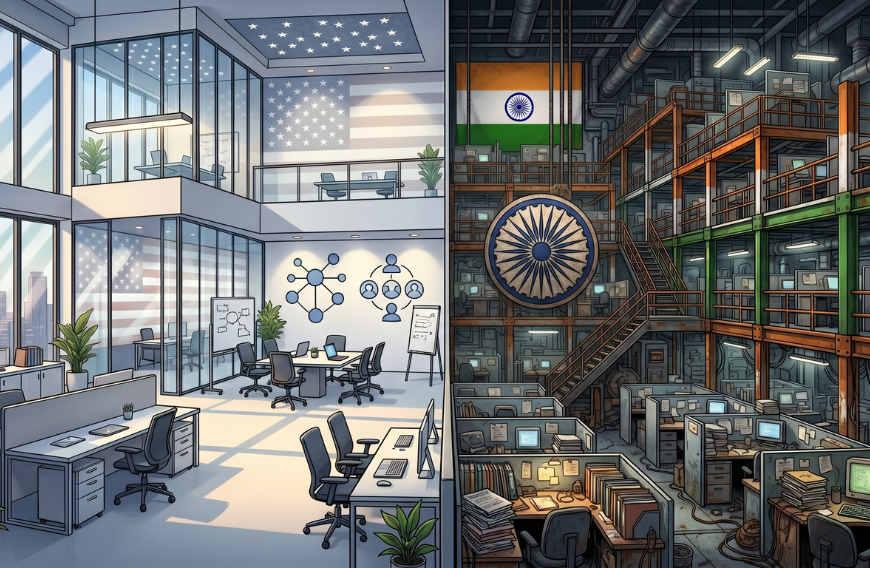
Amid rising layoffs and immigration uncertainty in the U.S. tech sector, many Indian professionals are increasingly viewing India’s fast-growing startup ecosystem as a potential next chapter. Yet a new survey suggests that even as companies like Flipkart, Zoho, and Zomato attract global talent, concerns over toxic work culture, long hours, and burnout continue to cloud India’s tech ambitions.
For Seattle-based telecom professional Anjali Shah, one of the biggest advantages of living and working in the U.S. is the workplace culture. “It’s a no-nonsense work culture. Everyone comes at their respective times and clocks in their hours. There is no expectation that you have to stay in the office because your boss hasn’t left yet. You are done, you go. It is so refreshing and very different from my very grinding job back in Bangalore, India,” she says.
At the same time, growing immigration scrutiny, stricter visa policies, and an unstable U.S. job market have forced many work visa holders to reconsider their long-term plans in case they need to return to India. Several major multinational companies have announced large-scale layoffs and restructuring efforts in recent months. In this climate, persistent layoff rumors across the tech industry have created anxiety among employees and an uneasy realization that many may need a backup plan.
Yet while India’s high-growth economy offers ambitious career opportunities, concerns over toxic work culture continue to make some professionals hesitant about returning. Sumit Singh, who moved back to India after spending five years in the U.S., says he is already feeling the pressure.
“Coming back was always on the cards for me, but I did not expect that timeline-driven work grind would still continue in India.”
Asked where he believes Indian work culture differs most from American corporate environments, Singh says, “American workplaces usually value direct communication, clarity, and quick feedback. While in India, I feel that structure is still hierarchy-driven.” He adds, “Everyone wants to build the next big thing. But nobody wants to go back to the kind of work culture where your entire life revolves around work.”
That tension reflects a broader sentiment among many Indian professionals abroad. Even as Indian startups and homegrown tech giants gain global visibility and attract admiration from employees at companies like Microsoft and Amazon, concerns over punishing work cultures, long hours, and burnout-heavy environments continue to persist.
READ: Former Google contractor alleges Indian hiring networks shared interview questions in Silicon Valley (May 13, 2026)
A new survey by anonymous professional networking platform Blind found that nearly half of Indian professionals — 48 percent — would actively explore or seriously consider joining an Indian homegrown company if they were laid off tomorrow. Yet the biggest barrier was not compensation, but workplace culture.
According to the survey of 1,205 India-based professionals conducted between April and May 2026, 47 percent identified toxic workplace culture as their biggest concern about joining Indian companies. Another 18 percent cited work-life balance worries, meaning nearly two-thirds prioritized quality-of-life concerns over compensation. Only 18 percent said pay gaps were their primary hesitation.
The findings reveal a deeper shift in priorities among India’s tech workforce. For years, higher salaries, career-growth prospects and stock options were deciding factors for career decisions. Today, employees increasingly appear willing to trade some compensation for healthier workplaces and flexibility.
The irony is that many of these professionals are genuinely interested in India’s startup ecosystem. The survey found that employees from global technology giants were among the most open to joining Indian firms. Workers from Microsoft, Amazon, Oracle, and Google formed a significant portion of respondents considering a move toward Indian employers.
Among preferred destinations, Flipkart emerged as the most attractive, drawing interest from 20 percent of respondents. Food delivery companies Zomato and Swiggy followed at 14 percent, while Zoho attracted 10 percent. Fintech firms Paytm and PhonePe received seven percent support each.
Despite the enthusiasm there is a skepticism.
On Blind’s anonymous forums, employees discussed experiences that reinforce concerns about burnout culture in India’s tech sector. One employee at Flipkart reportedly described the environment as suitable only “if you have no life outside work,” while another employee at Zoho complained about weekend work, lack of overtime benefits, and poor work-life balance.
These anxieties are hardly isolated. A previous Blind survey found that 83 percent of Indian IT professionals reported experiencing burnout, with one in four employees working more than 70 hours a week.
For many professionals, the fear is not simply about long hours but about a workplace mindset they believe remains deeply hierarchical and demanding.
“Indian companies still struggle with the idea that productivity does not mean constant availability,” says Neha Rai, another software professional who previously worked for both an Indian startup and a U.S.-based technology firm.
Interestingly, the survey also showed how dramatically India’s startup ecosystem has reshaped professional aspirations. Traditional IT outsourcing giants like TCS, Infosys, and HCL collectively drew only three percent support despite employing millions and dominating India’s technology landscape for decades.
Instead, employees appear more attracted to product-driven startups and consumer technology brands seen as innovative and globally competitive.
Still, the biggest warning sign for India’s tech industry may be the 40 percent of respondents who selected “none of the above” when asked which Indian company they would join. The figure suggests many professionals still do not believe Indian employers have built workplaces capable of competing with global tech standards.
READ: Ray Dalio says the Middle East is becoming a ‘Silicon Valley of Capitalists’ (December 8, 2025)
Blind says its internal AI analysis — which tracks employee sentiment, search trends, and engagement patterns — found that companies like Flipkart, PhonePe, and Infosys were among the most searched Indian employers by Microsoft and Amazon workers between February 2025 and May 2026.
That signals a major opportunity for Indian firms at a time when layoffs and hiring slowdowns continue to reshape the global technology industry. As Silicon Valley companies cut jobs and tighten immigration pathways, more Indian professionals may eventually look homeward for opportunities.
But attracting global talent back may depend less on salaries and more on whether Indian companies can shed their reputation for burnout-driven cultures.
In one Blind discussion about toxic work culture in India’s tech industry, a verified Microsoft employee summed up the challenge bluntly: “We need to find a way to pivot mindset and boost mental health.”
For India’s startup ecosystem, work-life balance may ultimately become the defining test of its next growth phase — not whether it can build billion-dollar unicorns, but whether it can build workplaces employees actually want to stay in.
(Some names in the story have been changed on request)