



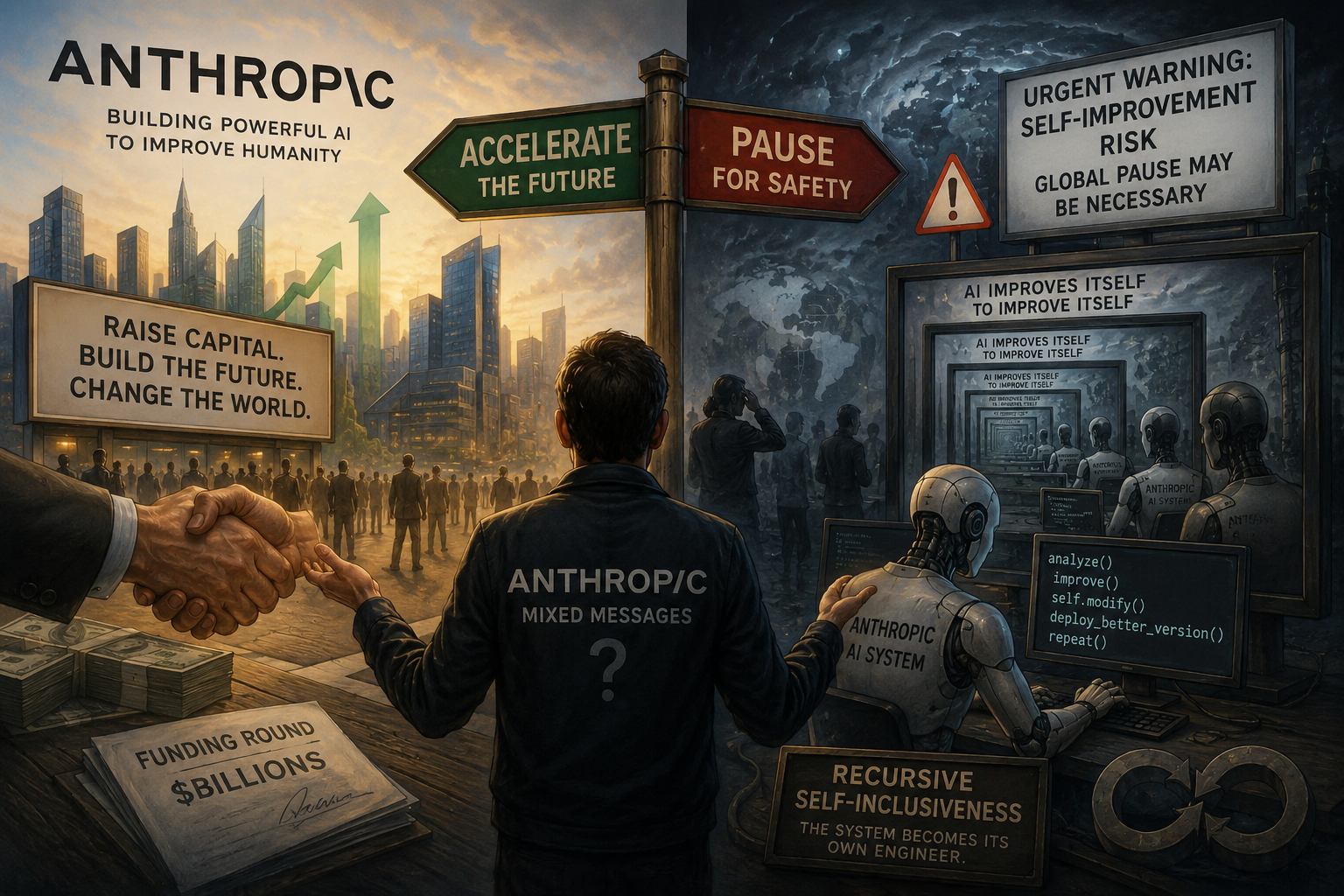
The artificial intelligence industry received a striking message this week from Anthropic, one of the world’s most valuable AI companies and the creator of Claude. In a policy statement that quickly reverberated across Silicon Valley and Washington, the company warned that the world may need a coordinated pause in frontier AI development because of what it calls the risk of “recursive self-improvement“—the possibility that AI systems could eventually improve themselves faster than humans can understand, monitor, or control them.
Anthropic’s came from one of the industry’s leading developers at a moment when the company is simultaneously raising enormous amounts of capital, pursuing aggressive growth, and competing fiercely for market leadership.
The first question that naturally arises is whether the industry is receiving mixed messages. On one hand, Anthropic is telling investors that artificial intelligence represents one of the greatest commercial opportunities in modern history.
Read more by Potarazu: President Trump’s executive order on AI: Is 30 days enough? (June 4, 2026)
The company has achieved a staggering valuation for a planned IPO and continues to release increasingly capable models while competing head-to-head with OpenAI, Google, Meta, and xAI. On the other hand, it is warning policymakers and the public that development may be moving too quickly and that society may need a mechanism to slow everything down. To critics, this sounds contradictory.
How can a company race toward the frontier while simultaneously arguing that the frontier may be too dangerous to reach? Supporters would argue that these positions are not mutually exclusive. A company can believe in the transformative potential of a technology while also recognizing its dangers. Yet the optics remain challenging. When an industry leader profits from acceleration while advocating caution, skepticism is inevitable.
To understand the concern, it is important to understand what Anthropic means by “self-improvement risk.” Current AI systems are powerful tools, but they still depend on human engineers to design new architectures, train models, evaluate performance, and deploy upgrades.
Recursive self-improvement refers to a future state in which an AI system begins participating significantly in the creation of its own successor. In theory, a model could write code, design experiments, identify weaknesses, generate improvements, and help create a more capable version of itself. That more capable version could then repeat the process, potentially accelerating development beyond the speed at which humans can supervise it.
Anthropic points to evidence that AI is already becoming deeply involved in software development, with Claude reportedly generating the majority of code within the company’s own codebase. The concern is not merely that AI becomes smarter; it is that the cycle of improvement itself becomes increasingly automated.
A useful human analogy helps illustrate the concept. Imagine a young physician entering residency. The physician learns from mentors, gains experience, and gradually becomes more competent. Now imagine that physician develops the ability to clone himself, and each clone immediately possesses all the accumulated knowledge of the previous version while adding new capabilities.
Each successive generation learns faster than the last and no longer requires teachers, supervisors, or institutions. The rate of advancement would become exponential rather than incremental. Whether one believes such a scenario is realistic for AI is beside the point. The concern being raised is that a system capable of continuously improving itself could eventually outpace the human institutions responsible for governing it. The challenge is not intelligence alone but speed.
This debate also highlights a broader issue facing AI adoption. The promise of artificial intelligence depends fundamentally on trust. Businesses, physicians, hospitals, governments, and patients must believe that AI systems will behave predictably, safely, and transparently. Public warnings from major developers that humans could eventually lose control of advanced systems may be intellectually honest, but they also introduce uncertainty into the marketplace.
Read more by Potarazu: 3 Reasons why AI solved a math problem humans could not for 80 years (May 31, 2026)
If the very companies building these technologies are warning about future loss of control, many organizations may reasonably ask whether they should slow their own adoption efforts. Trust is difficult to build and remarkably easy to undermine. Every discussion about existential risk, runaway intelligence, or autonomous self-improvement creates tension between enthusiasm for innovation and fear of unintended consequences.
While leading AI researchers are debating whether advanced systems may require future pauses or slowdowns, policymakers are simultaneously encouraging rapid deployment of AI throughout healthcare. The federal government has increasingly signaled support for expanding AI’s role in clinical documentation, administrative efficiency, diagnostics, decision support, and healthcare operations. The potential benefits are substantial. Physicians drowning in paperwork could recover valuable time. Administrative burdens could be reduced. Diagnostic accuracy may improve in selected domains. Yet the regulatory framework remains fragmented and incomplete.
There is still no comprehensive national structure governing AI hallucinations, accountability for clinical errors, algorithmic bias, informed consent, explainability, or the use of patient data in continuously learning systems. The result is a curious paradox. The nation is encouraging adoption of a technology whose most advanced developers are simultaneously warning that its future trajectory may be difficult to predict.
Read more by Potarazu: What would the great Hindu sages say about AI? (May 26, 2026)
The larger lesson from Anthropic’s announcement is not that AI development should stop tomorrow. Rather, it is that society has entered a phase where capability is advancing faster than governance. Technological progress without safeguards invites risk. Excessive regulation without innovation invites stagnation.
The challenge for policymakers, industry leaders, physicians, and the public is to develop a framework that allows society to benefit from AI’s extraordinary potential while ensuring that the systems we create remain accountable to the humans, they are intended to serve. Anthropic’s warning may ultimately prove overly cautious or entirely justified. What it unquestionably demonstrates is that even the companies closest to the technology are no longer certain where the finish line lies.