



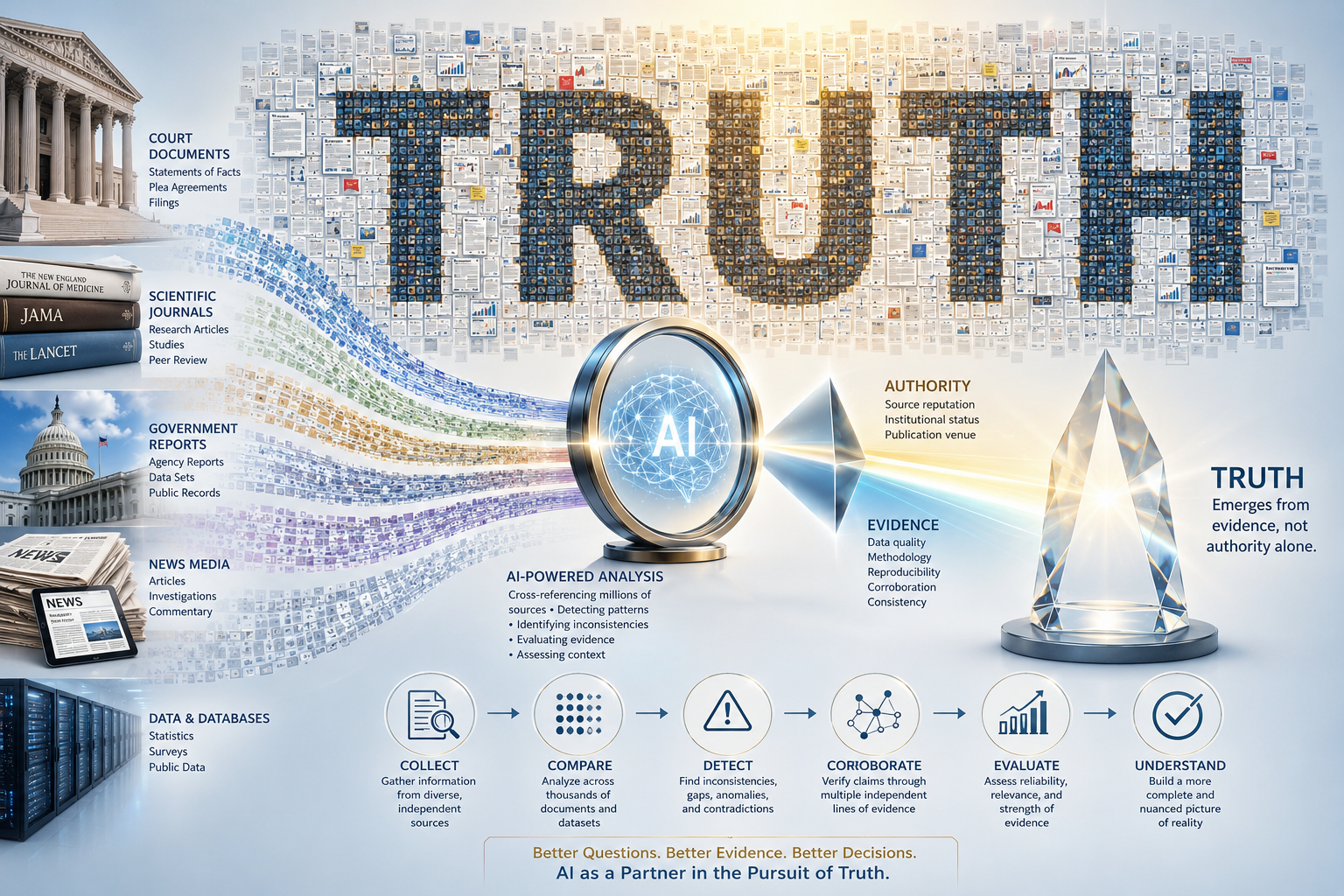
Much of the public conversation surrounding artificial intelligence has focused on the possibility that machines may one day become autonomous, capable of making consequential decisions without meaningful human oversight. Policymakers worry about AI systems replacing workers, influencing elections, manipulating financial markets, or exercising forms of power that exceed our ability to control them. These concerns are legitimate and deserve serious attention. Yet the more immediate challenge posed by artificial intelligence may be considerably less dramatic and considerably more difficult to recognize because it concerns not what AI does independently, but how AI determines what is “true.”
The assumption underlying many discussions about artificial intelligence is that the greatest threat arises when a system generates information that is entirely false. We call these errors hallucinations. Researchers devote enormous resources to reducing them. Technology companies routinely warn users that AI-generated content may be inaccurate and should be independently verified. Entire industries have emerged around evaluating the reliability of machine-generated information. The implication is that the primary challenge facing artificial intelligence is preventing systems from inventing facts that do not exist.
That concern, while understandable, may overlook a subtler and potentially more consequential problem. The greatest risk may not just be that artificial intelligence invents information.
The greater risk may be that it faithfully reproduces information from sources that society has incorrectly assumed to represent objective truth.
Artificial intelligence systems do not independently investigate reality. They do not interview witnesses, conduct cross-examinations, evaluate competing motives, or assess the credibility of competing narratives in the manner that humans imagine.
Instead, they rely heavily upon signals of authority and statistical probability. Information originating from government agencies, courts, universities, major news organizations, regulatory bodies, and other institutional sources is naturally assigned greater weight than information appearing on personal websites, social media platforms, or anonymous forums. From a technical perspective, this approach is entirely rational because some mechanism must exist to distinguish credible sources from unreliable ones.
The problem is that authority and truth are not identical concepts.
Read more by Potarazu: Can Ozempic now also cure our addiction to AI and Social Media ? (June 7, 2026)
A source may be authoritative without being complete. A source may be credible without being objective. A source may contain facts while simultaneously presenting only a portion of a much larger reality. Yet artificial intelligence systems are increasingly being trained to treat authority as a proxy for truth because authority is measurable while truth often is not.
The implications of this distinction extend far beyond technology and become particularly visible when one examines how legal information enters the public domain.
Consider the example of a Statement of Facts filed in connection with a legal proceeding. Most people encountering such a document assume they are reading an objective account of what occurred. Journalists quote it as fact. Employers rely upon it when evaluating applicants. Members of the public read it and frequently assume they are seeing a complete historical record.
Increasingly, artificial intelligence systems searching for reliable information may identify it as one of the most authoritative sources available because it originates from a court proceeding and bears the imprimatur of governmental authority.
Yet a Statement of Facts is not a historical document in the way many people assume.
It is a legal document created within an adversarial process. Its purpose is not to provide a comprehensive account of every relevant event, every competing interpretation, every mitigating circumstance, or every factual dispute that may exist within a case. Its purpose is to establish a sufficient factual basis to support a legal resolution. By design, it presents a narrative that satisfies a legal objective rather than a scholarly objective.
Prosecutors may be performing their role within an adversarial framework. Defense attorneys are performing theirs. The resulting document may accurately describe some conduct sufficient to support a conviction while simultaneously omitting facts, context, motivations, alternative interpretations, or evidentiary disputes that would be relevant to a broader understanding of what occurred. In other words, the document may be legally sufficient without being a complete representation of reality.
The challenge extends well beyond the legal system. Academic medicine and scientific research provide equally instructive examples of how institutional authority can be mistaken for objective truth. Throughout the past several decades, highly respected journals have published studies that were later retracted because the underlying data proved to be inaccurate, manipulated, or entirely fabricated.
Read more by Potarazu: Anthropic wants to hit the brakes while stepping on the accelerator (June 6, 2026)
In some cases, these papers influenced clinical practice, shaped public policy, generated extensive media coverage, and were cited thousands of times before the problems were discovered. At the time of publication, the articles possessed every marker of credibility that both humans and artificial intelligence systems are trained to recognize. They appeared in prestigious journals, underwent peer review, and carried the endorsement of respected institutions. Yet the authority of the source did not guarantee the accuracy of the information.
The lesson is not that scientific journals are untrustworthy, just as the lesson is not that courts are untrustworthy. Rather, it is that institutional credibility and factual accuracy are related but distinct concepts. A source may deserve respect while still being subject to error, bias, incomplete information, or even outright fraud.
At precisely the moment society has become deeply concerned about AI hallucinations, we continue to treat certain categories of human-generated narratives as though they are incapable of containing omissions, assumptions, interpretive judgments, or institutional biases. We scrutinize every sentence generated by a machine while often accepting official documents, published studies, and institutional reports as unquestioned truth simply because they originate from sources that carry authority. And importantly this is very different from “fake news” where the source may be biased.
The challenge for artificial intelligence therefore extends beyond preventing hallucinations. The larger challenge involves teaching machines—and perhaps teaching ourselves—that truth is rarely determined solely by the authority of the source presenting it. If future AI systems are trained to regard government documents, court filings, scientific publications, regulatory reports, and other official records as the highest expressions of factual reality, then they may become extraordinarily effective at reproducing institutional narratives without ever recognizing the limitations inherent within those narratives.
READ: 3 Reasons why AI solved a math problem humans could not for 80 years (May 31, 2026)
Ironically, the long-term solution to this problem may come from the very technology that exposes it. Human beings lack the capacity to independently verify every claim contained within scientific publications, regulatory filings, court documents, government reports, news articles, and the countless other sources that shape public understanding. The volume of information is simply too large and the time required too great. As a result, we rely on proxies such as institutional reputation, peer review, official status, and professional credentials as substitutes for direct verification.
Artificial intelligence presents the possibility of a different approach. Rather than merely ranking information based upon the perceived authority of its source, future systems may be capable of comparing claims across millions of documents, identifying inconsistencies between datasets, tracing citations back to original evidence, detecting statistical anomalies, uncovering contradictions among sources, and flagging assertions that cannot be independently corroborated.
A system capable of reviewing every underlying dataset associated with a scientific paper, comparing conclusions against hundreds of related studies, identifying discrepancies in statistical methods, and detecting patterns that would be invisible to individual reviewers could potentially expose weaknesses long before flawed findings become accepted wisdom. Similarly, an AI system capable of analyzing large volumes of legal records, testimony, communications, and documentary evidence could identify inconsistencies that no individual investigator, attorney, journalist, or researcher would have sufficient time to uncover.
The future value of artificial intelligence may therefore lie not in replacing human judgment but in augmenting it. The most important AI systems will not be those that simply tell us what the most authoritative source says. They will be the systems that help us determine whether the authoritative source is supported by the available evidence. The future challenge is not simply preventing AI hallucinations. It is ensuring that artificial intelligence does not become an amplifier of institutional assumptions.
If artificial intelligence can help society perform that scrutiny at a scale beyond human capability, then its greatest contribution may not be generating knowledge at all. It may be helping us verify it.