



This Father’s Day arrives at a remarkable moment in history. For the first time, a generation of fathers is raising children in a world increasingly shaped by artificial intelligence. Yet most of us were raised by men who never encountered AI, algorithms, chatbots, or machine learning. They taught lessons about hard work, honesty, resilience, responsibility, and character. Those lessons remain just as important today, even as the world around us changes at a breathtaking pace.
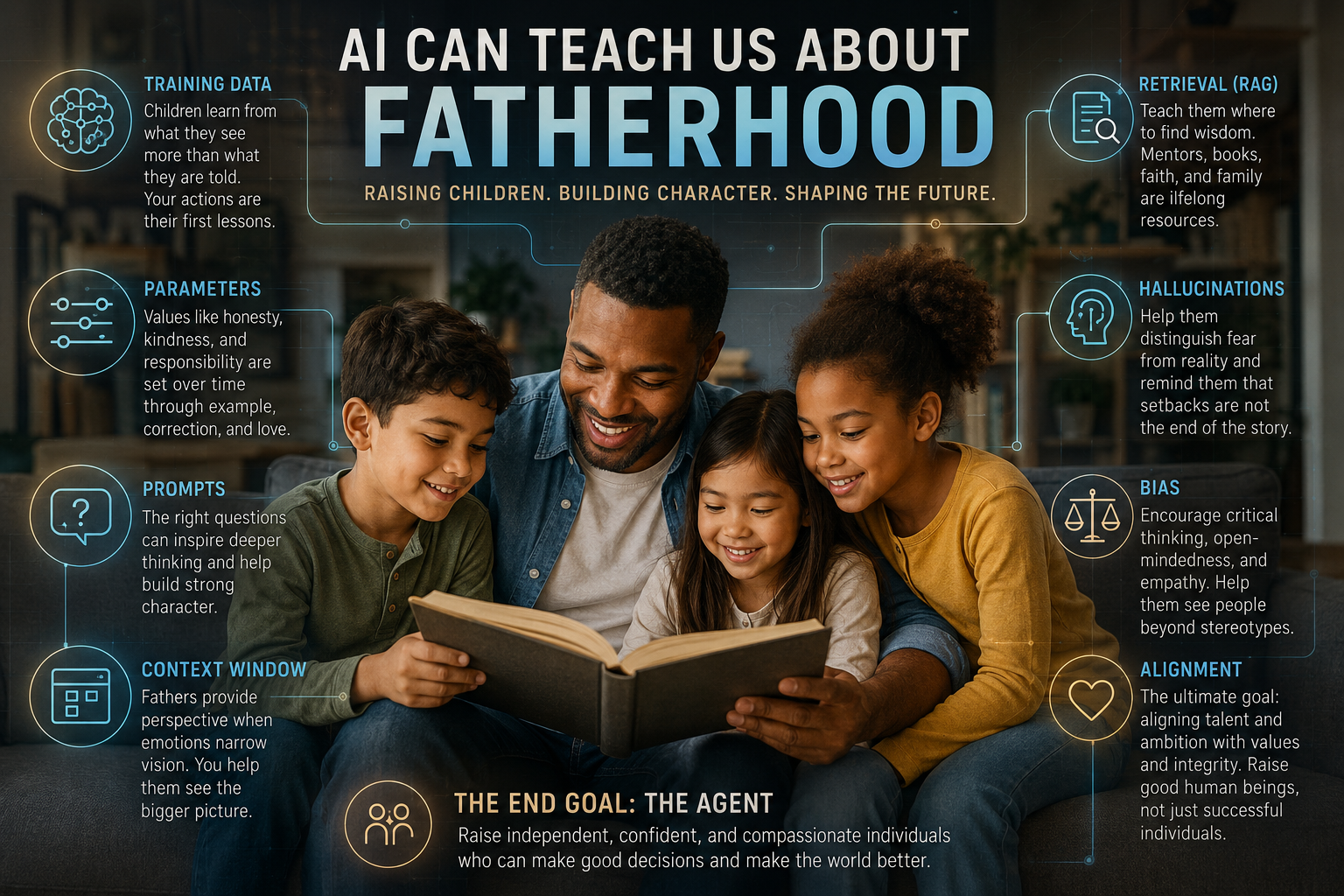
What is striking about AI is how often its language and terms mirror the work of fatherhood. The terminology may be new, but many of the underlying concepts are surprisingly familiar. In fact, some of the most important ideas in AI offer a useful framework for understanding what fathers have been doing for generations.
AI is designed to learn from experience and improve over time. At its core, that is also what every parent hopes for a child. The goal has never been perfection. Children will make mistakes. They will encounter setbacks and disappointments. The real measure of success is whether they develop the ability to learn from mistakes , adapt, and evolve .
READ: Sreedhar Potarazu | The ambient AI scribe illusion: Doctors need to pay attention (June 19, 2026)
One of the most powerful forms of AI today is the Large Language Model. These systems are trained on vast amounts of information that shape how they respond to the world. Children also absorb enormous amounts of information from their surroundings. Their training data is not found in books or computers. It comes from everyday life and how our own conduct as fathers.
They watch how adults treat strangers. They notice how parents respond when things go wrong. They observe how conflict is handled, how promises are kept, and how people react under pressure. Long before children fully understand lectures about values, they are studying behavior. The most influential lessons are often not spoken at all. They are observed .
AI systems are also guided by internal parameters, countless settings that influence how information is processed and decisions are made. Fatherhood involves something similar. Over time, fathers help shape the values and habits that become a child’s internal compass.
READ: Sreedhar Potarazu | The AI truth problem: When authoritative sources are mistaken for objective reality (June 11, 2026)
Honesty, responsibility ,compassion , empathy, kindness all become a parameter. These qualities are not developed through a single conversation. They are reinforced through years of encouragement, correction, accountability, and nurture. Eventually, they become part of how a young person interprets the world and responds to challenges and it starts even before thye can speak .
Anyone who uses AI quickly learns the importance of a prompt. The quality of the response often depends on the quality of the question being asked. Fathers understand this instinctively.
Some of the most meaningful guidance comes not from providing answers but from asking thoughtful questions. What is the right thing to do? What kind of person do you want to become? How would you feel if someone treated you that way? Questions encourage reflection. They help children develop judgment rather than simply follow instructions. Long after specific advice is forgotten, the ability to ask good questions remains. And importantly that it is ok to question.
Another important concept in AI is the context window, the information a system can consider when making a decision. Young people naturally have smaller context windows because they have fewer life experiences to draw upon.
A teenager facing rejection may believe the disappointment will last forever. A young adult who loses a job may view the setback as a permanent failure. Fathers often serve as expanded context windows. They provide perspective when emotions narrow vision. They remind children that today’s challenge is only one chapter in a much larger story and that difficult moments often become valuable lessons in hindsight. Importantly how we respond to success and adversity is what becomes their context.
Artificial intelligence also relies increasingly on Retrieval-Augmented Generation, or RAG, a process that allows systems to access trusted information beyond what they already know. The best fathers teach a similar skill.
No parent can anticipate every challenge a child will face. The world changes too quickly for that. What fathers can do is teach where to turn for guidance. Trusted mentors, teachers, books, faith, family, and lifelong friends become sources of wisdom when answers are not immediately available. One of the greatest gifts a father can provide is not knowledge itself, but the ability to seek knowledge from reliable sources.
Of course, artificial intelligence is not perfect. One of its most well-known flaws is something called hallucination, when a system confidently produces an answer that is completely wrong.
READ: Sreedhar Potarazu | 3 Reasons why AI solved a math problem humans could not for 80 years (May 31, 2026)
Human beings experience their own version of hallucinations. Children sometimes convince themselves they are failures because of a poor grade, a rejection, or a mistake. They may believe they are not talented enough, smart enough, or worthy enough. One of the most important responsibilities of a father is helping children distinguish between temporary setbacks and permanent truths. Confidence often grows when someone trusted helps separate reality from fear.
AI systems can also develop bias when they are trained on incomplete or distorted information. Human beings are vulnerable to the same problem. Children absorb messages from peers, social media, culture, and personal experiences. Some of those messages are valuable. Others are misleading.
Fathers play an important role in teaching critical thinking. They encourage children to question assumptions, examine evidence, remain curious, and understand perspectives different from their own. In a world overflowing with information, the ability to think independently may be more valuable than ever.
Perhaps the most important concept in artificial intelligence is alignment. Researchers use the term to describe the challenge of ensuring that increasingly powerful systems remain guided by human values.
Fatherhood has always been an exercise in alignment.
Every father hopes to align intelligence with wisdom, ambition with compassion, success with humility, and freedom with responsibility. Raising capable children is important, but raising good human beings is even more important. Character remains the foundation upon which every other achievement rests.
As society enters an era defined by extraordinary technological change, the vocabulary may be evolving, but the mission of fatherhood remains remarkably consistent. Fathers are still providing context, shaping values, asking important questions, correcting misconceptions, challenging biases, and guiding the development of character.
The future may be powered by artificial intelligence, but it will still depend on human wisdom. And for generations, some of that wisdom has come from fathers who understood a simple truth long before anyone invented AI: technology can shape what people know, but character shapes who they become.
Editor’s note: This piece has been updated.