



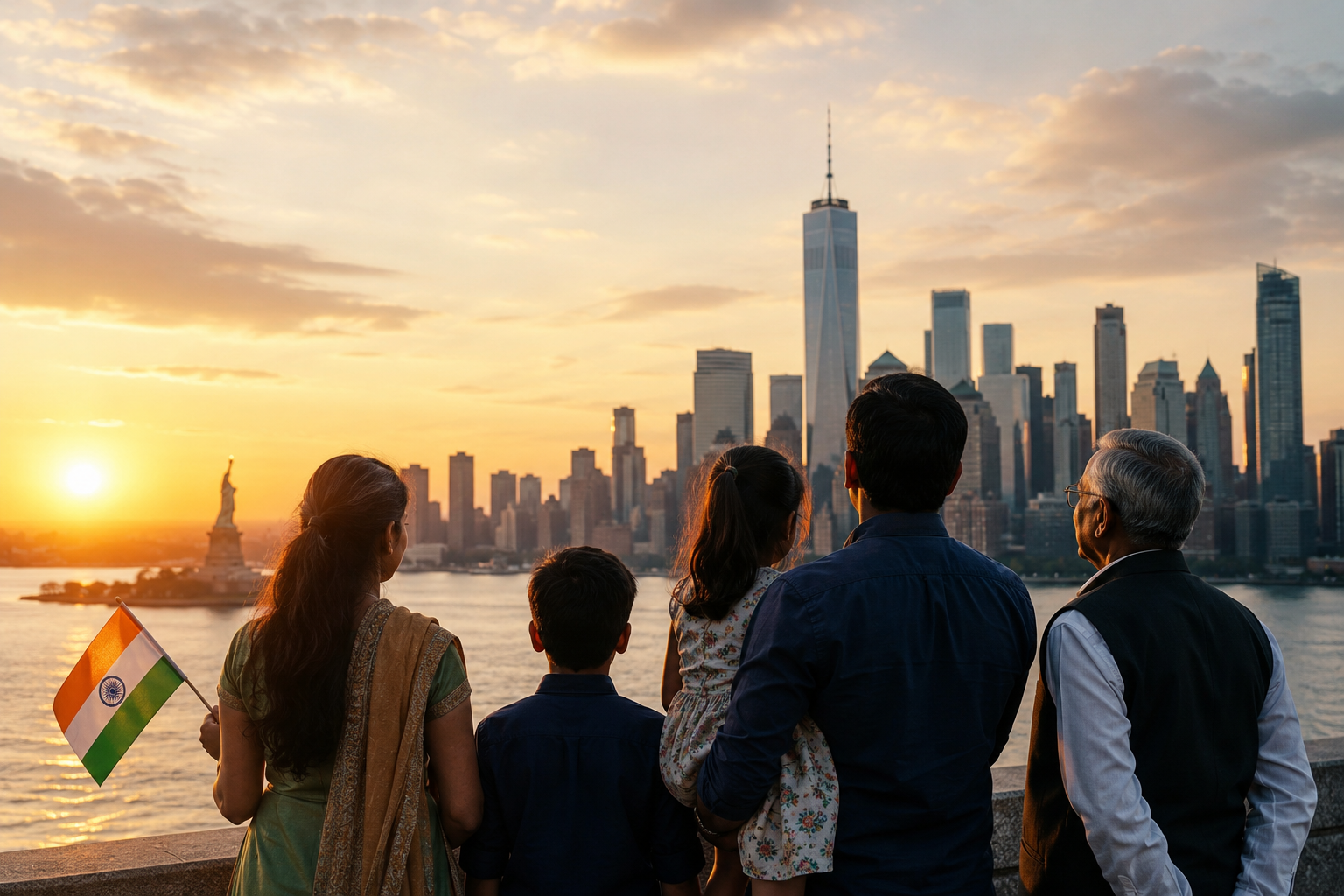
An elder I have known for decades, a man who crossed the Pacific in the early 1970s with a graduate fellowship and ambitions larger than his luggage, said something recently that I have not been able to forget. The word diaspora, he told me, once felt accurate. It carried the ache of distance, the dignity of exile, the possibility of return. It suggested a people living elsewhere but belonging, in some final sense, to another shore.
Now the word stings.
He is not going back. His children were born here. His grandchildren will know India first through stories, food, names, gods, weddings, and summer journeys; but the country that will educate them, tax them, summon them to jury duty, disappoint them, employ them, and bury them is America. He did not say this with betrayal in his voice. He said it with the calm of a man who had finally given language permission to catch up with life.
He is not a sojourner. He is not a guest. He is home.
More than five million Americans of Indian origin have reached some version of that same truth. They have arrived not merely as a community of professionals, but as a settled civic presence. They run companies, teach in universities, staff hospitals, build laboratories, write software, manage capital, argue cases, contest elections, and raise children whose Americanness is not provisional. Two Indian Americans have sought the presidency. One has served as vice president. Their names are no longer surprising in boardrooms, newsrooms, classrooms, courtrooms, and statehouses.
READ: Satish Jha | A Trojan horse in the laboratories: The provincialization of Indian science (
By the familiar measures of immigrant achievement, the first act has been completed.
But prosperity is not the same as belonging. Visibility is not the same as acceptance. Representation is not the same as settlement. Every immigrant community discovers, sooner or later, that the harder test begins after success.
America is generous in myth and anxious in practice. It invites talent, celebrates ascent, and then becomes uneasy when the invited begin to alter the visible composition of power. This is not new. The Irish, Italians, Jews, Chinese, Japanese, Catholics, and many others learned that the terms of American welcome are constantly renegotiated. A community may be praised for its discipline and resented for its advancement in the same breath. It may be asked to assimilate and then told that its assimilation has made it too competitive. It may be admired as exemplary until the example begins to feel like a threat.
Indian Americans are entering that zone of historical ambiguity. Their success is now large enough to be admired and resented at once. In a society troubled by stagnant wages, declining trust, educational sorting, technological displacement, and the erosion of old middle-class certainties, a high-achieving immigrant group becomes easy to misread. It did not create the anxiety. But it can become its face.
When Indian names appear at the top of spelling bees, medical residencies, technology companies, university departments, congressional ballots, and corporate succession lists, some Americans experience this not as national enrichment but as displacement. The perception is wrong, but not mysterious. People who feel history moving against them often search for human agents. They rarely blame abstract systems. They blame those who seem to have benefited from them.
This is the old danger of visible excellence. The overseas Chinese in Southeast Asia, Lebanese traders in West Africa, Jews in Europe, Indians in East Africa under the British, and countless other commercially or educationally successful minorities discovered that contribution does not protect a community from suspicion. Sometimes it produces the suspicion. A minority may help build the house and still be accused of owning too many rooms.
Indian Americans must therefore learn a civic discipline that their material success did not require: the discipline of becoming legible as fellow citizens, not merely as exceptional achievers. This is a subtler task than wealth accumulation. It cannot be solved by another CEO appointment, another Nobel Prize, another university presidency, another campaign donation. It requires participation in the shared life of a country beyond the corridors where merit is measured. It requires school boards, town meetings, public service, neighborhood trust, cultural humility, and the slow habit of showing up when no prestige is attached to showing up.
But the mirror must be turned inward as well.
Read: Satish Jha | The equilibrium doctrine: India’s grand strategy in the US-Iran-Israel triangle (June 20, 2026)
For a generation, Indian American institutions performed an essential immigrant function. Temples, language schools, professional associations, alumni networks, cultural festivals, and community media gave order to displacement. They preserved memory. They softened loneliness. They allowed parents to transmit something more enduring than career ambition to children growing up in a different civilizational weather. At their best, these institutions resembled the Irish parish, the Jewish community center, the Greek church, the Chinese association, the Black church, the Italian mutual-aid society: shelters of continuity in the bewilderment of arrival.
There is nobility in this work. No serious account of assimilation should confuse belonging with amnesia. America has never been strongest when it demanded the erasure of origins. It has been strongest when older inheritances were brought into a common civic frame and made answerable to democratic life.
The question, then, is not whether Indian Americans should remain attached to India. Of course they should. Love does not obey immigration law. Family, language, memory, grief, obligation, and gratitude travel across borders long after passports change. It would be absurd, even cruel, to ask immigrants to sever the emotional country from which they came.
The question is what kind of attachment survives permanent settlement.
There is a difference between cultural memory and political extension. There is a difference between reverence for a civilization and obedience to a state. There is a difference between practicing Hinduism in America and importing the political battles of India into American civic life. That difference is now becoming urgent.
A visible and organized minority within the Indian American community has invested heavily in the ideology known as Hindutva. This is not merely devotional Hindu life, nor the ordinary pride of an immigrant group seeking dignity in a new country. Hindutva is a modern political project, rooted in claims about nationhood, religious identity, historical grievance, and majoritarian power. Its American expression operates through fundraising, lobbying, school-board interventions, cultural campaigns, and the cultivation of political legitimacy.
The distinction must be made carefully. The overwhelming majority of Indian Americans are not ideological soldiers. Most Hindus in America practice a faith of household devotion, ritual continuity, philosophical pluralism, family obligation, and seasonal celebration. Their Hinduism is not reducible to any political movement. To conflate a civilization, a religion, and a political ideology is both intellectually lazy and morally dangerous.
Read: Satish Jha | The myth of the statistical exception: Dismantling India’s factory of unrealized potential (June 1, 2026)
Yet it is equally dangerous to pretend that organization does not matter. In public life, organized minorities often shape outcomes more effectively than silent majorities. A small number of disciplined institutions can define a community’s external image, influence curricula, pressure politicians, intimidate critics, and move money across causes with consequences far beyond their numerical size.
This is where the Indian American story meets a larger American problem. The United States has always permitted diasporic politics. Irish Americans cared about Ireland. Jewish Americans cared about Israel. Cuban Americans shaped policy toward Cuba. Armenian Americans, Greek Americans, Ukrainian Americans, and many others have carried ancestral causes into American public life. Such advocacy is not inherently illegitimate. It is often morally necessary. A democratic society must leave room for memory, loyalty, and transnational concern.
But it must also ask a limiting question: when does advocacy for an ancestral homeland begin to distort citizenship in the adopted one?
That question cannot be answered by suspicion alone. Immigrants should not be asked to prove loyalty more aggressively than anyone else. The old American habit of demanding patriotic excess from newcomers has often been ugly. But neither should immigrant success become a shield against scrutiny. Citizenship is not a certificate of innocence. It is a discipline of responsibility.
For Indian Americans, the responsibility is double. They must resist the scapegoating that turns achievement into evidence of foreignness. But they must also resist the temptation to use American power, American money, and American legitimacy to deepen illiberal tendencies elsewhere. A community cannot ask to be protected by liberal democracy in America while financing contempt for liberal democracy in India. It cannot demand pluralism for itself and excuse majoritarianism for others. It cannot denounce racism here and indulge civilizational supremacy there.
This is not an argument for silence about India. It is an argument for moral consistency.
Read: Satish Jha | The widening gap: Legitimacy, epistemic chaos, and the next civilization (June 4, 2026)
A settled Indian American citizen may criticize American failures and Indian failures with equal seriousness. He may love India without serving any Indian government. He may celebrate Hindu civilization without surrendering judgment to those who weaponize it. He may defend India’s security without endorsing the persecution of minorities. He may take pride in ancestry without making ancestry the basis of politics.
That is the mature form of belonging: not forgetting the first home, but refusing to let it override the obligations of the second.
The old hyphen — Indian-American — once carried the tenderness of transition. It allowed a generation to cross from one world to another without humiliation. But every hyphen eventually asks whether it is a bridge or a shelter. The children and grandchildren of the first arrivals will not live forever in their parents’ grammar. Their Americanness will be less defensive, less explanatory, less burdened by translation. They will not ask whether they belong. They will ask what belonging requires of them.
That is why this moment matters. Indian Americans have reached a stage where success alone is no longer an adequate communal philosophy. The next chapter cannot be built only on achievement, cultural pride, professional networks, temple construction, elite visibility, and nostalgia for a homeland transformed by memory. It must be built on civic imagination.
What would that imagination look like?
It would mean entering American public life not only as Indians with interests, but as Americans with responsibilities. It would mean caring about the opioid crisis in rural Ohio, the schools of Detroit, the housing crisis in Boston, the loneliness of elderly Americans, the dignity of Black life, the future of Latino children, the fate of public universities, and the repair of democratic trust — not because these issues affect Indian Americans directly, but because they define the country to which Indian Americans now belong.
It would mean understanding that America is not merely a platform for immigrant ascent. It is a shared and wounded republic. To settle here permanently is to inherit its wounds, not only its opportunities.
The elder who objected to the word diaspora had come to this realization without theory. He did not need a manifesto. He had lived long enough to know the difference between affection and allegiance. He still loved India. He still spoke its languages, remembered its monsoons, argued over its politics, and carried its dead within him. But his civic life had crossed the ocean and stayed.
He votes here. Pays taxes here. Worries here. Mourns here. Belongs here.
That is the permanent settlement.
Not the end of memory. Not the abandonment of ancestry. Not the thinning of culture into bland Americanness. But the final relocation of political responsibility.
The first generation came with luggage. The second built houses. The third will inherit a country. The question is whether Indian Americans will help repair that country as citizens, or merely succeed inside it as a community.
Arrival is over.
Belonging has begun.
1 Comment
The hypocrisy of this piece is staggering. It barks at Indian Americans practicing Hinduism, framing it as a dangerous “foreign import,” while conveniently ignoring that every other immigrant group does the exact same thing.
When Israeli Americans lobby for Israel or Muslim Americans organize around Middle Eastern and South Asian politics, it is called “morally necessary” diasporic advocacy. But when Hindus organize, the author panics and slaps a “sinister Hindutva” label on it.
Why are Jewish, Irish, or Ukrainian causes treated as legitimate expressions of American pluralism, while Hindu identity is singled out as a subversive threat to democracy? This isn’t objective analysis—it is textbook Hinduphobia disguised as civic responsibility.
What a pathetic, laughable and ridiculous joke indeed. Don’t you see your own hypocrisy?