



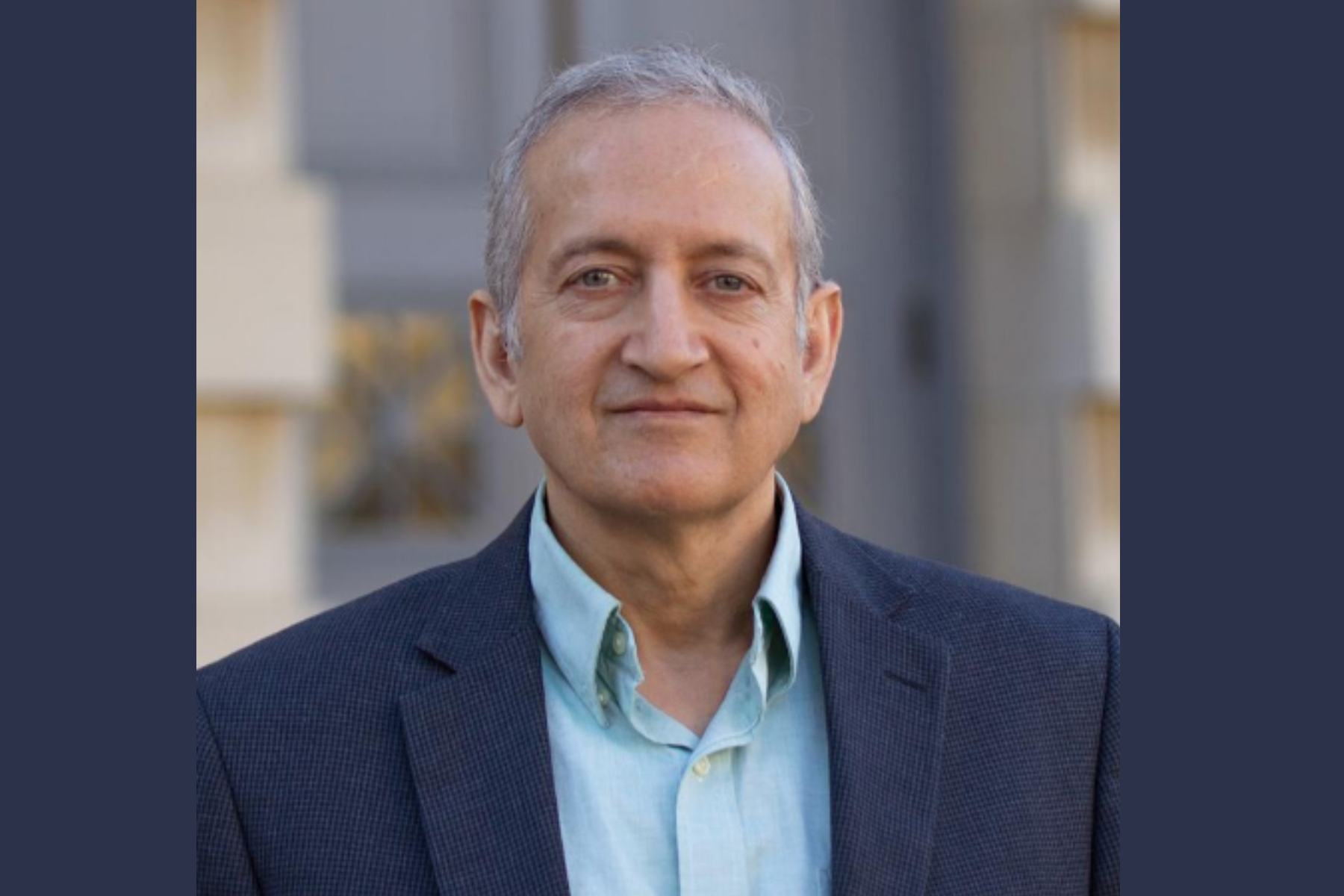
The Penn State Alumni Association has presented its 2026 Honorary Alumni Award to theoretical physicist Jainendra K. Jain and two others acknowledging their contributions to the university’s academic standing.
Jain was recognized at a ceremony on June 12 at the Hintz Family Alumni Center with Michele Kirsch and Ted McCourtney, who too don’t have Penn State degrees, but have significantly enhanced the institution’s global reputation.
Jain, an Evan Pugh University Professor and the Eberly Family Chair in Physics, has been a faculty member at Penn State since 1998. He also serves as the director of the Penn State Center for Theory of Emergent Quantum Matter.
Read: Penn State senior Joshua Mathew earns prestigious international student award
(April 2, 2026)
The university recognition comes shortly after Jain received the prestigious 2025 Wolf Prize in Physics, one of the highest scientific honors in the world, which he officially accepted at a state ceremony in Jerusalem on June 18, 2026.
His path to becoming a world-class theoretical physicist began under challenging circumstances. Born on Jan. 17, 1960, in Sambhar, a rural village on the eastern margin of the Thar Desert in Rajasthan, India, Jain completed his early schooling in a local government institution.
When he was 12 years old, a severe vehicle accident involving a tram in Kolkata claimed his mother’s life and left Jain with a permanent disability.
Returning home on crutches, his education and physics aspirations faced a highly uncertain future. His path forward was restored by the Jaipur Foot, a low-cost orthopedic prosthesis developed in Rajasthan by Dr. P. K. Sethi and master craftsman Ram Chandra Sharma.
The medical innovation enabled him to walk again, continue his schooling, and eventually travel to the United States on his first-ever flight in 1981 to pursue graduate studies.
Read: Indira Mysorekar named vice dean Penn State College of Medicine
(May 26, 2026)
Jain completed his foundational higher education entirely in India, earning a bachelor’s degree in physics from Maharaja College in Jaipur in 1979, followed by a master’s degree from the Indian Institute of Technology Kanpur in 1981.
He later earned his doctorate from Stony Brook University in New York in 1985 before completing postdoctoral appointments at the University of Maryland and Yale University.
Jain reshaped condensed matter physics by predicting a new class of exotic particles he named “composite fermions.” His breakthrough theory provided the definitive framework to explain the fractional quantum Hall effect, showing how electrons interact in low-dimensional materials under intense magnetic fields.
While deep-rooted at Penn State, Jain has expanded his scientific leadership back to his home country. He was recently appointed the founding director of the Lodha Theoretical Physics Institute in Mumbai, an institution backed by India’s philanthropic Lodha Foundation to foster top-tier quantum research ecosystems for young national scientists.