




As layoffs continue across corporate America, a new trend is emerging: workers pushed out of the U.S. are finding jobs in India but often at a fraction of their former salaries.
“The 2026 visa changes and $100k fee have made staying in the U.S. feel like a trap,” an H-1B professional living and working in the United States recently wrote on Blind, an anonymous professional networking and workplace community platform.
The post reflects growing anxiety among many foreign professionals employed in the U.S., particularly those on work visas, as they grapple with shifting immigration policies, corporate restructuring and a wave of layoffs.
Uncertainty surrounding the higher H-1B hiring fee, the rapid adoption of artificial intelligence, ongoing cost-cutting measures and broader economic pressures has prompted many companies to reduce their workforces.
Most recently, in June, JPMorgan Chase filed a WARN notice announcing plans to lay off 244 employees at its Plano, Texas, campus, citing a local realignment. Since the start of 2026, more than 40 companies have announced significant layoffs across the United States.
READ: Survey: Indian workers returning from the US face lower salaries and fewer jobs (July 8, 2026)
Amid concerns over higher visa costs and ongoing corporate restructuring, a new survey points to another emerging trend: workers leaving the United States are being rehired in India at significantly lower salaries. The report also suggests that while India’s expanding Global Capability Centers (GCCs) are expected to create more jobs, many professionals are not seeing those opportunities translate into stronger hiring.
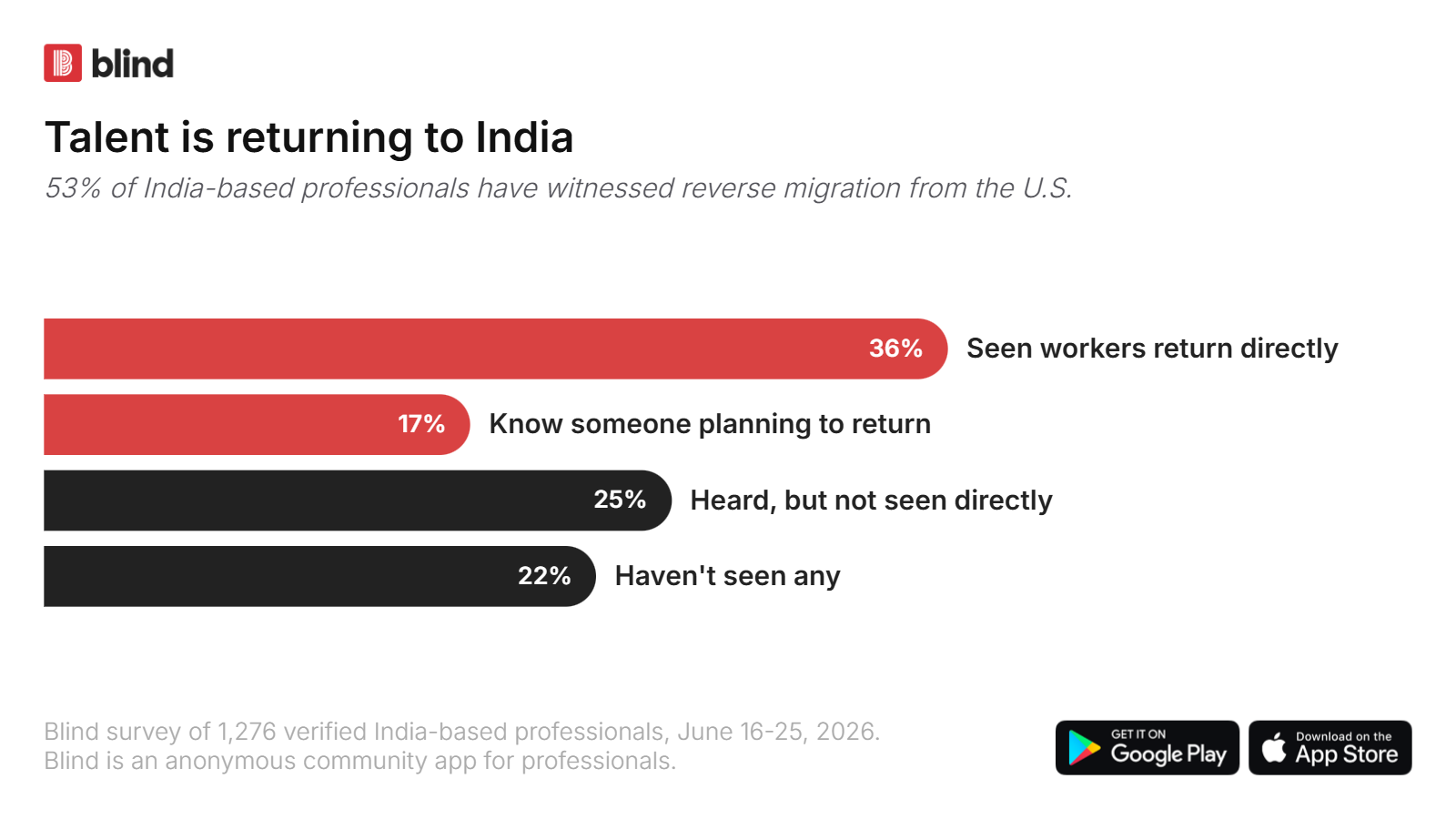
Among 1,276 verified professionals surveyed by Blind, an anonymous professional networking and workplace community platform, 53% said they had witnessed reverse migration to India. At the same time, only 26% said job openings had increased over the past year, while 51% reported that hiring opportunities had actually declined.
Some professionals who have returned to India say their experiences reflect the survey’s findings.
Swapnil Sagar, an Indian technology professional who spent a decade in the United States and worked at Microsoft, was among the roughly 10,000 employees laid off by the company in May 2025. Although he was not rehired through a Global Capability Center, he recently secured a position with a technology company in Bengaluru.
Reflecting on the employment landscape in India, Sagar told The American Bazaar, “The job market in India is better than in the U.S., but the challenge is getting a good paying job.”
Blind said more than 3 million verified professionals worldwide use the platform. It added that more than 90% of employees at companies including Meta, Uber, PayPal and Capital One, as well as more than 70% of Microsoft employees in India, are active users.
The report suggests that the primary beneficiaries of the shift are U.S. technology companies, which are rehiring former U.S.-based employees through their GCCs in India at lower compensation levels. One Google employee, speaking anonymously on Blind, said, “Average pay has gone down in the last 6 months. So, you might be looking at a 1/5th pay [of the US].”
For employers, the economics are compelling. Workers may accept lower salaries and benefits in exchange for relief from visa uncertainty, while companies reduce labor costs by shifting roles to India.
When asked about the salary gap between India and the United States, Sagar said, “As for MNCs paying less in India vs the U.S., I think it is understandable given the expenses are less in India.”
Another employee at a major technology company wrote anonymously on Blind: “Companies are basically using BLR/HYD offices as a ‘global restructuring’ fallback. The U.S.-return tag still gets you interviews in India, but recruiters play mind games with your salary expectations the moment they see you’re relocating. Is it actually easier to find a decent role back home now, or are we just trading visa stress for bad quality life, traffic, potholes and a 1/3rd pay cut?”
READ: After 11 years in America, Indian professional considers returning home amid layoff fears (June 17, 2026)
The survey findings appear to reflect what many professionals say they are experiencing. About 36% of respondents said colleagues or job candidates had already returned to India, while another 17% said they knew people planning to relocate. The trend was most pronounced at large consumer technology companies, with 57% of Amazon employees, 58% of Walmart employees and 55% of Uber employees reporting reverse migration. These companies are also among those expanding their India-based GCCs most aggressively, suggesting the shift is most visible where offshoring is accelerating.
The findings also point to a potential challenge for local job seekers in India, who were expected to benefit from the rapid expansion of Global Capability Centers. According to the report, many of those openings appear to be going to engineers returning from the United States rather than candidates already in India. The report suggests U.S. technology companies are increasingly filling GCC roles with experienced employees displaced from their U.S. operations, allowing them to retain talent at a lower cost.
As a result, the job market may appear to be expanding while becoming more competitive. Half of respondents (51%) said employment opportunities had declined over the past year despite continued GCC growth. The report concludes that while expansion is real, many professionals perceive the market as offering fewer opportunities amid a growing pool of qualified candidates.
Sagar offered advice for technology professionals looking for work in India. “In Bangalore, which can be called the SFO of India, job seekers especially in tech should look at start-ups and smaller companies as they might pay you better than big tech giants,” he said.