



For decades, humans have tried to teach machines how to think like us. But as artificial intelligence becomes increasingly powerful, perhaps the more important question is what humans can learn about themselves from machines.
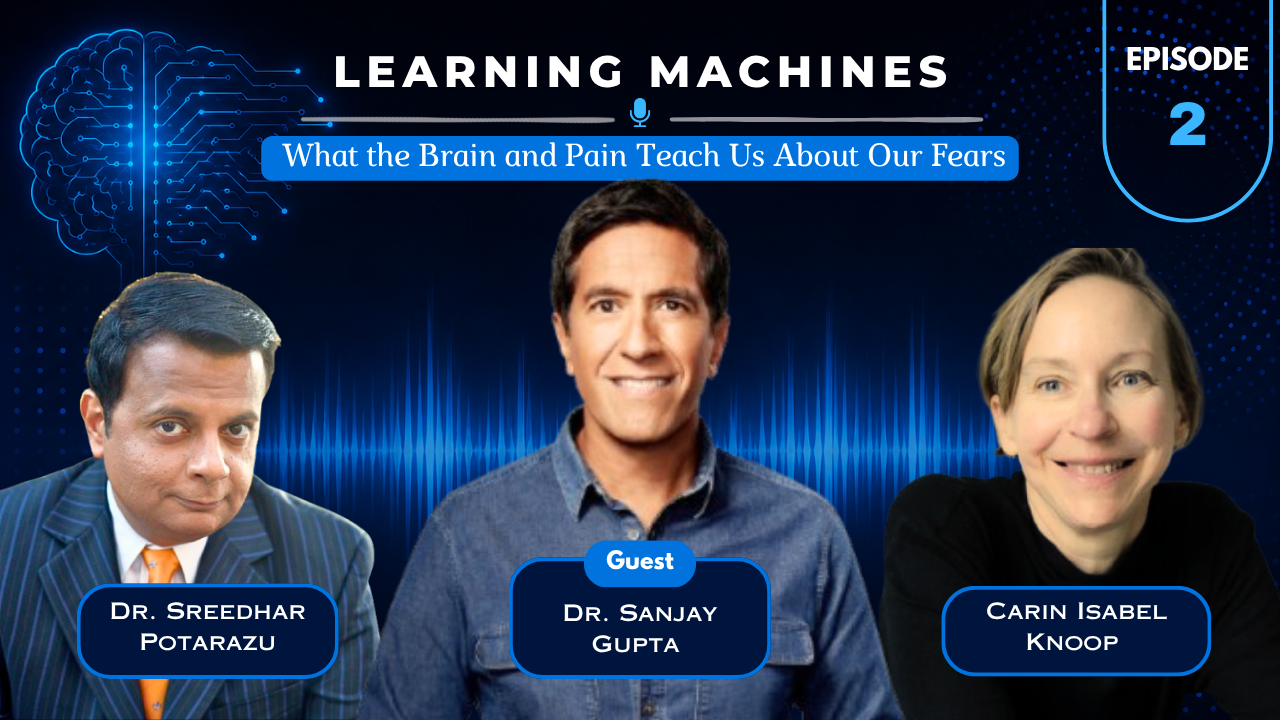
That question formed the backdrop of the second episode of the “Learning Machines” podcast, featuring Dr. Sanjay Gupta, the renowned neurosurgeon, Emmy Award-winning journalist, bestselling author, and one of the world’s most recognizable voices in medicine.
The episode, released today, is available on YouTube and Spotify.
Hosted by physician-entrepreneur Dr. Sreedhar Potarazu and Harvard Business School executive director Carin-Isabel Knoop, the conversation explored the connection between pain, fear, technology, resilience and the human brain.
“At Learning Machines, part of our exploration is understanding what we can learn from machines, all the while we’ve been trying to teach machines to be like humans,” Potarazu said while introducing Gupta. “But perhaps even before we try to understand what we can learn from machines, we need to take a deep look at what it means to understand ourselves.”
Gupta, whose latest book “It Doesn’t Have to Hurt” examines the science of pain, said his interest in the subject dates back to his training as a neurosurgeon.

For centuries, he explained, medicine treated the mind and body as separate systems — an idea influenced by philosopher René Descartes. Pain was traditionally understood as a simple signal traveling from an injured body part to the brain.
But modern neuroscience has shown a far more complex relationship. “What we’ve learned over the last 400 years is the idea that there is basically a gate-control mechanism to all of this,” Gupta said.
“These signals that are going to the brain are being informed by all sorts of things — your expectations, your previous experiences with pain.”
Even factors that seem unrelated, such as stress, emotional state, or a difficult conversation, can influence how people experience pain, he noted.
The brain, Gupta explained, does not merely receive pain signals; it interprets them.
“Pain is sensation plus emotion plus specific context,” he said. “It is the most widely shared human experience and yet probably one of the most misunderstood.”
To illustrate the point, Gupta recalled operating on two patients of similar age, health, and medical conditions who underwent nearly identical procedures for herniated discs.
One patient recovered quickly and was walking shortly after surgery. The other struggled with pain and required significantly more support. The difference, Gupta discovered, was not the surgery itself but other factors, including anxiety.
READ: Sreedhar Potarazu and Carin Isabel Knoop | Friction vs fiction: AI automators, validators, and cyborgs (May 22, 2026)
The example, he said, reinforced how closely physical experiences are connected to mental and emotional states.
Watch the podcast on YouTube:
Knoop raised the question of whether technology has amplified human suffering by exposing people to a constant flood of information, stress and anxiety.
Gupta said technology may contribute to what is known as the “nocebo effect” — the opposite of the placebo effect — where negative expectations themselves can produce harmful outcomes.
He said the same principle may apply to society’s relationship with artificial intelligence.
“If people come to believe deeply and repeatedly that a technology is going to make them obsolete, that belief does not sit passively,” Gupta said.
Fear of AI, he suggested, could prevent people from embracing tools that might actually help them.
“The cruelest feature of the nocebo effect is that it can manufacture the very harm that it was actually only predicting,” Gupta said.
Learning Machines Podcast: Watch the first episode with Vivienne Ming (May 22, 2026)
The conversation also explored why, despite spending trillions on healthcare, the United States continues to struggle with chronic illness and declining health outcomes compared with other developed nations.
Gupta pointed to multiple factors, including stress, lack of activity, diet, ultra-processed foods and widening economic inequality.
“We are one of the most stressed countries in the world,” he said.
He also reflected on how younger generations are growing up surrounded by unprecedented uncertainty — from wars and economic instability to climate change, pandemics and concerns over artificial intelligence.
“When I was a kid, I don’t think I once contemplated the end of the world,” Gupta said. “My kids have grown up in a world where they’re constantly barraged with that sort of information.”
A major theme of the discussion was resilience — especially how parents and leaders can help younger generations navigate discomfort and uncertainty.
Gupta said one of the greatest challenges for parents is finding the balance between giving children a comfortable life and allowing them to develop the ability to overcome adversity.
“The greatest gift that we can give them probably is their ability to be resilient,” he said.
He compared resilience to building a muscle: avoiding every challenge may provide short-term relief but could make people less prepared for future difficulties.
Toward the end of the conversation, Potarazu asked Gupta what three lessons people should teach their children about dealing with pain.
Gupta offered three ideas: recognize that pain exists in the brain, understand that expectations shape experiences, and learn to resolve rather than ignore difficult chapters from the past.
“The body will continue to keep the score,” he said, emphasizing the importance of addressing emotional as well as physical experiences.
As every episode of “Learning Machines” concludes, Potarazu asked Gupta the central question of the series: What is one thing humans should learn from machines?
Gupta’s answer was a vote of confidence in humanity.
“I’m placing all my bets on our human brains,” he said. “On us humans.”
In a conversation about machines, the final lesson was ultimately about people: that even in the age of artificial intelligence, understanding the human mind may remain the greatest frontier.
Listen to the full episode on Spotify: Learning Machines Podcast with Dr. Sanjay Gupta