



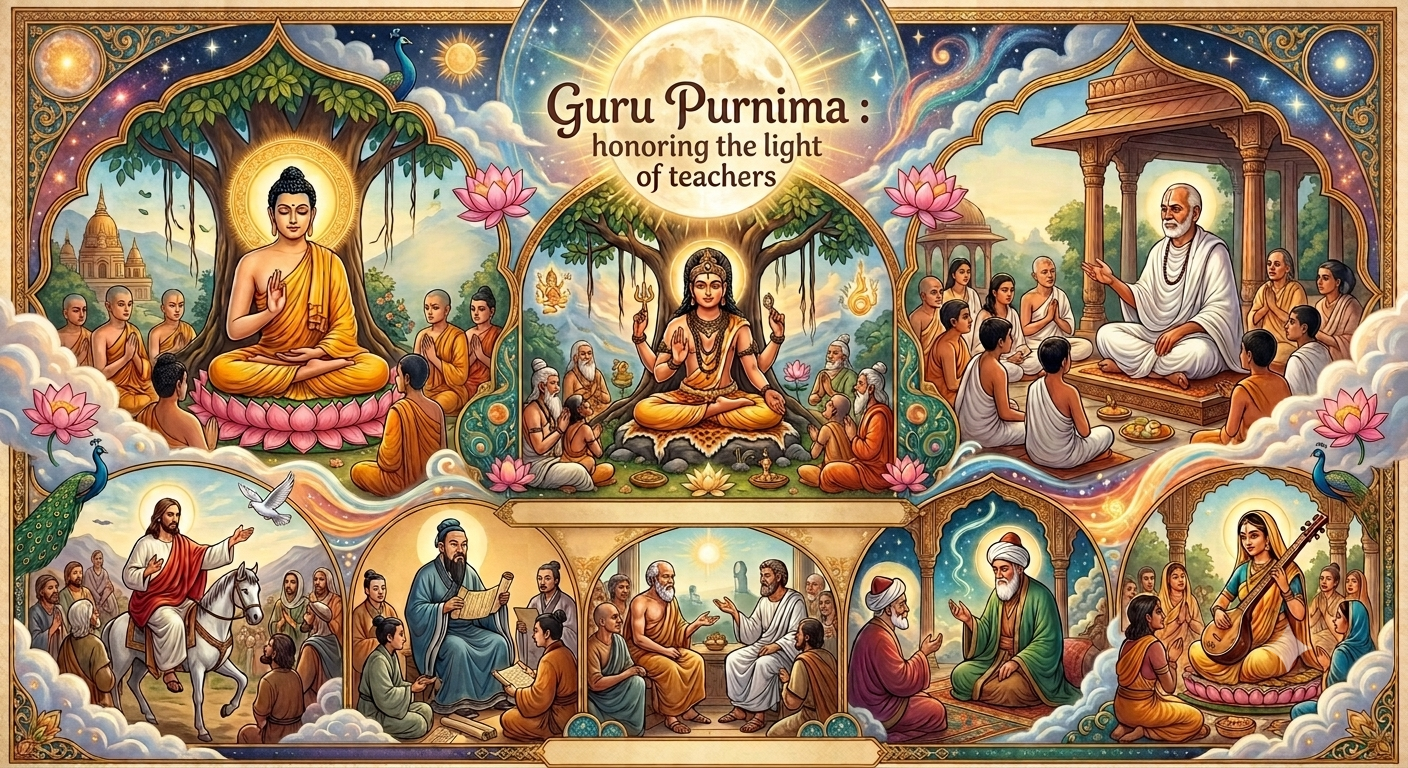
Today, millions of Hindus, Buddhists, and Jains around the world will celebrate Guru Purnima, a day dedicated to honoring the relationship between the teacher and the student. Although often viewed as a religious observance, its deeper significance extends beyond any one tradition. Guru Purnima represents one of humanity’s oldest ideas: that knowledge alone is insufficient unless it is transformed into wisdom, and that transformation often requires the guidance of another person.
The timing of Guru Purnima is itself significant. The festival is observed on the full moon, or Purnima, of the Hindu month of Ashadha, which occurs shortly after the summer solstice. Ancient Indian civilizations closely observed celestial cycles and connected them with human activity and spiritual reflection. The full moon represented completeness, illumination, and the ability to see clearly. The symbolism was not simply about the brightness of the moon but about the illumination of the human mind.
The word guru captures the essence of this relationship. In Sanskrit, gu means darkness and ru means the remover of darkness. A guru is therefore not simply someone who teaches facts or transfers information. A guru helps remove ignorance by guiding another person toward greater understanding, awareness, and wisdom.
This concept appears across Hinduism, Buddhism, and Jainism, although each tradition associates Guru Purnima with different historical figures and events.
For Hindus, Guru Purnima honors Sage Vyasa, one of the most important figures in Indian intellectual and spiritual history. Vyasa is credited with compiling the Vedas, authoring the Mahabharata, and preserving a vast body of knowledge that shaped generations of philosophical thought. His contribution was not only the creation of texts but the organization and transmission of knowledge so that future generations could learn from it.
READ: Sreedhar Potarazu | Would Indian students in America tolerate the MCAT exam being leaked? (July 26, 2026)
For Buddhists, Guru Purnima commemorates the Buddha’s first sermon at Sarnath after attaining enlightenment. The significance of that moment was that personal realization became a teaching that could benefit others. The Buddha did not keep enlightenment as an individual achievement; he transformed it into a path that others could follow.
For Jains, the day is associated with Gautama Swami, the first disciple of Lord Mahavira. This tradition highlights an equally important aspect of the guru relationship: great teachers require great students who are willing to listen, learn, and preserve the knowledge entrusted to them.
Across these traditions, one common theme emerges. Knowledge survives because it is passed from one generation to another through a relationship built on trust, discipline, and respect.
However, in modern times, the meaning of the word guru has become more complicated.
In India, it is common for accomplished artists, musicians, dancers, writers, and scholars to proudly state that they are disciples of a particular guru. The statement is one of respect and gratitude. It acknowledges the person who shaped their development and helped them reach a level they could not have achieved alone.
But there is another question that is rarely asked.
Would that guru recognize the individual as a true disciple?
The relationship between guru and disciple has always been based on mutual responsibility. The student offers humility, commitment, and a willingness to learn. The teacher accepts the responsibility of guiding the student’s intellectual, ethical, and personal growth. A guru is not created simply because someone claims the title of disciple. The relationship is earned through years of dedication, trust, and transformation.
The reverence a student shows toward a teacher is not expressed merely through words or public acknowledgment. It is demonstrated through actions over a sustained period of time. It is reflected in the discipline with which the student approaches learning, the respect shown for the teacher’s guidance, and the way the student carries forward the values and wisdom received from the teacher.
READ: Sreedhar Potarazu | AI is burning through free cash flow (July 25, 2026)
A true disciple does not simply claim association with a guru; the relationship is revealed through commitment, character, and conduct. The teacher’s influence becomes evident not in the number of times the student speaks the teacher’s name, but in how the student lives, learns, and contributes to the world. In this sense, the bond between guru and disciple is not based on recognition alone but on a lifelong process of growth and responsibility.
In Telugu, there is a powerful phrase: guru ki minchina shishya, meaning the disciple who has surpassed the guru. At first glance, this may appear to contradict the traditional reverence shown toward teachers. In reality, it represents one of the highest forms of respect a teacher can receive.
The purpose of a true guru is not to create followers who remain dependent forever. The purpose is to develop individuals who eventually think independently, contribute something new, and perhaps even accomplish more than their teacher. When a student surpasses the teacher, it is not a failure of the guru. It is the fulfillment of the guru’s purpose.
Perhaps no image captures this idea more profoundly than Dakshinamurthy, the form of Shiva regarded in Hindu philosophy as the Adi Guru, or the first teacher.
Dakshinamurthy is traditionally depicted sitting beneath a banyan tree surrounded by sages. Unlike conventional images of teachers who speak, lecture, and explain, Dakshinamurthy teaches through silence. His hand forms the Jnana Mudra, symbolizing the connection between individual consciousness and universal knowledge.
The guru does not simply provide answers. The guru helps awaken the ability to discover answers.
We live in an era where information is abundant and accessible. Artificial intelligence can summarize books, answer questions, and provide explanations within seconds. Digital platforms allow students anywhere in the world to learn from experts they may never meet. These advances represent one of the greatest expansions of human access to knowledge in history.
Yet access to information has not eliminated confusion, uncertainty, or the search for meaning.
The reason is that information and wisdom are not the same.
Information tells us what is known. Wisdom helps us understand what matters. Information can explain how something works. Wisdom helps us determine why it matters and how we should act.
This distinction is why teachers and mentors remain essential even in an age of advanced technology. A machine can provide information, but a mentor provides perspective. A machine can identify patterns, but a teacher helps develop judgment
The relevance of Dakshinamurthy’s teaching extends far beyond religious symbolism. The silent guru represents the idea that true learning involves transformation. The most influential teachers are not remembered only because of what they taught but because of how they changed the way their students viewed themselves and the world around them.
Perhaps the challenge for younger generations today is not a lack of access to teachers but a changing understanding of what a teacher represents. In a culture that increasingly values speed, visibility, and individual achievement, the patience and humility required in a true teacher-student relationship can sometimes be overlooked.
Every Guru Purnima, I find myself reflecting on the extraordinary individuals who shaped my life, not simply by what they taught me, but by who they were. My first encounter with the meaning of a guru came when I was fourteen years old in the presence of Swami Chinmayananda. At that age, I could not fully comprehend the depth of his teachings, but I sensed something that would only become clearer over the years: the quiet power of a person whose life itself becomes the lesson.
READ: Sreedhar Potarazu | Chatbots can Auto-Tune our minds and voice: The Maya of AI (July 21, 2026)
As I look back, I realize that I have been blessed with many gurus. My professors, many of whom were giants in medicine and science, taught me far more than anatomy, physiology, or ophthalmology. They demonstrated intellectual rigor, humility, compassion, and the relentless pursuit of excellence. Their greatest lessons were not found in textbooks but in the way they approached patients, colleagues, and life itself. Looking back, I recognize that they were teaching character as much as they were teaching science.
Among those who profoundly influenced me was Guru Vempati Chinna Satyam, one of the greatest exponents of Kuchipudi. Although I never learned dance under him, he accepted me with the affection of a son rather than the distance of a student. One of the greatest honors of my life was standing beside him during the installation of the statue of Siddhendra Yogi, the founding guru of Kuchipudi, in a temple in the very town where this classical dance tradition was born.
Above all, my first and most enduring gurus were my parents. They did not teach through lectures or philosophy, but through the quiet discipline of everyday life. They instilled virtues that no university could confer: integrity, compassion, humility, perseverance, respect for learning, and faith that one’s actions ultimately define one’s character. Whatever I have accomplished has been built upon the foundation they laid long before I understood its value.
On this Guru Purnima, I bow in reverence to each of them.
I do so with profound gratitude, but also with humility, recognizing that no student ever fully lives up to the ideals of those who shaped them.
Through my words or actions, I have sometimes fallen short of the standards they hoped I would uphold and I seek their forgiveness.
My prayer is that I may continue to align my life with the values they entrusted to me and, in whatever years remain, honor their teachings not merely through words, but through the choices I make and the life I lead.
In the timeless words of Saint Tyagaraja:
“Endarō Mahānubhāvulu Andariki Vandanamulu”
(There are countless great souls, and to every one of them, I offer my humble salutations.)