



When we read something that moves us, challenges us or teaches us something new, one of the first things we instinctively want to know is who wrote it. We look for the name on the cover of a book, beneath an article, at the bottom of a scientific paper or beside a work of art because we have come to believe that knowing the author tells us something important about the work itself. The author gives the work an identity, establishes ownership and, perhaps most importantly, gives us someone to credit when the work succeeds and someone to blame when it fails.
Artificial intelligence is beginning to disrupt that assumption, and the debate has largely focused on whether people are using AI to do work that they are supposed to do themselves. Ivy League universities are struggling to determine whether students are using AI to write essays and take examinations, while similar concerns are emerging in scientific publishing, journalism, law, software development, medicine and the workplace. The instinctive response has been to ask whether AI was used, as though the mere involvement of a machine determines whether the work is legitimate.
The publishing industry is already discovering the crisis of authorship .In July, a major book deal for debut novelist Jerry Falade collapsed after his agents withdrew his crime novel “Call Me, I’ll Hide the Body,” reportedly following a bidding process that had reached about $2 million, after they said they could no longer verify that the manuscript had been written entirely by Falade, although he has denied using generative AI.
The result is a strange new reality in which authors may increasingly have to prove not only that their work is original, but that they actually wrote it, forcing publishing to confront a question that lies at the heart of this article: if AI was used to research, edit, challenge an argument or improve prose, does that diminish the work, or should we instead ask whether the author’s ideas, experiences, judgment and voice remain at the center of it?
READ: Sreedhar Potarazu | Almost a third of America does not have a primary care doctor (August 16, 2026)
I am not convinced that is the right question. The more important question is whether the human being behind the work continues to exercise judgment, contribute meaning and accept responsibility for the final product.
What makes this question particularly interesting is that the crisis of authorship did not begin with artificial intelligence. We have been struggling with it for centuries.
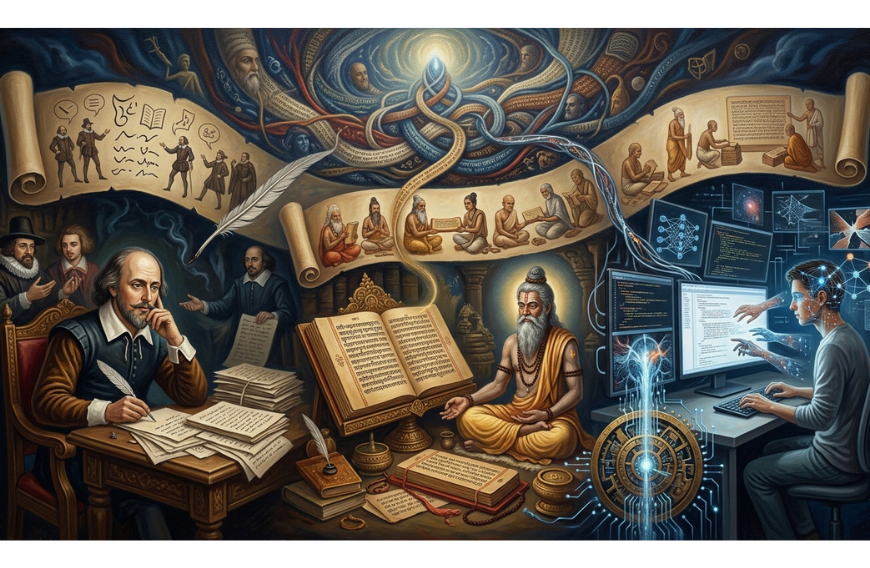
Consider William Shakespeare. We speak about Shakespeare as though the question of authorship is settled, yet scholars have spent generations examining whether he wrote every part of every play attributed to him. The more serious modern discussion is not necessarily about whether Shakespeare was secretly someone else, but about whether the idea of Shakespeare as a solitary genius is itself misleading.
There is substantial scholarly evidence that collaboration was common in the commercial theater of Shakespeare’s time, and the authorship of several plays remains contested. The Folger Shakespeare Library notes that at least half of the plays produced in the public theater of Shakespeare’s era are conservatively estimated to have involved collaboration, and scholars have long debated the contributions of other writers to works such as “Henry VI” and “Henry VIII.”
That should make us pause because we continue to call these works “Shakespeare’s plays” even when scholars cannot always determine precisely who wrote which portions.
The Vedas take this question even further. In the traditional Hindu understanding, the Vedas are apauruṣeya, meaning not of human authorship. They are understood as knowledge that was perceived or revealed to the ancient rishis, who transmitted what they had received rather than claiming authorship in the modern sense. Whether one approaches the Vedas through the lens of religious tradition or through the historical study of their oral transmission and development, the underlying concept is fundamentally different from our modern obsession with identifying an individual author.
We are comfortable saying that the Vedas are among the foundational texts of one of the world’s oldest civilizations without insisting that a single individual must receive credit for every word. The knowledge itself is considered more important than the identity of the person who transmitted it.
Why, then, are we so uncomfortable with the idea of authorless or collectively created knowledge when we encounter it today?
Perhaps because modern society has made authorship synonymous with ownership.
But human knowledge has never really been created by individuals alone. Language itself is collective. Science is cumulative. Every discovery depends upon discoveries that came before it.
Every writer inherits a vocabulary, a cultural history and an intellectual tradition that existed long before that writer put a sentence on a page.
The idea of the solitary author may therefore be more of a convenient fiction than an accurate description of how human knowledge actually develops.
Artificial intelligence is making that fiction increasingly difficult to maintain.
Generative AI has entered the territory we traditionally associate with human cognition. It can review scientific literature, generate computer code, summarize legal documents, analyze medical information, write essays and create images and music. It does not merely help us carry out an idea; it can participate in developing the idea itself.
That is where the boundaries become difficult.
READ: Sreedhar Potarazu | If AI gives professional advice, does it need a license? (August 9, 2026)
Imagine a student writing a research paper. If AI corrects grammar, improves sentence structure or identifies repetitive language, most people would consider that an advanced form of editing. If the student asks AI to challenge the argument, identify weaknesses and present the strongest counterargument, the technology may actually make the student’s thinking better. But if the student provides a vague prompt and allows AI to develop the argument, conduct the analysis, write the paper and generate the conclusions, it becomes much harder to argue that the resulting work represents the student’s independent thinking.
The problem is that there is no bright line between these two situations. They exist on a continuum, and that continuum is precisely what makes the current debate so uncomfortable.
AI can give us a better sentence, but it cannot necessarily give us a reason to believe the sentence. The distinction, therefore, is not simply whether AI was used. The distinction is whether AI is being used to replace the capability being evaluated or to enhance the capability that already exists.
Scientific publishing is already beginning to confront this distinction. Journals increasingly require authors to disclose the use of generative AI in manuscript preparation while maintaining that AI cannot be an author because it cannot accept responsibility for the work. The distinction is important because authorship has traditionally meant more than producing words. It means accepting responsibility for the accuracy, interpretation and consequences of what has been written.
But there is another problem that concerns me even more than the question of ownership.
It is the potential disappearance of individual voice.
AI can make our writing more polished, but it may also make our writing more similar. Millions of people can now ask the same systems to produce an essay, a speech, a business proposal or an opinion piece, and the result will often be grammatically sophisticated, logically organized and remarkably predictable. The danger is not that AI will make us unable to write. The danger is that it may make us less interested in developing a voice of our own.
That is why I think the Shakespeare question matters so much.
Suppose tomorrow we discovered definitive evidence that Shakespeare did not personally write every line attributed to him. Would “Hamlet” suddenly become less profound? Would “King Lear” become less tragic? Would the language lose its power? I doubt it.
We might revise the attribution, but the work would remain.
The same is true of the Vedas in a different sense. Their significance does not depend upon our ability to identify a modern-style individual author. The tradition itself rests on the idea that knowledge can be received, preserved and transmitted without belonging to a single person.
Perhaps these examples reveal something important about our current anxiety over AI.
We may be placing too much emphasis on who physically produced the words and too little emphasis on whether the work contains meaningful human judgment. That does not mean authorship is irrelevant. It means that authorship may need to be understood differently.
Credit and responsibility are not necessarily the same thing.
A person may deserve credit for an idea even if AI helped express it. A team may deserve credit for a scientific discovery. An editor may substantially shape a book. A producer may transform a musical performance. A software engineer may build upon thousands of lines of code written by others.
The more important question is who remains responsible for the final result.
This becomes particularly serious when AI moves beyond writing and begins making decisions.
Imagine an autonomous vehicle making a decision that results in a fatal accident. Imagine an AI healthcare system modifying a treatment recommendation based on continuously changing patient information and a patient being harmed as a result.
The machine cannot take responsibility. It cannot be imprisoned, pay damages, experience guilt or accept moral responsibility. Whatever autonomy we give an AI system, we have not yet created a moral agent in the human sense.
Responsibility therefore has to remain with people and institutions. The difficult question is determining which people and institutions.
That is where I believe the real crisis of authorship lies.
We may eventually enter a world in which the question of who typed the words becomes almost meaningless. The more important questions will be who conceived the idea, who exercised judgment, who verified the facts, who had the authority to approve the result, who benefited from the decision and who had the opportunity to prevent harm.
READ: Sreedhar Potarazu | Indians may be more connected. But are we connecting? (August 2, 2026)
In other words, we may have to redefine authorship around responsibility rather than production.
Perhaps Shakespeare offers us one lesson: a work can survive uncertainty about exactly who wrote every part of it. Perhaps the Vedas offer another: knowledge can be considered meaningful even when it is understood as transcending individual authorship. And perhaps AI is now forcing us to reconcile these ideas with a world in which machines can participate directly in the creation of human knowledge.
The value of human contribution may therefore shift from producing every piece of information manually to exercising judgment over information that machines can increasingly produce for us.
The crisis of authorship, therefore, may ultimately have very little to do with who wrote the words.
It is about who gave those words meaning, who decided that they were worth saying, who verified that they were true and who is willing to stand behind them when they are wrong.
For centuries, we have asked, “Who wrote this?”
In the age of artificial intelligence, perhaps we need to ask a more important question.
Who is willing to stand behind it?
Because when AI does the work, the person who deserves the most credit may not be the person who produced the most words.
It may be the person who is still willing to take the blame.