




If one were to look at modern immigration patterns in America, one would see that for decades, Chinese investors dominated the EB-5 immigrant investor program, while the H-1B, the temporary, employer-sponsored, nonimmigrant visa, had been the dominant domain of Indian professionals. But things might be changing in the immigration landscape. In the first quarter of fiscal year 2026, something remarkable happened — India surpassed China to become the largest source of EB-5 petition filings.
Data from IIUSA, the national nonprofit trade association for the EB-5 industry that represents stakeholders responsible for billions of dollars in foreign investment through the EB-5 Regional Center Program, revealed that 668 investors filed petitions during Q1 FY2026, surpassing China, which had 649 filings. India has now become the largest investor market in the first quarter of the new fiscal year.
The new milestone reflects how changing immigration policies are shifting the visa environment. The trend also reflects growing disposable income among Indians, particularly professionals on work visas in the U.S. And, according to experts, the major driving force behind this shift remains increasing demand for a faster, more secure path to permanent residency in the United States.
Industry experts say the surge is being driven largely by Indian H-1B and F-1 visa holders already in the U.S., many of whom are turning to EB-5 as a way to bypass lengthy employment-based green card backlogs and gain greater flexibility over their careers and futures.
READ: Thinking of an EB-5 Visa? Do not miss the crucial Sep 30 deadline (August 2, 2026)
In an exclusive interview, The American Bazaar spoke with Huimin Jenny Zhan, founder and CEO of Beyond International. With more than 20 years of experience in public markets, real estate and alternative investments, Zhan has managed more than $4 billion in assets. She talks about how Indian professionals in Silicon Valley can now more easily afford an investor visa and why the newly created EB-5 Reserved (Set-Aside) categories, which are backlog-free, offer a rare opportunity for backlogged communities.
The American Bazaar: For years, China dominated the EB-5 market. What factors have contributed to India overtaking China in new EB-5 filings in Q1 FY2026, and is this a temporary shift or the start of a longer-term trend?
Huimin Jenny Zhan: EB-5 filings by Indian nationals have overtaken Chinese filings in Q1 FY2026. This shift appears to be driven by three main factors: a tougher H-1B policy environment, India’s stronger GDP growth, and AI-fueled stock market gains that have increased wealth among Indian tech professionals in Silicon Valley.
Now allow me to unpack all this. Some may recall that in September 2025, the current U.S. administration imposed a $100,000 H-1B visa fee which was later struck down by a federal court in June of this year. Those 10 months caused a lot of anxiety for many Indians working under an H-1B visa and several of them took matters into their own hands by filing for an EB-5 visa. For further context, Indian and Chinese H-1B visa holders approval volume differs significantly, with Indian nationals capturing roughly 71% of all H-1B approvals compared to about 12% for Chinese nationals.
Moreover, Indian nationals experience much longer backlogs in almost every professional immigration category except EB5. Hence, another reason they are outpacing Chinese on new EB-5 filings. Second, India’s annual GDP growth over the past five years has consistently outpaced China’s, driven by strong domestic demand and a growing services sector. At the same time, China has faced structural slowdowns and real estate challenges that have been widely covered by the media. India’s high-net-worth population has also increased compared with China’s, and this wealth effect has allowed more Indian nationals to consider filing for an EB-5 visa.
Lastly, the recent AI led stock market boom has benefitted the stock option value of the tech company workforce. According to a report from Joint Venture Silicon Valley, 23% of the high-tech workforce in Silicon Valley is made up of Indian-born professional versus 18% China-born executives. Which again, translates to having a slightly larger number of Indian tech professionals that can afford filing for an EB-5 visa.
I believe this is likely the start of a longer-term trend that will continue as new regulations on Chinese exit and entry administration into the U.S. take effect on Sept. 15. This will reshape the future of the Chinese EB-5 applicant pool and will further restrain the pipeline of Chinese applications, which probably bodes well for Indian nationals.
The IIUSA data shows a significant increase in Indian investors choosing rural EB-5 projects. What is attracting Indian investors to these reserved categories, and what advantages do they see compared with traditional EB- 5 investments?
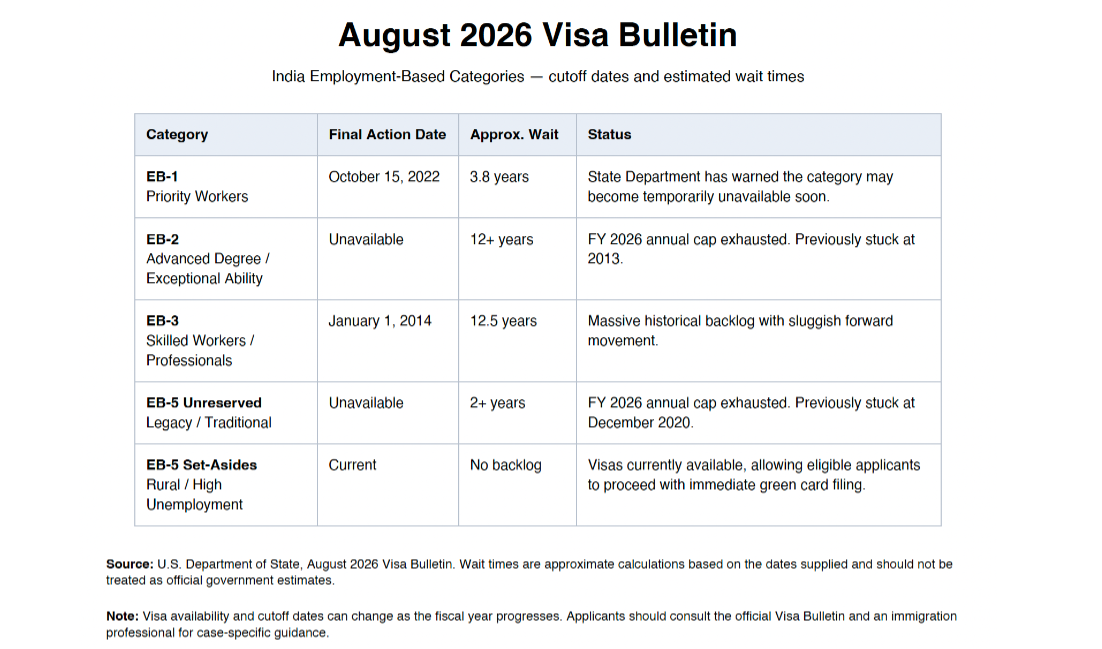
Indian nationals considering filing under the EB-5 visa program are dealing with a unique situation. A scenario I have come to call a “dual reality.” While the traditional (Unreserved) EB-5 category faces a severe backlog, the newly created EB-5 Reserved (Set-Aside) categories are backlog-free. When you compare the traditional employment-based categories (EB-1, EB-2, and EB-3), these are completely bound by chronological wait times spanning anywhere from nearly four years to well over a decade. That is not the case for the EB-5 Reserved or the Set-Aside category.
READ: Are Indian families turning to EB-5 for long-term security? (March 5, 2026)
Additionally, the biggest differentiator for H-1B or F-1 visa holders already in the U.S. is that EB-5 Set-Asides allow for concurrent filing (Form I-485). While an EB-2/EB-3 applicant must wait over a decade just to apply for their final adjustment of status, a new EB-5 Rural investor can file immediately and secure an unrestricted Work Permit (Employment Authorization Document) and
Travel Document in months. We have seen individuals who filed under the EB-5 rural category, receive an unrestricted work permit and travel document, often referred to as a “combo card,” within six months. This flexibility can be especially valuable for individuals who want to change jobs, start a business or raise capital—options that are generally not available under an H-1B visa.
For that reason, the EB-5 Reserved or Set-Aside category visa can be an attractive option for those seeking greater freedom and long-term stability in the United States.
Based on your experience working directly with Indian families, who is today’s typical Indian EB-5 investor? Has the profile evolved from ultra- high-net-worth individuals to include tech professionals, entrepreneurs, and families seeking education and long-term stability in the U.S.
Yes, it globally shifted from high-net-worth individuals to professionals or international students already in the U.S. Let’s take the case of an Indian tech professional in Silicon Valley, the combination of their salary, bonuses, restricted stock grants, self-directed IRA, and/or 401K balances, allow them to seriously consider filing for an EB-5 visa.
As demand from India continues to grow, do you foresee India eventually facing the kind of long-term EB-5 backlog that Chinese investors experienced, or does the reserved visa categories created under the Reform and Integrity Act change that equation?
In my view, the reserved visa category does change the equation. The rural category is growing in popularity because it receives twice as many visa numbers each year as the high-unemployment area (HUA) classification.