



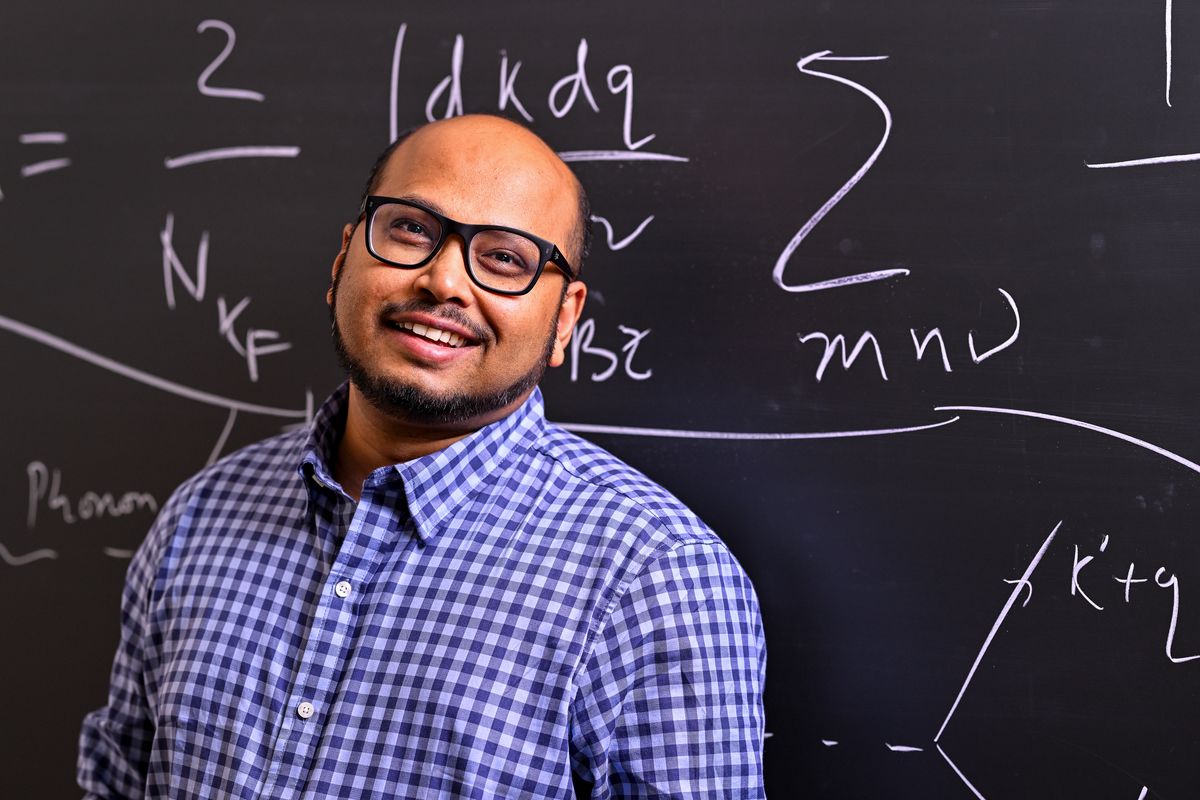
With support from a prestigious National Science Foundation CAREER award, Subhasish Mandal, an Indian American physicist at West Virginia University, is working to supply future quantum technologies with materials that don’t exist yet.
Mandal, an assistant professor in the WVU Eberly College of Arts and Sciences Department of Physics and Astronomy, will develop computer tools for designing the quantum materials that will be required to build quantum computers and other advanced technologies, according to a university release.
Quantum technology could change the way we compute, communicate, and collect information. Regular computers use bits, which are either 0 or 1. Quantum computers use quantum states, which can exist in many possible configurations at the same time. However, building useful quantum technologies can be difficult because quantum states are very fragile and can easily be affected by their surroundings.
An Indian Institute of Technology Madras alumnus, Mandal’s research focuses on understanding and designing materials that can protect these delicate quantum states. One important part of his project involves studying how electrons interact with tiny vibrations from the atoms inside materials. These interactions strongly influence a material’s quantum properties and may hold the key to creating more stable quantum technologies.
READ: Dr. Rakesh Sindhi to lead WVU Medicine Center for Organ Transplantation (August 28, 2026)
“One of the biggest challenges in quantum technology is finding materials that can maintain their quantum behavior outside carefully controlled laboratory environments,” Mandal said.
Mandal will study specially designed materials made by stacking different substances one atomic layer at a time. Like mixing ingredients in a recipe to create something entirely new, combining different materials at the atomic level can create quantum properties that one material could not produce by itself.
Using advanced computer methods and large-scale simulations, Mandal’s team will study how electrons and atomic vibrations work together to create quantum behavior. These processes can help determine whether a material has special properties such as superconductivity, which allows electricity to flow without energy loss.
Mandal will also focus on topological quantum states, which can resist certain types of disturbances. Scientists say they believe combining superconductivity and topological quantum states could help create the basic building blocks for future quantum computers.
He will develop free software to help researchers find new quantum materials, broadening scientists’ access to advanced computer tools and potentially speeding up scientific discoveries by reducing the time and money needed to test new materials.
“Instead of making every quantum material possible in a laboratory to see which perform well, researchers could first use the software to run simulations to identify the most promising options,” Mandal said. “Then scientists could focus their laboratory experiments on materials most likely to have useful quantum properties.”
In addition, Mandal will create easy-to-understand lessons about quantum science and technology, organize immersive summer workshops at WVU, and provide hands-on opportunities for high school, college, and graduate students who will learn computer skills that are increasingly important in scientific research, advanced manufacturing, high-performance computing, and new quantum industries.
READ: Vikram Manikonda named to Defense tech innovator GRVTY’s advisory board (August 14, 2026)
“As quantum technologies move from the laboratory toward real-world applications, there is a growing need for a workforce that understands both the science and the tools behind them,” Mandal said. “This project allows us to train students at multiple levels and help prepare them for careers in one of the fastest growing areas of science and technology.”
Mandal’s award comes through NSF’s Faculty Early Career Development Program, the Foundation’s most prestigious awards in support of early-career faculty who demonstrate the potential to serve as academic role models in research and education.
Mandal joined the WVU Department of Physics and Astronomy in 2022. In December 2025, his work on quantum materials was highlighted by Nature Communications, and he received the 2026 Cottrell Scholar Award from the Research Corporation for Science Advancement.
Mandal obtained his PhD from the Department of Physics at Michigan Technological University and pursued his postdoctoral research at Rutgers University. Prior to that, Mandal was a Yale-IBM postdoctoral researcher in the Department of Applied Physics at Yale University.