



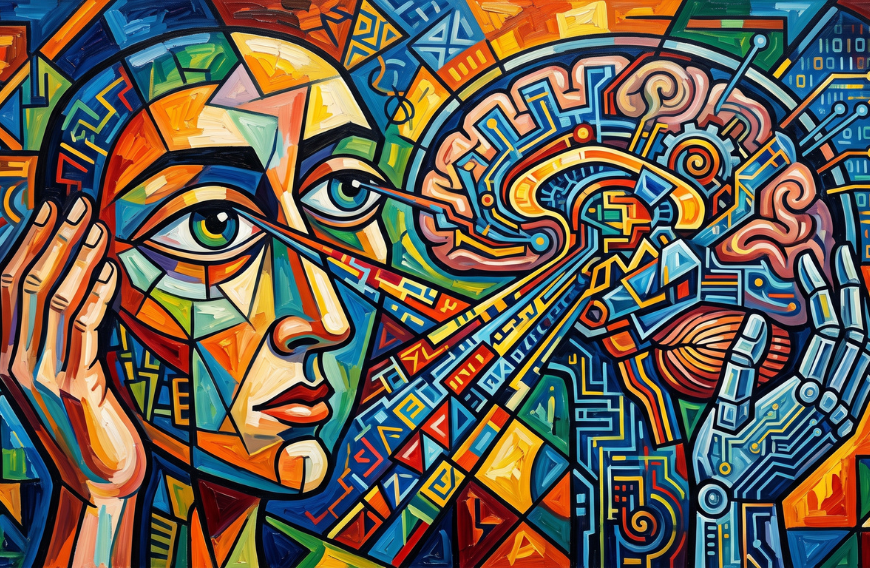
What we can learn from bugs
The word “symbiosis” comes from biology and simply means living together. It describes a close relationship between two different organisms, but that relationship can take very different forms. In mutualism, both organisms benefit from the relationship. In commensalism, one benefits while the other is largely unaffected. In parasitism, one benefits at the expense of the other. There is also a point at which a relationship can become so dependent that one organism cannot function normally without the other. This continuum is important when we think about humans and AI.
What happens at the point where two systems begin to depend on one another? If AI simply replaces human judgment, that relationship can move toward dependency, with humans gradually losing capabilities they once exercised themselves. If AI extracts value from humans without providing a meaningful reciprocal benefit, the relationship begins to resemble parasitism.
But if humans and AI remain distinct while each contributes capabilities that strengthen the other, the relationship begins to look more like mutualism. The DeepMind Institute’s recent discussion of Artificial Symbiotic Intelligence offers a useful framework for thinking about this new paradigm .
Orchestra for sight, vision and perception
The term Artificial Symbiotic Intelligence does not infer AI replacing human intelligence, but humans and AI developing a relationship in which their different capabilities complement one another and produce something neither could achieve as effectively alone.
We started this AI journey decades ago by first developing an understanding of how the human thought process works and then trying to teach machines to mirror that. And now machines are moving learning faster than we may have first anticipated creating a new paradigm for our co-existence with AI in a symbiotic relationship.
READ: Sreedhar Potarazu | Do the people running in the midterms know anything about AI? (September 25, 2026)
Some of the earliest attempts to understand AI were influenced by the understanding of the organization of neurons in the visual cortex. Frank Rosenblatt’s perceptron was inspired by the idea of neurons receiving and combining signals, while the landmark work of David Hubel and Torsten Wiesel demonstrated that neurons in the visual cortex respond selectively to increasingly complex features of the visual world.
Their work helped establish a hierarchical view of visual processing in which complex representations could emerge from combinations of simpler ones. That idea eventually influenced convolutional neural networks and modern computer vision. In a very real sense, AI began by looking at how humans see and the collaborative network involved in the brain that facilitates that process. The process behind sight, vision and perception involves a hierarchy of neural function working in tandem as part of an orchestra.
As AI advanced, systems also began to interact with one another, use external tools, access memory, interpret images, reason over information, take actions and work alongside humans. Rather than viewing intelligence as something that resides entirely inside one “closed system,” the idea now is that there is a collective intelligence emerging through the coordination between humans and machines.
The human visual system already operates according to many of these collaborative principles. We tend to think of the process of seeing as something that happens in isolation, but sight is actually a distributed process involving multiple specialized systems that transform, transmit, interpret and integrate signals. What we ultimately experience as vision emerges from this massive interpretation of collaborated signals. Perception takes it a step further when our emotions, memories, beliefs are superimposed on vision
When light enters the eye, the rays focus onto the retina. The retina, however, is not a simple film. It’s a sophisticated neural processing system containing many different cells with specific functions including photoreceptors, bipolar cells, horizontal cells, amacrine cells and retinal ganglion cells. They collaborate with one another to transform the incoming optical signals. By the time information leaves the eye through the optic nerve, it is no longer a raw image of the outside world. The visual system has already extracted and reorganized information about contrast, intensity, spatial relationships and changes over time.
The information then travels through the optic pathways before reaching the primary visual cortex. From there, visual information is distributed across multiple brain regions that contribute to different aspects of visual processing. Some pathways are particularly important for identifying objects and determining what something is, while others contribute to spatial relationships, movement and visually guided action. Color, depth, motion, shape and other properties are processed through interconnected networks rather than by one central visual processor.
The steps to creating symbiosis
The first lesson Artificial Symbiotic Intelligence can take from vision is that intelligence does not necessarily require one system to do everything just as how the brain processes signals from sight to vision to perception.
READ: Sreedhar Potarazu | AI is the mirror. The Sutras are the questions. Socrates is still asking. (September 21, 2026)
The second lesson is then even more important. The visual system does not merely process signals; it coordinates information. Each stage changes what it receives before passing information onward, and the information moving through the system is integrated with signals from other parts of the brain. The result is not simply a chain of independent calculations but a dynamic network in which different components contribute different forms of information to a shared representation of the world.
This distinction becomes particularly important when we separate sight from vision and vision from perception.
Sight begins with processing of sensory information. Vision is a higher cortical function that involves our interpretation of those images. Perception involves our interpretation of what we visualize based on emotions, memories, bias and context. If I see a familiar face across a crowded room, I am not merely detecting two eyes, a nose and a mouth. My brain is integrating visual information with everything it already knows about that person and then creating a perception.
Perception therefore represents a higher form of collaboration within the brain itself. Sensory systems contribute information about the external world, while memory contributes information about the past, attention determines what matters at that moment, and higher cognitive systems provide context and interpretation. The resulting perception is more than the sum of the individual signals.
This provides a useful way to think about the relationship between humans and AI.
The goal of human-AI collaboration should not necessarily be to create an AI that thinks exactly like a human. Nor should the goal be to make humans behave more like machines. The more interesting possibility is that humans and AI could occupy different but complementary roles within a larger cognitive system.
AI can process enormous amounts of information, identify patterns across datasets, maintain consistency across repetitive tasks and rapidly generate possible explanations or solutions. Humans bring other capabilities that remain difficult to reduce to computation alone, including lived experience, values, contextual understanding, social judgment, responsibility and the ability to determine what matters in a particular human situation. The point of symbiosis is not for one side to replace the other. It is to create a system in which each contributes capabilities that the other does not possess in the same way.
READ: Sreedhar Potarazu | AI is burning through free cash flow (July 25, 2026)
Artificial Symbiotic Intelligence may represent a similar evolution in AI. Instead of asking whether one model can become intelligent enough to replace all the others, we may need to ask how different forms of intelligence can work together. The answer may involve AI models communicating with other AI models, but it may also involve something more important: humans remaining active participants in the system.
The future of intelligence may therefore become increasingly symbiotic, with humans and machines contributing different capabilities to a shared cognitive system. In that future, AI would not simply give us answers. It would help us see patterns we could not see, remember information we could not retain, explore possibilities we could not calculate and challenge assumptions we might otherwise overlook. Humans, in turn, would provide the context, judgment, values and responsibility necessary to determine what those capabilities should mean and how they should be used.
Crossover point
There may come a point when the amount of thinking, analysis, writing, coding and decision support performed by AI systems exceeds the amount performed by humans themselves — the cognitive crossover point.
A growing share of the work of processing information and solving problems is being performed by machines rather than human brains. The important question then becomes how we manage the ratio between them without “crossing over” or yielding control.
The visual system provides a useful example because the brain does not consciously process everything that enters the eye. Human and machine intelligence may need to work in a similar way, with some forms of cognition delegated to AI while humans retain responsibility for judgment, context, values and decisions that require an understanding of what matters. The challenge will be to find the right balance, so that increasing machine capability expands human intelligence rather than gradually replacing the human capabilities that give that intelligence meaning.
We began artificial intelligence by looking at the brain and trying to understand how biological neurons could process information. Perhaps the next stage requires us to look again, this time not simply at the neuron or the visual cortex, but at the relationships among the components of the entire AI ecosystem to create a symbiotic form of intelligence.