



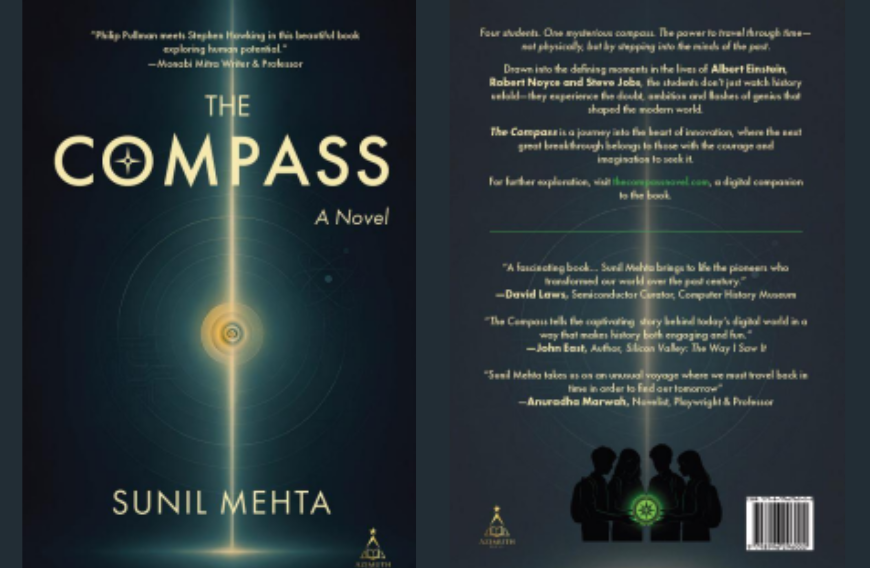
What happens when a seasoned Silicon Valley innovator, a technologist who holds 92 U.S. patents with a four-decade career spanning Intel, turns his pen to fiction? A captivating book like “The Compass” takes shape.
“The Compass,” is a sweeping debut novel written by Sunil Mehta, published by Rupa Publications, that sits at the unique intersection of time, science, and the human curiosity that drives discovery.
Mehta’s journey to authorship is as unconventional as it is compelling. Raised in Mumbai, he earned his engineering degree from IIT Bombay before moving to the United States in 1980 for graduate studies at Pennsylvania State University and MIT.
Yet, alongside a prolific career designing the digital architecture of tomorrow, Mehta has always maintained a deep, lifelong passion for cultural curation, literature, and scientific history.
Mehta’s professional trajectory spans four decades at the intersection of advanced technology, semiconductor engineering, and Silicon Valley entrepreneurship, running parallel to his lifelong engagement with literature, history, and cultural curation.
He began his professional career at Intel in 1984, marking the start of a four-decade journey in the semiconductor industry that continues today through his role as a Silicon Valley startup executive and technologist, a career defined by 92 U.S. patents and 18 technical publications.
Alongside his technical work, Mehta maintains wide-ranging creative pursuits as a cultural curator who created the digital archive sunilslists.com and an opinion writer whose current affairs pieces have appeared in the San Jose Mercury News and on Medium.
That rare synthesis of technical precision and imaginative breadth breathes life into “The Compass,” blending historical fantasy and science fiction, the novel asks a mesmerizing premise: What if a compass could lead you straight into the minds of history’s greatest innovators and who among us would truly be worthy of it?
In an exclusive interview with The American Bazaar, Mehta sits down to discuss his transition from microprocessors to manuscripts, the inspirations behind his expansive debut, and how a lifetime spent chasing technological breakthroughs informed a story about the timeless magic of discovery.
The American Bazaar: For readers who may be discovering your work for the first time, how would you introduce yourself and the journey that brought you from the semiconductor labs of Silicon Valley to the world of fiction writing?
Sunil Mehta: I’m an engineer by vocation. About 5 or 6 years ago, I started reading some biographies […] of 3 individuals, who I think, more than anyone else in the 20th century and beyond, transformed science and technology: Albert Einstein, Robert Noyce, and Steve Jobs. One of my motivating factors for writing the book was to actually bring [Noyce’s] story into the world. So anyway, I wanted to tell the stories, like I said, in a relatable and digestible way, and […] that’s when I got the idea to kind of make it fiction.
READ: ‘Trump is a gift that keeps giving’: Arun Kumar on his new book Trumpiana (October 7, 2026)
After a long, successful career in semiconductor engineering and leadership, what was the exact moment or realization that made you decide to write “The Compass”? Has writing a book always been a lifelong ambition for you?
I went back and re-read their […] biographies, and it really struck me that around the time of the great accomplishments and breakthroughs, there was already a lot of drama. So, that’s when I kind of had this epiphany that I don’t need to make up any fictional elements. I can actually use almost exactly what happened.
So, basically, I converged on this idea that I would lay out the actual things that happened. And then I had to connect these dots. I had to fill in the gaps to make a coherent narrative.
That’s when I got the idea of having kind of a time travel-like motif, a mind travel, or mental time travel. And it so happened that there was actually a device that was given to Einstein, the compass. And that perfectly fit my purposes because the compass actually is, first of all, a very symbolic device, right? It shows direction, right?
In a nutshell, what is “The Compass” about, and what inspired you to write a debut novel that intertwines historical fiction with the birth of the digital age?
One of my motivating factors for writing the book was to actually bring [Robert Noyce’s] story into the world, but within the context of what came before him and after him. And also to basically place him at the same level, or on the same pedestal, if you will, as Einstein and Jobs, because I think that’s where he rightfully belongs. I wanted to write the novel for both young people and adults. So that’s when I said I need to make a framework [… and] have a common thread [of] a time travel like kind of motif.
How long did the idea live in your head before you actually committed to writing it, and what made now the right time in your life and career to tackle it?
I got the idea […] after I finished these biographies, and it took me […] roughly a year or so to crystallize it. It took me roughly about three years to write the […] first draft. About four years ago is when I started writing the novel. For the first two of those three years, I was working full-time at a chip […] semiconductor company. So it was sporadic, you know, but then I kind of retired […] about two years ago. I would say more than half of the time spent on each chapter was not just writing, but doing research.
As a debut author coming from a completely different professional background, did you experience imposter syndrome while writing a novel, and how did you push past it?
Yeah, sometimes, actually more than imposter syndrome, it was more like, ‘Will anyone ever read this book?’ My initial draft actually was like 205 or 210,000 words. So then what I, for a long time actually, I had kind of almost decided to make it a three-book trilogy. Then that’s when I got connected with Rupa […] The editorial director […] told me […] that you really need to cut it down by at least 25%. I managed to cut it by like, yeah, more than 50,000 words. The actual body of the novel is about 150,000 words. I told them to make the book, like, bigger, the trim size bigger. I wanted a 6-by-9 […] so that the people would not get, like, intimidated by the book and not even pick it up.
But now, with the success of the book, will there be a sequels in the works soon?
First of all, I’m kind of pretty burnt out, I would say. Also, by the way, I don’t know if I mentioned, but I decided to un-retire and went and joined a startup, but working with them for them half time, but still, it does take a lot of energy and effort. But even if I had not done that, I think I would definitely be ready for a break. And also, like I said, I never intended this to become a vocation. But, having said all that, many people have asked me this question, and it got me thinking. So, this concept of […] telling a […] nonfiction but very, you know, dramatic and interesting story of real people, I can think of a few other situations already where the same kind of plot device can be used, so who knows.
As someone certified as a Project Management Professional (PMP) who has led large interdisciplinary R&D teams, how do you see the intersection of structured project management and pure, unstructured creativity?
So in the semiconductor industry, like I said, I worked for more than 40 years […] those patents didn’t come out of thin air, right? They come from working as a part of a team and developing new technologies and new products, and in the course of that, right, you discover certain needs, or certain gaps that need to be filled, and then you use your creativity to find, you know, innovative ways to fill those gaps. But all of those are within the framework and the context of large teams. You’re constantly working with many people from many, many different departments, because semiconductors is a very complex field.
READ: How India built a new model for robotic surgery: Insights from Dr. Mahendra Bhandari and Siddharth Siva (September 2, 2026)
Now, writing, on the other hand, is completely the opposite. It’s completely solitary […] in the writing part, you can’t do any of that […] And also, I cannot go to some other novelist and ask for guidance. So in that sense, it was kind of a scary thing, like, almost like jumping without a parachute. And also what helped is that I had an insider’s view of Silicon Valley and also of how innovation works.
Why fiction now? With dozens of technical papers and 92 patents under your belt, what made you choose a fictional narrative and time-travel framework over a traditional nonfiction memoir or tech history book to tell the story?
I decided to make it fiction to make […] it more interesting and more relatable, especially for young adults […] because I’m so fond of fiction, somehow I imagine that fiction is more interesting than nonfiction in general […] and I also felt more comfortable writing fiction. And secondly, there are already, like, dozens of nonfiction books that exist […] I didn’t want to just add yet another kind of book to this […] long list of existing books. I wanted to do something unique.
What were some of the biggest hurdles you faced as a debut author trying to structure a complex, multi-layered time-travel book?
The initial draft turned out to be very long, which is understandable because I had so much to tell and there are three stories plus the framing story, right? So my initial draft actually was like 205 or 210,000 words, which is like a “War and Peace” kind of book length. Maybe not that long, but almost getting there. So that I knew for sure, no adult would pick up that book.
Balancing a demanding high-tech career with writing a debut novel is not easy. What did your writing routine look like, and what surprised you most about the writing and publication process?
Because, for the first two of those three years, I was working full-time at a chip […] semiconductor company. So it was sporadic, you know, but then I kind of retired […] And I spent about a year. The third year was much more rapid progress. But for each chapter, the process was, like I said, unusual because, like, the first step was to just make the skeleton, right, of what’s going to be happening.
But then, I had to […] I really wanted it to be true to the facts. So I had to go back and, whatever draft I had written, I had to do all my research, pull out all the papers and books and all that and make sure it was all authentic […] I would say more than half of the time spent on each chapter was not just writing, but doing research.
Since the book bridges history and imagination, if Robert Noyce or Steve Jobs suddenly popped up in the present day to read The Compass, which part of your fictionalized version of their lives do you think they’d nit-pick or argue with the most?
At the time of Einstein’s death in 1955, Robert Noyce was working in a company called Philco in Philadelphia […] So it did not seem too much out of the realm of possibility for Noyce to visit Princeton and meet Einstein, you know? Obviously, […] that part I had to make up, there’s no evidence that that ever happened, but still, it’s plausible, right? And so that’s when kind of I’d made the connection between noise and Einstein.
And finally, how did you handle reader feedback and revisions when you were transitioning from technical peer review to creative critique, and what’s the one message you hope readers, whether tech professionals, history buffs or fiction lovers, take away from The Compass?
The editorial director actually is quite experienced and insightful. And I also got some feedback from my daughter and also I did some self like reflection. And basically, I concluded that I really wanted to write one book, and it was a compromise to break it up into three parts […] after a lot of deep soul-searching, I decided to go back to making it one book. But then the editorial director told me that I really need to cut it down by at least 25%. So again, I went back to the drawing board.