



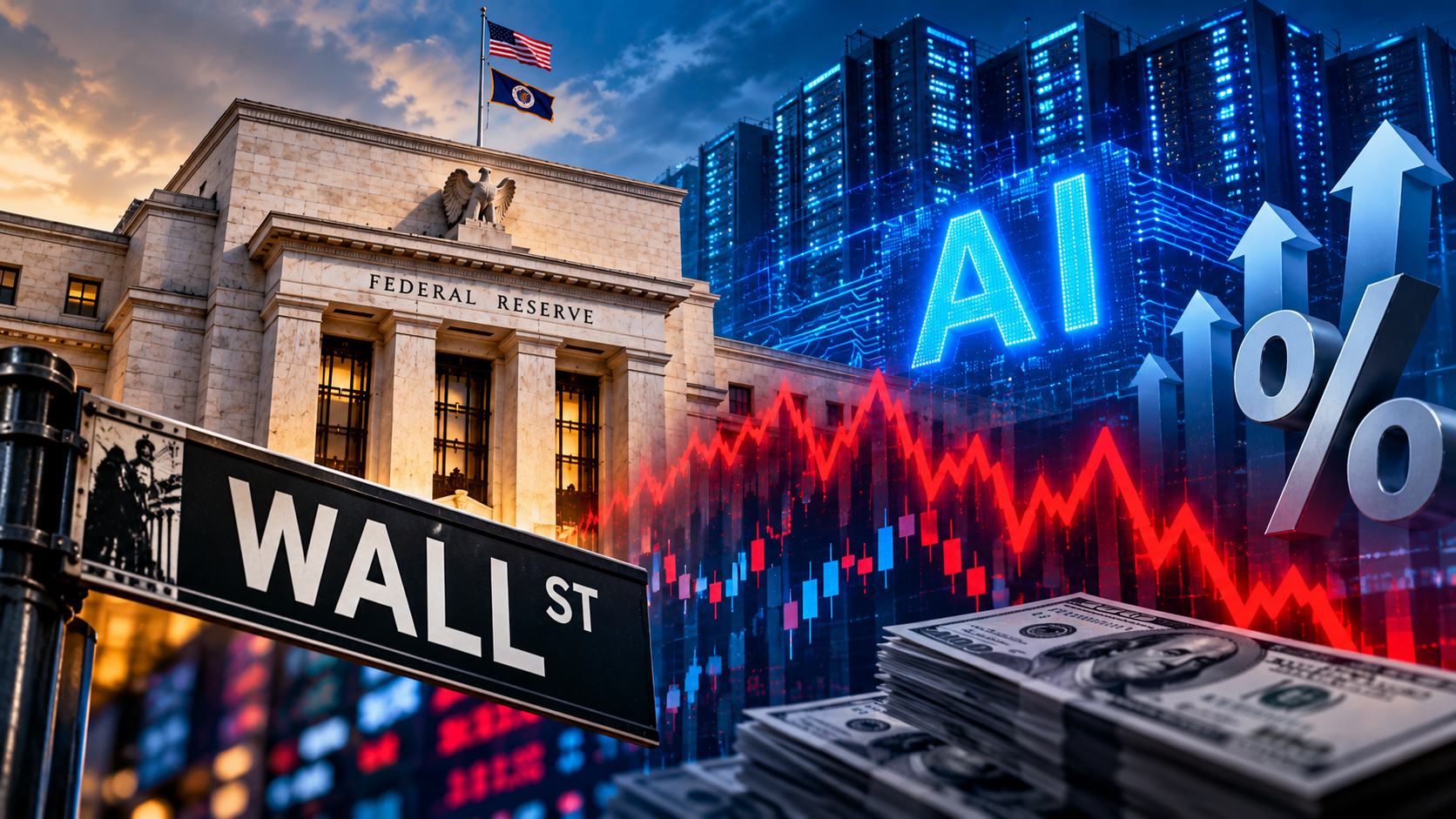
For most of this year, Wall Street ran on a single input: the mood of one man in Washington. From February until the Federal Reserve’s September meeting, equities rose and fell on what the President said, signed, threatened or postponed. A post could lift the Nasdaq. A pause on a tariff or a hint of progress with Tehran could erase a week of losses. Investors learned to trade the headline, and the headline learned that the market was listening.
Then the Fed did the one thing the narrative had no place for. On September 16, Chair Kevin Warsh and his colleagues voted unanimously to raise the federal funds rate by a quarter point, to a range of 3.75 to 4.00 percent. Markets had spent the year waiting for a cut. They got a hike, and the minutes signaled that another could follow before year-end.
The bad news was always there
Since that meeting, the tone has changed, and the commentary keeps treating each new worry as a fresh shock. It is not. The inflation pressure from the oil shock of the Iran conflict was there. The reliance of the AI build-out on borrowed money was there. The valuation was there. A market that is rising on momentum does not price any of it. A market facing a Fed that is tightening begins to.
READ: After the midterms: Will Wall Street’s rally survive? (October 10, 2026)
The repricing arrived on Wednesday. A hotter-than-expected inflation report, with headline CPI at 3.7 percent, sent the Nasdaq down 1.88 percent, its worst day since July. The damage was not spread evenly. CoreWeave fell 16 percent, Oracle 9 percent, Dell 11 percent. Long Treasury yields spiked, with the 30-year touching 5.63 percent before pulling back. These are not the stocks of a market worried about slowing demand for AI. They are the stocks of a market worried about the cost of money.
Not a bubble bursting, but a bubble being audited
The S&P 500 is only about one percent below its record close of 7,818.93 set on October 5. The Nasdaq is roughly three percent off its high. Nothing here is a collapse, and I will not pretend otherwise. The largest AI names, Nvidia and the big hyperscalers, remain highly profitable, and investors have so far forgiven their borrowing.
What has changed is the question. For two years the market asked whether AI would deliver. Now it asks who can afford to finance it. The International Monetary Fund’s October stability report counts fourteen circular financing deals since 2023, in which investors, suppliers and customers fund one another, totaling roughly $650 billion of debt and $1.4 trillion of future revenue commitments. CoreWeave’s bonds now trade at yields that Bloomberg notes are typical of distress. Credit investors have turned selective, and a data-center IPO collapsed in Australia last week. A bubble does not need to burst to be audited. This one is being audited now, at 3.75 percent and rising.
Leverage turns a pullback into a bloodbath
The amplifier is borrowed money. FINRA margin debt reached a record $1.50 trillion in June, dipped to $1.42 trillion in July, and recovered to $1.45 trillion in August, up 37 percent from a year earlier. Schwab clients alone owed $187.9 billion in margin loans at the end of September. Leveraged ETFs have more than doubled in assets over the past year. Hedge fund gross borrowing was reported at $7.2 trillion in July.
I offer these numbers with a caution. Margin debt has peaked before every major decline, but the lag can be many months, and the September figure, due within days, will describe the world before this month’s shock. What leverage does is change the nature of a decline. A ten percent pullback in an unlevered market is a correction. In a levered one it triggers margin calls, forced selling and more margin calls. The figure to watch is October’s, published in mid-November. A rise during a selloff means borrowers are buying the dip. A sharp drop means the forced selling has already begun.
Washington’s problem
Here is where the market story becomes a political one. The President opposes rate hikes, and the Fed is hiking. If inflation stays elevated, Warsh may have to raise again, perhaps in October, though analysts at Pantheon think December is more likely and the market odds have swung between thirty and fifty percent. A second hike would put the White House and its own appointee at odds, and it would land in the final weeks before the November 3 midterms.
If Republicans lose the House, and perhaps the Senate, the policy problem deepens. A divided Congress limits fiscal options just as oil prices, which have been trading in the low $90s, keep inflation sticky. The administration has less room to cut taxes or spend its way out, and the Fed has less cover to cut.
The argument I made earlier this year was that the market was the binding constraint on Trump’s choices. I would now put it differently. The market was a constraint he could manage, because he could talk to it. The bond market is a constraint he cannot. And he has less reason to calm equities with good news now than he did in the spring. The gains are banked, and the news that would reassure investors, lower oil and lower inflation, is not his to deliver on command.
What would change my mind
My base case is not a crash. It is a choppy, fragile market in which the AI trade is repriced for the cost of capital. Broad credit has not confirmed the stress: high-yield spreads, by the latest readings I have seen, are around 325 basis points, which is tight by historical standards, and the VIX, near 20, signals unease rather than panic. A real break would need a credit event, such as a failed AI financing or a default, or the 30-year yield pushing decisively higher, or the S&P 500 losing 7,500.
Until then, the lesson is older than any of us. Cheap money builds the story, and expensive money tests it. For months, the market chose the pleasant thought. The Fed has now asked for the reality of paradise.
This column is analysis, not investment advice.