



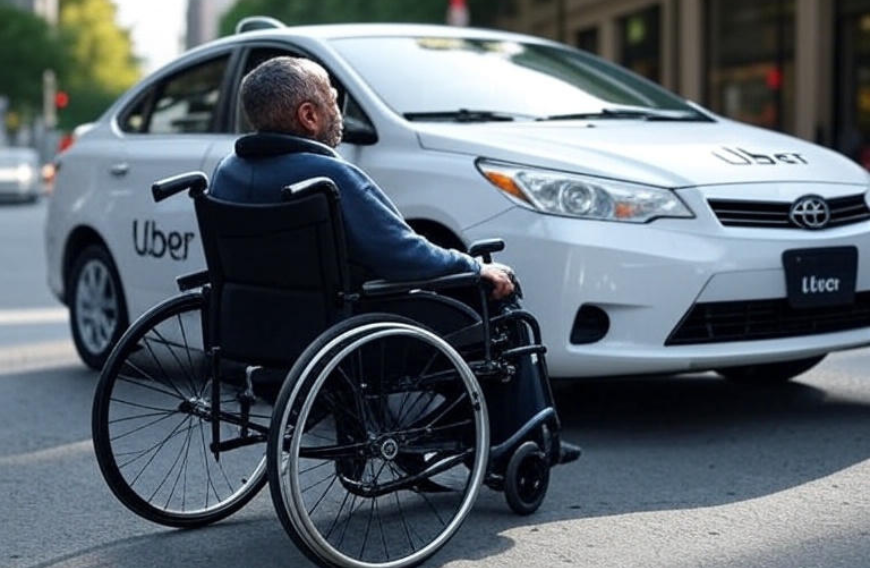
The U.S. Department of Justice (DOJ) has sued Uber, alleging the ride-hailing giant discriminated against individuals with physical disabilities in violation of federal law.
The DOJ’s civil rights division specifically alleges that Uber and its drivers “routinely refuse to serve individuals with disabilities, including individuals who travel with service animals or who use stowable wheelchairs.”
“Despite the importance of its services to people with disabilities, Uber denies people with disabilities full and equal enjoyment of its services in several critical ways,” lawyers for the DOJ wrote. “Uber also refuses to reasonably modify its policies, practices, or procedures where necessary to avoid discriminating against riders with disabilities.”
The DOJ contends that this has led to “significant economic, emotional, and physical harm to individuals with disabilities.”
READ: Self-driving startup Nuro secures $203 million from Nvidia and Uber (
The DOJ alleges further that Uber has imposed additional charges on riders requiring special accommodations, such as cancellation fees when service is refused. These practices, along with others outlined in the complaint, are said to breach the Americans with Disabilities Act. The department further claims that Uber and its drivers unlawfully impose cleaning fees for service animals. Additionally, some drivers are accused of insulting or mistreating passengers with disabilities and denying reasonable accommodations, such as allowing mobility-impaired riders to sit in the front seat.
The complaint details alleged mistreatment of 17 Uber passengers with disabilities, as per Reuters. Among them is J.E., a 7-year-old amputee from the Bronx, New York, who was reportedly denied a ride home from his brother’s birthday party in Pelham Bay Park after a driver questioned his wheelchair, asking, “Is that coming?” Another case involves Jason Ludwig, a Gulf War veteran traveling with a service dog, who was allegedly refused a ride from Newport News to the Norfolk, Virginia, airport, causing him to miss his flight and forcing him and his wife to drive 16 hours back to Yarmouth Port, Massachusetts. A third incident concerns Jeff Clark of Mount Laurel, New Jersey, who claims that four Uber drivers in Philadelphia canceled his rides within 17 minutes after learning he was blind and used a guide dog.
Uber responded in a statement, as quoted by TechCrunch, asserting that it “fundamentally” disagrees with the DOJ’s claims and emphasizing that it maintains a “clear zero-tolerance policy for confirmed service denials.”
READ: The Federal Trade Commission sues Uber, after Google and Meta (
“Every driver must acknowledge and agree to comply with our U.S. Service Animal Policy and all applicable accessibility laws before using the Uber Driver app, and we regularly remind drivers of these obligations. When we confirm a violation, we take decisive action, including permanent account deactivation,” the company added further.
In its complaint, filed Thursday in the Northern District of California, the DOJ states that it notified Uber in 2024 that the company’s handling of disabled riders was under investigation. The complaint notes that, following this notice, Uber introduced a feature allowing passengers to indicate when they were traveling with service animals.
Uber has previously faced several legal challenges concerning discrimination against passengers with disabilities. In 2021, the U.S. Department of Justice (DOJ) sued the company, alleging it overcharged disabled riders by applying “wait time” fees to those needing extra time to enter vehicles. The lawsuit was settled in 2022, with Uber agreeing to pay millions to more than 65,000 affected users.
In April 2021, an independent arbitrator ruled that Uber must pay $1.1 million to Lisa Irving, a blind passenger who had been refused rides 14 times because of her guide dog. The decision determined that Uber’s drivers had breached the Americans with Disabilities Act (ADA) and California’s Unruh Civil Rights Act, with the total award covering $324,000 in damages and more than $800,000 in legal fees and costs.