



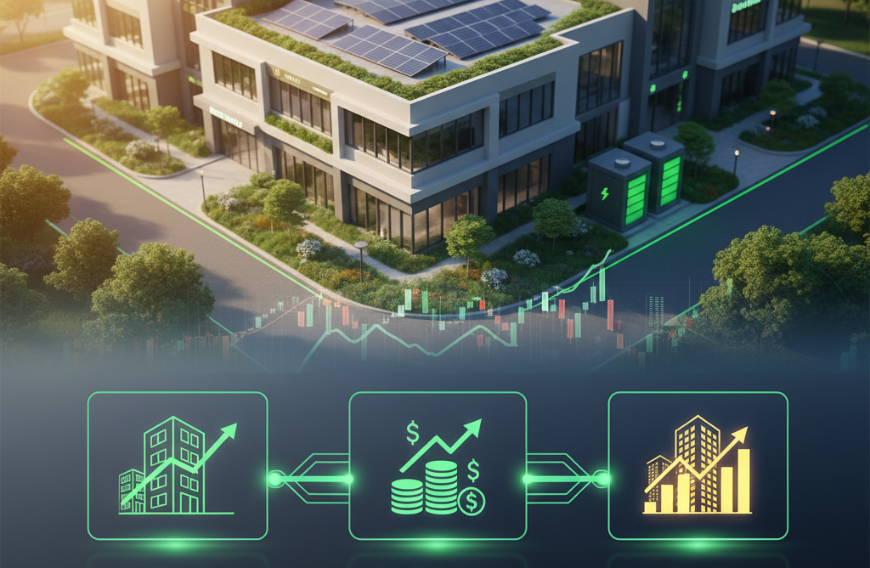
In a prior discussion, I argued that the next commercial real estate correction is likely to be performance-driven rather than interest-rate driven, as Building Energy Performance Standards and rising energy costs reshape asset-level risk. That framing focuses on what happens when buildings fail to adapt. An equally important question is what happens when owners move early. The evidence increasingly shows that proactive investment in energy performance is not defensive spending, but a source of durable financial advantage.
In commercial real estate, capital is often deployed reactively. Buildings are upgraded when systems fail, vacancies rise, or external pressures force action. Energy performance investments have historically followed this pattern, treated as discretionary projects rather than core asset strategy.
That approach is becoming increasingly costly.
Across markets and asset classes, a consistent pattern is emerging: owners who invest early in building energy performance outperform those who delay. The benefits are not abstract or reputational. They appear directly in operating expenses, tenant behavior, financing outcomes, and ultimately, asset value.
READ: Rokas Beresniovas | The myth of the ‘free market’ in fossil fuels (
Energy performance has moved from the margins of asset management to the center of financial performance.
Buildings with strong energy performance operate with structurally lower costs. High-efficiency heating, ventilation, and air conditioning (HVAC) systems, modern controls, improved envelopes, and electrified equipment reduce energy consumption and dampen exposure to volatile utility prices. These savings are recurring and predictable, which matters more than headline percentage reductions. Lower and more stable operating expenses translate directly into stronger Net Operating Income (NOI), particularly in markets where energy costs are rising faster than general inflation.
Performance improvements also reduce unplanned capital events. Older, inefficient systems fail more often, require emergency repairs, and generate tenant complaints. Proactive upgrades shift spending from reactive maintenance to planned investment, reducing operational disruption and smoothing cash flow over time. For owners managing large portfolios, this predictability is often as valuable as the energy savings themselves.
Tenant behavior reinforces this advantage. Institutional tenants, public-sector occupants, and larger commercial users increasingly evaluate buildings based on operating costs, resilience, and performance transparency. Efficient buildings offer lower utility pass-throughs, better thermal comfort, and fewer service interruptions. These factors influence leasing decisions, renewal rates, and tenant retention, even when headline rents are comparable.
In competitive leasing environments, energy-efficient buildings tend to experience lower vacancy volatility. During market downturns, they lose tenants more slowly. During recoveries, they lease faster. The result is not necessarily higher peak rents, but more durable occupancy and steadier cash flow across cycles.
From a capital markets perspective, performance investments reduce risk in ways that underwriting increasingly reflects, even when not explicitly labeled. Buildings with documented efficiency improvements and credible performance trajectories face fewer questions during refinancing and disposition. Buyers discount assets with large unfunded retrofit needs and uncertain operating costs. Conversely, assets with completed upgrades, lower energy intensity, and predictable operating profiles retain liquidity and optionality.
This matters because valuation is driven less by theoretical upside and more by confidence in future cash flows. Lower operating expenses, reduced regulatory exposure, and stable tenant demand compress risk premiums. Even modest improvements in perceived risk can outweigh the direct dollar value of energy savings when capital markets tighten.
The strongest financial outcomes are associated with early action. Owners who invest proactively capture savings over a longer period, avoid cost escalation, and retain flexibility in how and when capital is deployed. Delayed investment often costs more, must be completed under time pressure, and is harder to finance attractively. Performance improvements executed on the owner’s timeline are fundamentally different from those executed under regulatory or refinancing duress.
Despite this, many owners continue to view energy upgrades as discretionary or defensive spending. This framing misses the core economic reality. Energy performance investments are not simply about reducing consumption. They reshape the cost structure, risk profile, and long-term competitiveness of an asset.
Buildings that perform well financially in today’s market share common characteristics: lower and more predictable operating expenses, fewer capital surprises, stronger tenant retention, and clearer pathways through regulatory and refinancing events. Energy performance directly supports each of these outcomes.
The gap between proactive and reactive owners is widening. As energy costs rise, performance standards tighten, and lenders scrutinize operating risk more closely, efficient buildings increasingly separate themselves from the broader market. The result is not a dramatic premium for high performers, but a growing discount applied to those that fail to adapt.
Energy performance is no longer an operational footnote. It is a driver of cash flow quality and asset resilience. Owners who recognize this early are not just reducing costs; they are protecting value, improving liquidity, and positioning their portfolios for a market where performance increasingly determines financial outcomes.