



By Samarpita Bhawal
At a time when marketing leaders are expected to justify every dollar, prove impact with data, and still craft narratives that inspire trust, the role of the Chief Marketing Officer (CMO) is undergoing a fundamental shift.
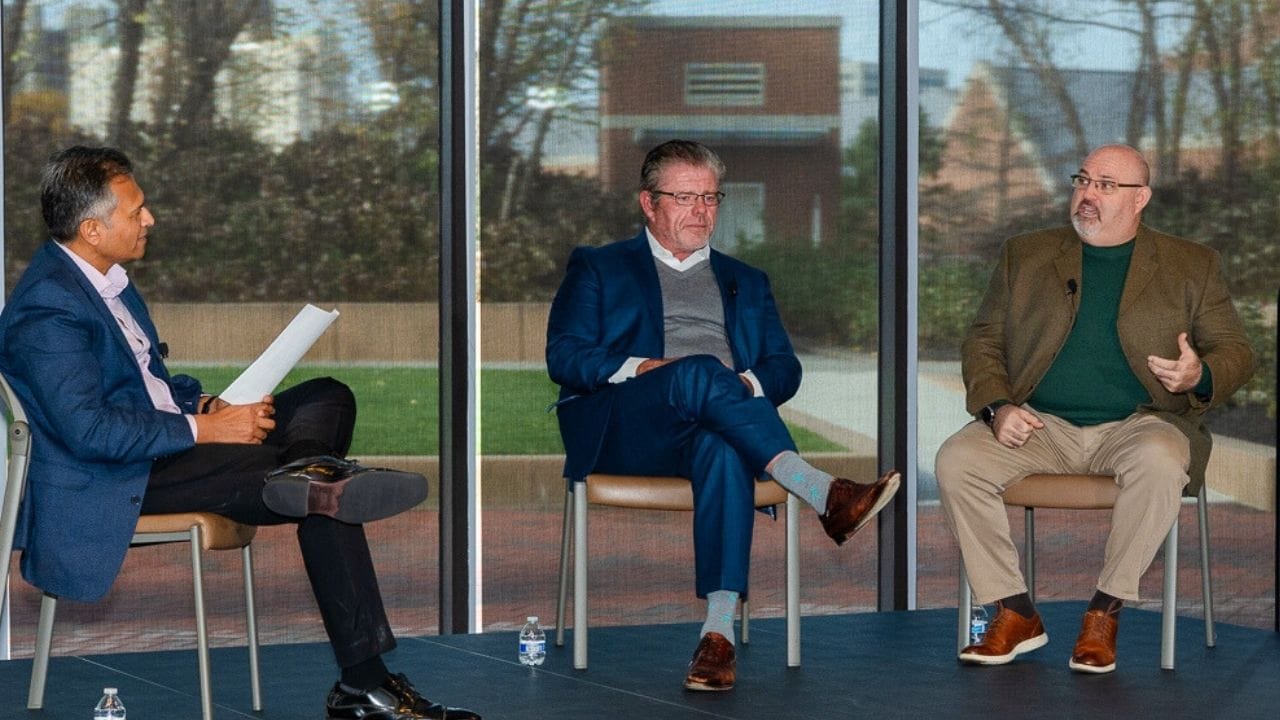
That tension sat at the heart of a panel titled “The CMO — Storytelling in the Age of Data,” held at The American Bazaar’s Leadership @ Inflection Points conference in Vienna, Virginia, on Nov. 14. Curated and moderated by Rohit Tripathi, the conversation brought together Jeff Bradbury, a veteran marketing executive with deep experience across tech and telecom, and Karsten Russell-Wood, Chief Marketing Officer at Equum Medical, a healthcare services and telehealth provider.
What emerged was not a tactical discussion about campaigns or channels, but a philosophical examination of storytelling itself — when it works, when it fails, and why CMOs today are increasingly judged not by creativity alone, but by their ability to align story, culture, and reality.
Russell-Wood opened by reflecting on how the perception of marketing leadership has changed over the years. Not long ago, he said, CMOs were often seen as operating in a subjective world — more art than science, more intuition than accountability.
That has changed.
“Years ago, the CMO was defined more by being a tea-leaf science,” he said. “But today, CMOs are subject to more scrutiny for actual value creation than many other roles.”
READ: Beyond compliance: How ESG is powering the next wave of business innovation (
Listening earlier in the day to CFO and CIO panels, Russell-Wood said it was clear that marketing leaders now sit under the same expectations as finance and technology executives. Storytelling, once considered soft power, is now measured against outcomes.
Bradbury, whose career spans strategy roles inside companies and advisory work across startups and large enterprises, agreed—but added a critical caveat. While data has elevated the CMO’s credibility, it has not replaced the need for narrative. If anything, it has made it more essential.
“Storytelling and the ability to create a commonality of purpose is fundamental,” Bradbury said. “It’s what allows organizations to pull in the same direction—internally and externally.”
Early in the conversation, Bradbury zeroed in on a theme that would recur throughout the panel: trust.
Trust, he argued, is not built through messaging alone, but through consistency between what a company says and what it does. He added another layer to the concept—authenticity—as the difference between brands that attract loyalty and those that quietly repel it.
“If you’re living up to what you say, people engage and follow,” he said. “If you don’t come across as authentic, people stop trusting your brand—and everything becomes harder.”
This idea of trust as a kind of stored capital would later become central to how both panelists described inflection points.
Asked by Tripathi to define what an “inflection point” means to him, Russell-Wood offered a definition that reframed the term away from growth charts and market cycles.
“For me, the inflection point comes when the existing story we’re telling no longer matches reality,” he said.
That mismatch, he explained, reveals itself in several ways: changing customer behavior, shifting economics, longer sales cycles, margin pressure, or even a subtle emotional change inside the organization—anxiety, uncertainty, or sudden exuberance.
“When that happens,” he said, “you really have to focus.”
Bradbury expanded on the idea, noting that inflection points are not always chosen. Sometimes they are imposed by external forces—market shifts, competitive pressure, or technological change. Other times, they are intentional, driven by leadership decisions.
In either case, he said, storytelling enters a narrow and dangerous window.
“There’s always a small window of time where you’re trying to lead people into where you’re going,” Bradbury said. “And the coin of belief is trust.”
READ: Sneha Mantri named first CMO of Parkinson’s Foundation (
That trust, he explained, is something organizations draw down during moments of change. If it has not been built beforehand—through authenticity and follow-through—the story collapses under scrutiny.
Bradbury illustrated the point with a real-time example from his own work. His current company, he said, is transitioning from a services model to a product company—a shift that cannot happen overnight.
“We didn’t get a massive infusion of capital,” he said. “We didn’t suddenly hire 500 engineers.”
Instead, the company had to narrate a future state while still operating in the present—showing customers the first proof points, then the next, gradually closing the gap between aspiration and execution.
“You have to understand the curvature of the inflection point,” he said. “How sharp it is—and how to get people to follow you along that journey.”
The danger, both panelists agreed, is overselling the destination without acknowledging the path.
Russell-Wood traced his own evolution as a marketer through this lens. Early in his career, he believed marketing’s role was to command the story—to define the narrative and push it outward.
Today, he sees the role differently.
“What I’ve evolved to believe,” he said, “is that my job is to remove confusion.”
Curiosity, he argued, is the most important trait of a marketer—not persuasion. Asking the right questions, understanding the environment, and clarifying ambiguity matter more than crafting elaborate narratives.
He recalled his time at Philips, where the company successfully transitioned from a legacy hardware manufacturer to an outcomes-based healthcare company. That shift worked, he said, because leadership invested deeply in explaining why the change was necessary, not just what the change would be.
By contrast, some of his less successful moments came when he focused too heavily on launches — events that gratified internal teams but failed to resonate with customers.
“We never pulled the customer along to understand why,” he said. “It was just, ‘Here it is.’”
Bradbury reinforced the point with a well-known anecdote from MIT. When a new media center was built, the campus initially installed no sidewalks. Instead, administrators waited to see where students naturally walked. Only after paths were worn into the grass did they pave them.
“The customer voice emerged and told you the answer,” Bradbury said.
The lesson, he argued, applies directly to marketing leadership: patience during moments of change allows stakeholders—customers, employees, partners—to reveal the paths that actually matter.
As the discussion turned to how inflection points differ across organizations of varying size, Bradbury reached for a metaphor from his Navy background.
“Speed is life. Altitude is life insurance,” he said.
Large organizations, he explained, have altitude—the ability to absorb shocks and adjust gradually. But they are harder to turn. Smaller companies move quickly, but lack stability; a wrong move can overshoot the target or double the work required to recover.
The physics are unavoidable.
“Size enforces a certain approach,” he said. “You can’t outrun risk forever.” When Tripathi asked which audience is harder to align—internal or external—the answer from both panelists was immediate.
Internal.
“No contest,” Russell-Wood said.
External customers, he explained, offer clarity. They buy—or they don’t. Internal stakeholders carry history, competing priorities, power dynamics, and emotional baggage. The CMO must tell a story that resonates across executives, frontline staff, clinicians, technicians, and finance leaders—each with a different lens.
“My external world is simple,” he said. “My internal world is not.”
Bradbury agreed, noting that internal alignment requires framing change in ways that allow different groups to see win-win outcomes. Without that, storytelling becomes performative—and trust erodes.
As the panel closed, Tripathi reflected on what the discussion revealed about the modern CMO. No longer simply a voice to the market, the CMO has become a cultural translator—absorbing internal signals, aligning them with strategy, and projecting a coherent story outward.
Russell-Wood said the day’s conversations—with CFOs and CIOs—reinforced that insight. Executive teams, he noted, often operate in silos by default. Bringing them together forces reflection on how interconnected their roles truly are.
“For me,” he said, “the homework is making sure I take the time to cross over—especially when it comes to culture.”
By the end of the session, one thing was clear: storytelling in the age of data is no longer about persuasion alone. It is about coherence—between values and behavior, between internal reality and external promise, between where a company is and where it claims to be going.
Inflection points, the panel suggested, do not break organizations. Mismatched stories do.
And in that space—where trust is currency, authenticity is proof, and confusion is costly—the modern CMO has become one of the most consequential roles in the C-suite.