



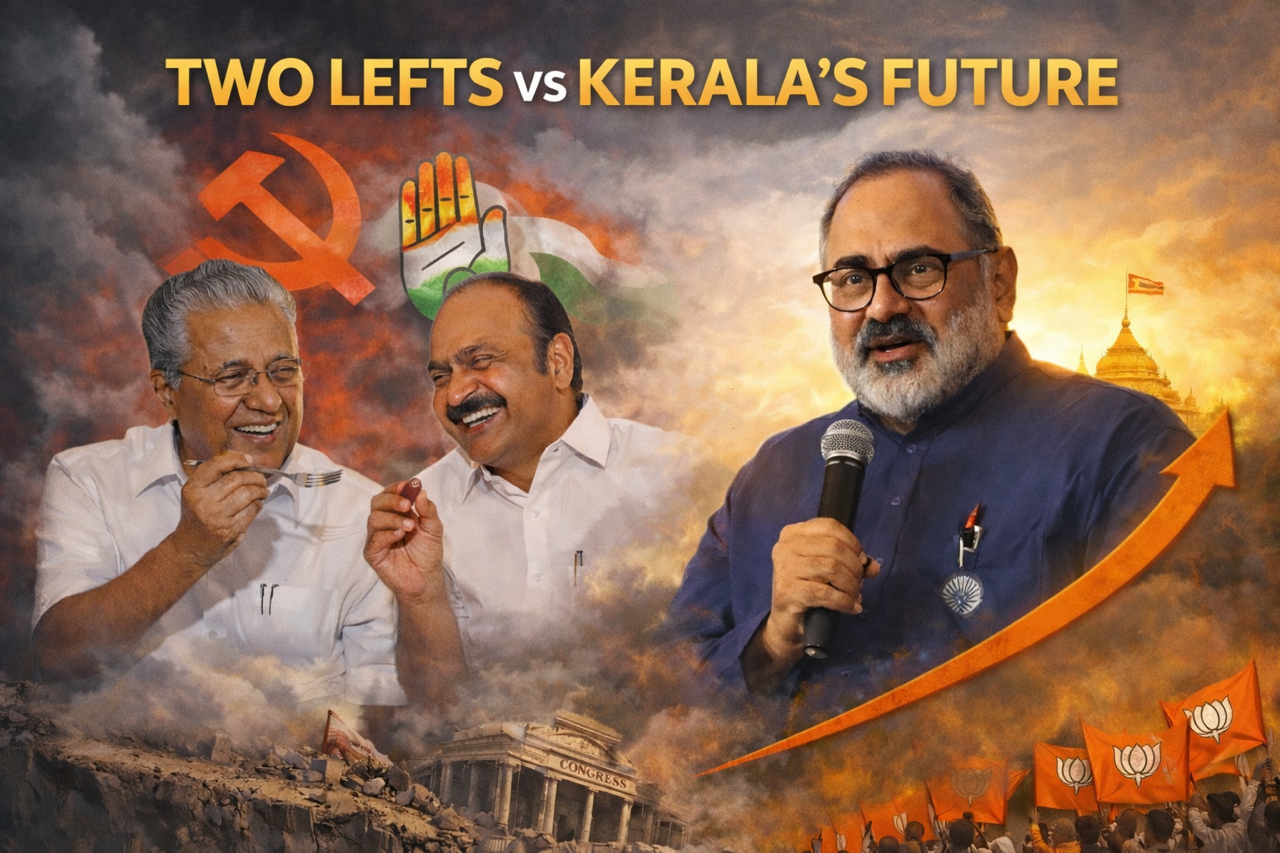
For decades, Kerala has rotated between the Indian National Congress and the Communist Party of India-Marxist (CPM), believing they offer different directions. In reality, both operate within the same ideological framework of control and socialism.
The south Indian state of Kerala is not lacking talent, education, or global exposure. What it lacks is political honesty.
For decades, we have been told that we are choosing between two different paths. The United Democratic Front (UDF) or the Left Democratic Front (LDF). The Indian National Congress and the Communist Party of India-Marxist (CPM). Left or right.
But let us be honest with ourselves.
Congress and CPM are birds of the same feather. The fundamental problem in Kerala is that these two parties have been acting as the left and the right, when in reality, both operate within the same ideological space.
That is precisely why Kerala remains stuck. It is socially vibrant, highly educated, and globally connected, yet economically constrained and structurally stagnant.
Both formations believe in an expanded role of the state, heavy regulation, bureaucratic control, and a mindset that views private enterprise with suspicion rather than respect. One calls it welfare with moderation, the other calls it ideology with conviction, but the outcome for the common citizen is largely the same — limited opportunity, delayed growth, and a system that rewards compliance more than creativity.
Kerala did not achieve its global standing because of these governments. It achieved it in spite of them.
The 27 states and 8 union territories reality
This is not just a theoretical argument. Across India, Congress and Marxist parties are working together in alliances, understandings, and cooperative arrangements that span as many as 27 states and 8 Union Territories.
Read more columns by Vinson Xavier Palathingal
As state BJP President Rajeev Chandrasekhar pointed out, whether through alliances, coordination, or mutual support, this is not a coincidence. It reflects the scale of their ideological alignment. They may fight each other in Kerala, but across the rest of India, they have no hesitation in standing together when it suits them.
That tells you clearly that this is not an ideological battle. At the core, they believe in the same system.
Legacy of enterprise ignored by politics
Kerala Christians trace their roots back to the earliest days of Christianity, and Kerala Muslims emerged through trade links during the time of the Prophet. These are not communities shaped by state patronage or ideological dependency.
They are communities built on mobility, commerce, risk-taking, and global engagement.
From the spice routes to the Gulf migration, from family businesses to multinational careers, Kerala’s social fabric has always been deeply entrepreneurial. The success of Malayalees across the world is not an accident. It is a continuation of this civilizational instinct.
And yet, there exists a striking contradiction.
The most business-oriented communities in India continue to support political formations that fundamentally do not trust business. This is not just ironic. It is self-limiting.
When the opposition wants to be more left
The situation becomes even clearer when we listen to the leaders themselves.
State Congress leader V.D. Satheesan, a contender for the chief minister’s post if the UDF wins, has openly and proudly declared that he is more left than Chief Minister Pinarayi Vijayan. That is not a slip of the tongue. It is a statement of positioning. It reveals that even the so-called opposition in Kerala is not offering an alternative ideology, but rather competing within the same framework to prove ideological purity.
CPM represents hard socialism. Congress represents softened socialism. But both share a core belief in state control, regulatory expansion, and a suspicion of wealth creation.
READ: India’s Kerala state shows how to fight Coronavirus (March 18, 2020)
This is reflected in the outcomes Kerala continues to experience. High unemployment among educated youth, a weak industrial ecosystem, heavy reliance on remittances, and a steady outflow of talent to other states and countries.
A system that consistently exports its best minds is not a system that is working.
The politics of patronage
Another dimension of this problem lies in how both UDF and LDF have used the machinery of the state.
Over time, government positions, boards, and public institutions have increasingly been treated not as instruments of governance, but as extensions of political reward systems.
There is a widespread and growing perception that political appointees are rotated across boards and quasi-government institutions, that short-term roles are structured in ways that enable long-term benefits, and that party loyalty often finds pathways into positions that should ideally be governed by merit.
Whether through controversies around appointments or through patterns that the public increasingly recognizes, the message that gets reinforced is troubling. Government is not merely serving the people. It is serving a network.
And in such a system, the entrepreneur, the professional, and the independent thinker are often left navigating unnecessary barriers, while others benefit from proximity to power.
Policy paralysis
The story of Kerala’s economic stagnation can be clearly seen in the real estate sector.
During the tenure of Chief Minister Achuthanandan of CPM, a series of rigid policies, such as artificially fixed fair values, high registration charges, and strict enforcement frameworks, began to suffocate organic growth in the sector. Instead of enabling market-driven expansion, the system became overcontrolled and disconnected from reality.
READ: #PoMoneModi is the retort to PM Modi speaking about Somalia in Kerala (May 11, 2016)
What is even more telling is what followed.
When Congress came to power, none of these policies were meaningfully reversed. They continued the same framework, the same thinking, and the same control.
This continuity reinforces a simple truth. Despite political rivalry, their economic mindset is identical.
The result is a system where growth is managed, not encouraged. Compliance becomes more important than innovation. Opportunity is shaped by rules rather than driven by potential.
The broader national context
At the national level, the past decade has seen a different direction.
Under the Bharatiya Janata Party (BJP)-led government, India has undergone significant changes in infrastructure, digital systems, and business facilitation. Highways, airports, logistics networks, digital payments, and direct benefit transfers have transformed the way the economy functions.
India today stands among the leading startup ecosystems in the world. Digital platforms like UPI have revolutionized everyday transactions. The Goods and Services Tax (GST), introduced by the BJP-led government in 2017, has unified taxation and improved transparency.
Equally important, despite constant predictions of unrest, India has not seen sustained nationwide instability during this period. In a country of this size and diversity, challenges will arise, but the system has remained stable and growth-oriented.
The direction is clear. It is toward development, efficiency, and opportunity.
Kerala is different and must be understood that way
Kerala is not like other states, and any serious political force must understand this.
Its social composition and history make it unique. The deep roots of Christianity and Islam in Kerala are not superficial. These communities are confident, entrepreneurial, and deeply integrated into society. They cannot be politically handled with a one-size-fits-all approach.
Leaders like Rajeev Chandrasekhar have demonstrated this understanding. His engagement with Christian concerns, including efforts related to supporting nuns who faced legal challenges in North India, shows responsiveness and respect.
And let us address one fear directly.
No political force can change Kerala’s food culture. No BJP can stop a Keralite’s fascination with beef. That fear is politically manufactured, not socially grounded.
Kerala will remain Kerala.
Breaking the monopoly: Why balance matters
Kerala’s problem is not a lack of talent or resources. It is a lack of political balance.
When two dominant forces operate within the same ideological framework, the system does not correct itself. Policies remain the same, inefficiencies continue, and opportunities are lost.
Even a modest shift in this election, say the BJP securing around 8 to 10 seats, can begin to change this dynamic. It can prevent Congress from once again claiming space as the only alternative and accelerate its long-term decline.
A party that remains out of power for too long cannot survive on legacy alone.
The inevitable political realignment
At that point, Kerala may finally evolve into a system where there is a real left and a real right.
CPM on one side and BJP on the other.
That is when democracy starts working properly.
And when that shift happens, today’s leaders will have to make real choices.
Satheesan, with his more left-leaning than Vijayan’s positioning, may eventually become a natural fit within the CPM itself. Other Congress leaders V.T. Balram, P.C. Vishnunath, and Shashi Tharoor, and so many like them, faced with shrinking political space, may ultimately be forced to move toward the BJP.
Politics has a way of forcing clarity.
The real question before Kerala
At its core, this is not about religion. It is about economics, opportunity, and the future of the next generation.
To the people of Kerala, especially Christians and Muslims, this is a moment to think clearly and locally.
In Kerala, no one is coming after you. No one is threatening your identity, your faith, or your way of life. That fear is irrational and politically amplified.
What is real is economic stagnation. What is real is the lack of opportunity. What is real is your children leaving the state for a better future.
I say this as a Christian who has been called “Chrisanghi” for years. Not because I changed my faith, but because I said something simple. The BJP, the so-called Hindu party, has better economic policies. That is my only point. My support is not about religion. It is about economics, opportunity, and the future of our children. Labels are easy. Facing reality is harder.
So ask yourself a simple question.
Do you want a system that controls you, or one that enables you?
Kerala has everything it needs. Education, global exposure, and a deeply entrepreneurial society.
What it has lacked is political balance.
A stronger BJP is not about ideology alone. It is about breaking a monopoly that has limited Kerala’s potential for decades.
Kerala does not need another election between two lefts. It needs a future that finally moves forward.