



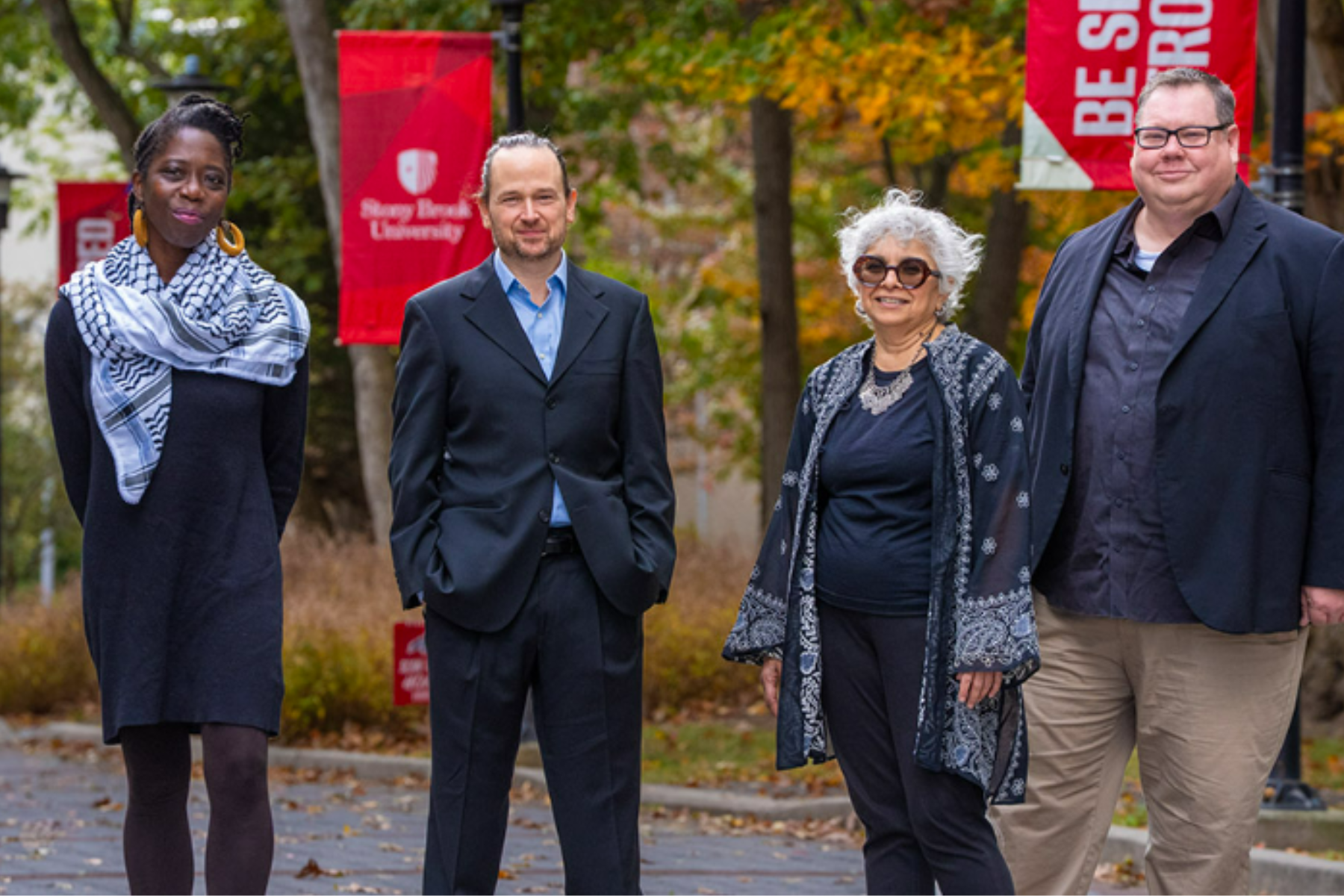
As artificial intelligence becomes a standard fixture in higher education, Stony Brook University scholars led by Indian American sociologist Manisha Desai have launched a new initiative to ensure the technology does not undermine democratic values.
Desai, executive director of the Center for Changing Systems of Power, and her colleagues have won a $300,000 Mellon Sawyer Seminar grant to fund a multi-year project titled “The Practice of Democracy and Academic Freedom.”
She received the grant with Michael Rubenstein, professor, the Humanities Institute, College of Arts and Sciences, Abena Asare, associate professor, Africana Studies, CAS), and Robert Chase, associate professor, Department of History, CAS).
“Technologies reproduce the inequalities of the society in which they’re created,” said Desai, Empowerment Trust Endowed Professor of Global Citizenship at the State University of New York.
“The goal is to move beyond the technical side of AI,” she said. “We are looking at how these systems might mirror or even amplify the gendered, racial, and colonial hierarchies that already exist in our society.”
Read: Indian American researcher Tejal Desai elected AAAS fellow
The seminar will kick off with a dedicated planning year, prioritizing the creation of a “collaborative commons” for faculty and students. Rather than focusing on software efficiency, the team will host symposia and workshops aimed at protecting free inquiry and ensuring that AI implementation remains rooted in human rights.
Desai, brings a global perspective to the project shaped by her upbringing and foundational education in India. Her academic journey began on the subcontinent before she transitioned to the United States, and she has spent decades documenting grassroots resistance and social movements in her home country.
Her previous scholarship notably explored the “subaltern” movements in Gujarat, where she analyzed how local communities navigated the pressures of neoliberal development.
Desai’s current work in India continues to inform this human-centric approach. She is currently collaborating with more than 2,000 women farmers in Maharashtra to study climate-resilient agriculture.
By treating these women as co-researchers, Desai ensures that the knowledge produced benefits the community directly, a philosophy of “co-produced knowledge” that will be a cornerstone of the Stony Brook AI project.
By examining the ubiquity of digital tools, the research team hopes to provide a roadmap for institutions to adopt AI intentionally while safeguarding the democratic principles of the modern university.