



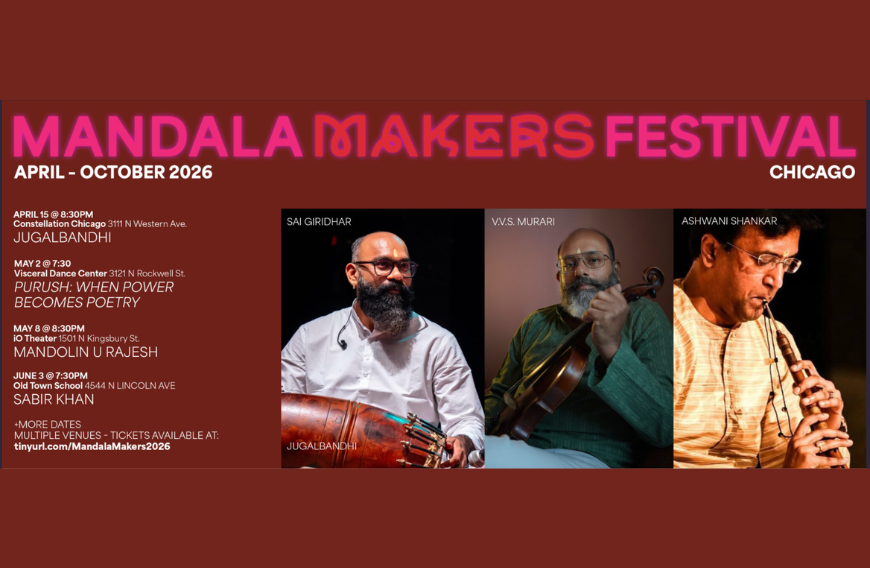
“Mandala presents a festival with the mission: to promote the new and next in the performance of South Asian dance and music.”— Pranita Nayar, founding artistic director, Mandala South Asian Performing Arts
These are times fraught with debates around identity, culture and assimilation in America. If you are an immigrant, the recent few months must have forced you to negotiate questions around visibility and freedom of cultural expressions. While there have been instances where the political rhetoric and racial hierarchy has led to questions around a need for indigenization, if sociologists are to be believed then such divisive messaging is often best addressed through art and creative expression.
And that is what a Chicago-based arts festival is powerfully achieving. Mandala South Asian Performing Arts is currently showcasing its eighth annual Mandala Makers Festival, which opened April 15. The festival that runs through October is using Indian classical music, and performing arts to beautifully display what multiple identities in America look like today.
READ: Sumathy Ram to release tribute album honoring legendary composer M.S. Viswanathan (January 13, 2026)
The theme chosen for this year, “live composition,” is especially relevant. “The annual multi-disciplinary arts festival celebrates creativity, diversity and innovation of South Asian artists in the United States and the global diaspora,” says Pranita Nayar, founder and artistic director of Mandala South Asian Performing Arts.
She adds, “The festival highlights both traditional and contemporary expressions while honoring cultural heritage. Through performances, community gatherings and collaborative programming the festival brings together artists and audiences to experience the richness of South Asian culture and amplify voices shaping the future of diasporic arts.”
Reclaiming narrative space
Like many big cities across America, Chicago too boasts of an Indian corridor – Devon Avenue – a busy, intersection of streets lined with South Asian businesses, cultural spaces, ethnic wear and a large South Asian population. It was here, back in 2019, Launched in 2019 in Chicago, that the festival initially started. Today it has evolved from intimate performances in the Devon Avenue corridor into a citywide platform inviting artists from across the country. The organizers through their various programs aim to center South Asian voices not just as heritage, or exotic but as dynamic dialogues that are part of America’s contemporary map.
READ: Indian American singer Malvika fuses Bharatanatyam influences and pop in new EP (February 22, 2026)
The concert opened with jugalbandhi, a confluence of north-meets-south Indian classics with violinist VVS Murari, shehnai player Ashwani Shankar, and percussionist Sai Giridhar. The performance followed like a conversation between regions, styles, and sensibilities. One of the festival’s most anticipated performances, “Purush: When Power Becomes Poetry,” staged at Visceral Dance Theater, challenges both Western assumptions and internal hierarchies within South Asian culture.
Classical Indian dance forms like Bharatanatyam, Kathak, and Odissi have, in modern practice, often been feminized—particularly in diaspora settings. “Purush” disrupts that narrative by centering male dancers, not as anomalies but as inheritors and innovators of these traditions. Artists like Colin Mascarenhas and Kiran James bring decades of training and a mesmerizing coalition of culture in contemporary spaces.
Come June and a concert at the Old Town School of Folk Music would feature sarangi maestro Sabir Khan and tabla artist Hindole Majumdar. Curated by veteran producer Brian Keigher, whose work spans global stages and major cultural institutions, the festival is as much about artistic excellence as it is about cultural positioning.
For immigrants, programs such as these are more than performances. They are in fact a living archive of how South Asian Americans are choosing to represent themselves on the world stage.