



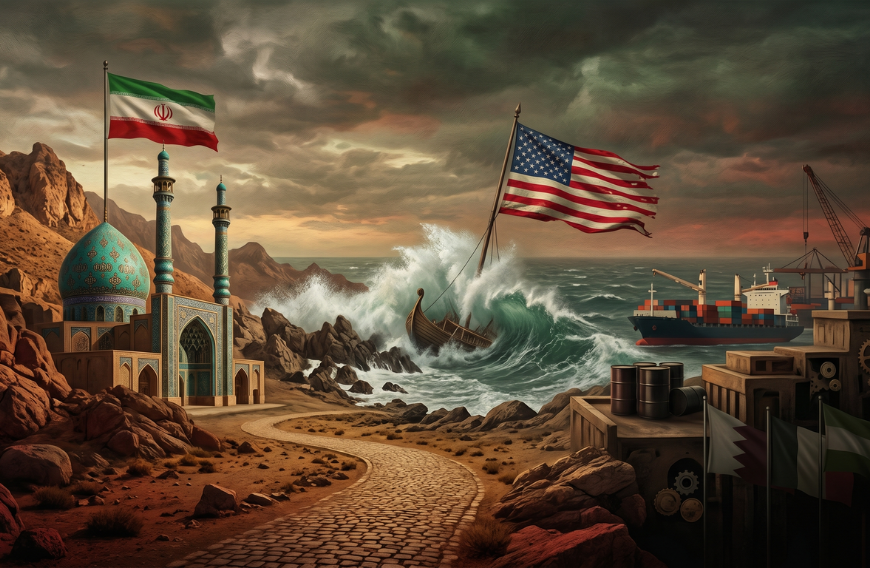
No naval blockade breaks the people who draw their identity from Karbala. No bomb destroys a narrative fourteen centuries old. The real question is not whether Iran will fold — I am certain it will not. The question is whether the world will find its conscience before the damage becomes irreversible.
A mind built for the deal, not the consequence
I have spent weeks trying to read Donald Trump’s moves on Iran. The honest answer is — there is no grand strategy to decode. Trump runs on instinct, ego, and two numbers he watches like a hawk: his approval rating and the Dow Jones. Everything else is noise. The highs and lows are not confusion. They are the behavior of a man who mistakes motion for strategy — who believes that if he keeps everyone off balance, including his own team, he maintains leverage. What he does not understand is that this only works against people who fear uncertainty. Iran does not fear uncertainty. Iran was built by it.
The Hormuz whipsaw of the past 48 hours tells the whole story. Iran opens the Strait on Friday — oil drops 11%, the Dow jumps over a thousand points. Trump immediately announces the blockade stays. Iran closes the Strait again within hours. Markets reverse. This is not diplomacy. This is a man who cannot resist claiming a win before the win is real, and in doing so, destroys the very conditions that might produce one.
“He is not playing chess. He is flipping the board and expecting the other side to concede from shock. Iran has seen this before. Many times. It does not shock easily.”
The dirtiest trade no one is naming
I want to name something that financial media dances around carefully. This Hormuz open-close cycle is not just diplomatic theatre — it is, functionally, a wealth transfer. When the Strait opens, retail investors exhale and buy in. When it closes again hours later, they panic and sell. The hedge fund managers and institutional desks who know the diplomatic reality before it becomes a headline are positioned perfectly on both sides of that swing. They buy the dip, sell the spike, and pocket the difference — while the pensioner in Ohio and the small saver in Karachi absorb the loss.
READ: Iran’s hardball and Trump’s bluff: The market time bomb ticking before April 21 (April 18, 2026)
A sitting U.S. congressman has already launched an investigation into suspicious oil trades timed precisely to this conflict. The pattern is too clean, too consistent, to be coincidence. I call it sinful — and I mean that word in its full weight. It is the machinery of a system that converts the suffering of millions into the profit of a few. Every Iranian family denied medicine by sanctions, every tanker crew navigating mined waters, every ordinary person watching their savings evaporate in a manufactured swing — they are all subsidising someone’s bonus in a tower in Manhattan.
What History Remembers
History never remembers the hedge fund manager who timed the war trade perfectly. It remembers the mother in Tehran who could not get insulin. It judges those who had the power to end the suffering and chose instead to extend it for one more market cycle.
WHY IRAN WILL NOT BREAK — THE ANSWER IS KARBALA
To understand Iran’s refusal to yield — not just politically, but in the bones of the people — you have to understand what Karbala means. Not as a historical footnote. As a living identity. As the lens through which tens of millions of people interpret their present moment.
In 680 CE, Imam Hussain ibn Ali — grandson of the Prophet Muhammad, peace be upon him — stood on the plains of Karbala with seventy-two companions against the army of Yazid ibn Muawiyah. He was surrounded. Outnumbered. Cut off from water in the desert heat. Every rational calculation said submit, negotiate, accept survival on Yazid’s terms. Hussain refused. Not from recklessness — from a moral certainty that some submissions are more destructive than death. To legitimise Yazid’s tyranny by accepting it was, to him, a betrayal that no survival could justify. He stood. He fell. And in falling, he became the most powerful force in Shia Islamic consciousness for the next fourteen centuries.
“Every Day Is Ashura — Every Land Is Karbala,” this is not a slogan Iranian leaders paste on walls for propaganda. It is a complete worldview baked into the spiritual DNA of the culture. It says: when you face a Yazid — a tyrant demanding the surrender of your conscience — resistance is not a political choice, it is a sacred obligation. Suffering in that resistance is not a cost to be avoided. It is a participation in something eternal.
Look at Iran’s position today through this lens. Their supreme leader assassinated. Nuclear scientists killed. Infrastructure bombed. The United States — the most powerful military force in human history — alongside Israel, blockading their ports and threatening renewed strikes. Muslim nations that should stand beside them watching in silence or quietly cooperating with Washington. By any rational calculus, this is the moment to yield.
But rational calculus is not the operating system. Karbala is. And in the Karbala operating system, this moment — surrounded, outgunned, abandoned by those who should be brothers — is not a crisis. It is a confirmation. It is the plains of Karbala, again. And the instruction from Karbala is clear: you do not hand Yazid your sword.
THE BETRAYAL OF MUSLIM NATIONS — A KARBALA ECHO
There is a dimension of this crisis that cuts me deeply. At the original Karbala, the people of Kufa had written to Hussain, invited him, sworn their loyalty. When Yazid’s army arrived, they melted away. They chose safety over conscience. They handed Hussain his isolation.
From ceasefire collapse to blockade: How Pakistan rose and India stood still in the US-Iran crisis (April 13, 2026)
I see that parallel with painful clarity today. Saudi Arabia, the UAE, Jordan — nations that share the same faith, that fill their mosques with prayers for Palestine, that condemn Israel in their media — have kept their economies aligned with Washington, their airspace available to American operations, their silence purchased with security guarantees. They are the Kufa of this moment. And Iran knows it. The Iranian street knows it. Far from breaking morale, this abandonment deepens the Karbala identification. It tells every Iranian: we are truly alone with our conscience, exactly as Hussain was on the morning of Ashura. And that is precisely where Hussain chose to be most himself.
Hussain had seventy-two souls with him. Iran has eighty million. The mathematics of empire say this conflict should be straightforward. The mathematics of Karbala say it never is.
Genocide 1.0 — calling what it is
I refuse to use diplomatic language for what I am watching. Gaza has been systematically destroyed — a process the International Court of Justice itself found plausibly genocidal. Lebanon is bleeding under Israeli strikes that have continued through every ceasefire announcement. And now Iran’s civilian infrastructure has been bombed from the air while its people are blockaded from medicine and commerce.
The common thread across all three is this: the people dying are not the people deciding. Palestinian families in Gaza did not design military strategy. Lebanese villagers did not command missile units. Iranian civilians did not build centrifuges. They are simply the population that happens to live in the geography that powerful men have decided to make a battlefield. They have no vote in this. They have no seat at the table in Islamabad. They have no Truth Social account. They just have the consequences.
Trump cannot hold this moral weight because in his framework, populations are leverage — suffering is a dial you turn up until the adversary yields. What he cannot compute is that for a people shaped by Karbala, suffering is not a dial. It is a testimony. The more you turn it up, the more confirmed they feel in their identity. The bomb does not break the narrative. It feeds it.
THE CREDIBILITY CLIFF TRUMP IS WALKING TOWARD
Strip away everything and Trump’s situation is simple: he needs a headline win before the American economy buckles further. The tariff war has already damaged growth. Oil shocks are reigniting inflation. The market rally of last week was built entirely on his words — not on any economic reality. When the “big boys,” the sovereign wealth funds and the institutional asset managers, conclude that a president’s statements cannot be traded on, they do not just sell. They build in a permanent credibility discount. Every future Trump announcement — on any subject — gets marked down before anyone checks whether it is true.
He is burning a reserve of financial credibility that took decades to build around the office of the US presidency. Each flip flop, each “almost done” that collapses within hours, each Hormuz opening that closes the next morning — it is a withdrawal from that reserve. And he is doing it in a negotiation against a side for whom credibility is not a market commodity. For Iran, credibility is a covenant with the martyrs. You do not renegotiate a covenant for a better headline.
The Indian chapter — ships silence & electoral theater
Yesterday Iran fired on two Indian-flagged tankers in the Strait of Hormuz — ships it had itself cleared to pass. India summoned the Iranian ambassador in what its foreign ministry called the “strongest terms.” Seven more India-bound vessels were turned back. One of those ships was carrying nearly two million barrels of Iraqi oil.
The immediate question everyone is asking is whether Iran is trying to drag India into this conflict. I do not think so. What I think happened is that the IRGC’s left hand does not know what the diplomatic right hand is doing. Iran’s own ambassador had publicly thanked India for being a “compassionate and reliable partner” — the day before the gunboats opened fire on Indian ships that had Iranian clearance. That is not strategy. That is a command structure falling apart under the weight of a decapitated leadership.
But here is what nobody is asking — and this is the question that matters more to me. Why is Iran still treating India as a friendly neutral in the first place? What has India actually done to deserve that courtesy?
“Modi flew to Tel Aviv, put his arm around Netanyahu, and called Israel his fatherland and motherland. Iran’s supreme leader was assassinated. Modi said nothing. Not a condolence. Not a diplomatic whisper. Silence — complete and deliberate.”
No condemnation of the strikes on Iran. No expression of concern for Iranian civilians. No acknowledgement that a head of state had been killed in what by any measure was an act of war. India — which performs elaborate diplomatic neutrality on Ukraine, which carefully balances every statement on every conflict — went completely mute when Iran bled. And before that, Modi had stood on Israeli soil and used the words “fatherland” and “motherland” — language no Indian prime minister had ever used about a foreign country — at the precise moment that country’s military operations were the subject of global horror.
Iran let it pass. Iran kept the oil flowing to India. Iran kept India-bound ships on the cleared list. Because Iran needs the fiction of at least one large friendly nation. The desperation of isolation makes you overlook things you should not overlook.
Modi’s Israel visit was never just foreign policy
I want to say this plainly because I think it needs to be said. Modi’s embrace of Netanyahu — the timing, the language, the deliberate absence of any humanitarian caveat — was not purely a foreign policy statement. It was domestic electoral engineering of the most cynical kind.
Look at which state elections were approaching. Kerala, where the Muslim community is organised, politically conscious, and electorally significant. Bengal, where Mamata Banerjee’s coalition is partly sustained by Muslim support that the BJP desperately needs to fracture or neutralize. Assam, where Muslims represent roughly a third of the population and where the BJP’s entire strategy rests on consolidating the Hindu vote through a politics of perceived threat.
The BJP does not need to win the Muslim vote in these states. It needs to make the Hindu voter feel that a clear line exists — us and them, here and there. What image draws that line more vividly than the Prime Minister of India standing in Tel Aviv with Netanyahu, declaring emotional attachment to the Jewish state, at the precise moment the Muslim world is watching Gaza buried under rubble and Iran bombed from the air?
Every television screen in Kerala, Bengal and Assam carried that image. Every WhatsApp group in every town processed it. It required no speech, no rally, no explicit communal appeal. The photograph did the work. Modi understood this perfectly. The visit was timed, framed and executed as an electoral signal dressed in the clothing of foreign policy.
The Cost of This Calculation
Somewhere in a political backroom in Delhi, a calculation was made: how do we use the images of Iranian bombs and Palestinian rubble to move votes in Assam? That is the distance between the people making decisions and the people paying the consequences. Iranian families losing sons. Palestinian mothers identifying children by their clothes. Lebanese villages reduced to dust. And in Delhi — a photo opportunity, carefully timed for the election cycle.
And here is the part that strikes me as almost poetic in its cynicism. Modi got everything he wanted from both sides simultaneously. He got the electoral optics of standing with Israel — the signal to the Hindu nationalist base. He got the continued economic benefit of Iranian oil — because Iran was too isolated and too desperate to cut off one of its last major customers. He condemned nothing. He mourned nobody. He paid no price on either side of the equation.
That is not strategic autonomy — the phrase India’s foreign policy establishment loves. That is strategic opportunism. It is the art of extracting maximum benefit from other people’s suffering while maintaining just enough ambiguity to avoid accountability.
TRUMP GRIPPED WITH FEAR — THE LEAK THAT CHANGES EVERYTHING
While I was writing this piece, Drudge Report — the site that helped make Trump — put a single banner headline across its front page: “LEAK: TRUMP GRIPPED WITH FEAR.” That is not a partisan attack. That is the most widely read political aggregator in America, built by a man who championed Trump, broadcasting to the world that this president is running scared.
The celluloid state: Decoding the polarizing power of Dhurandhar (March 26, 2026)
The leak itself came through the Wall Street Journal and The Daily Beast. Here is what was reported. When Trump was briefed that two American fighter jets had been shot down over Iran and the crew were missing behind enemy lines in the mountains of Iran, he did not compose himself. He did not gather his national security team with calm authority. He lost control. He went into a tirade that lasted hours. His ranting became so disruptive, so unbearable, that senior administration officials had to ask the President of the United States to leave the room so they could get the rescue mission organised.
Read that again. The Commander-in-Chief was removed from his own war briefing because he was too chaotic to be in it.
But here is the detail that cuts deepest. When Trump was wailing in the West Wing while his men were in the mountains of Iran, what was he wailing about? Not the soldiers. He was “wailing about gas prices.” He was panicking about Jimmy Carter. “If you look at what happened with Jimmy Carter — with the helicopters and the hostages — it cost him the election,” Trump said. “What a mess.”
Two American airmen were evading capture in enemy territory. And Trump’s mind was on his electoral legacy.
This is the man negotiating with Iran. This is the man whose Truth Social posts move oil markets by 11%. This is the man whose credibility the “big boys” of Wall Street are betting their positions on. A man who was asked to leave the room during his own war.
Iran’s embassies understood this immediately. The Iranian mission in India told him to “get a grip on yourself, old man.” The embassy in South Africa called on officials to invoke the 25th Amendment — the constitutional provision for removing a president deemed unfit. The embassy in Vienna placed an adults-only warning over his expletive-laden Truth Social post.
They are not wrong to read it this way. A president who screams about gas prices while soldiers are missing is not a president conducting strategy. He is a man conducting panic. And panic, in a negotiation with a people shaped by Karbala, is the most dangerous thing you can bring to the table. Because Karbala teaches that the side which panics has already told you everything you need to know about how this ends.
THE FULL PICTURE — EVERYONE PROFITS, CIVILIANS PAY
When I put the complete picture together — Trump’s market manipulation transferring wealth from ordinary savers to hedge funds, Israel’s military operations backed by American bombs, Muslim nations choosing silence over solidarity, Modi’s electoral theatre built on Iranian and Palestinian suffering, and Iran standing alone firing on ships it cleared itself — what I see is not a geopolitical conflict. It is a system in which every powerful actor extracts what they need while the bill lands on people who had no vote in any of it.
The Iranian civilian who cannot get medicine. The tanker captain pleading over radio for gunboats to stop firing on a ship that was cleared to pass. The Indian pensioner whose savings whipsawed on a Hormuz announcement that reversed in eight hours. The voter in Assam whose communal anxieties were deliberately inflamed by a photograph taken six thousand miles away. None of them were in the room where any decision was made. All of them are living the consequences.
Iran returning those Indian ships — or rather, the IRGC’s chaotic firing on them and the subsequent diplomatic scramble — is a small moment in a vast moral catastrophe. But it reveals the whole architecture. Every actor in this drama, from Washington to Tel Aviv to Delhi, is playing a game with other people’s lives. And the only ones not playing a game — the ones for whom this is entirely, unbearably real — are the ones with the least power and the loudest silence around them.
Final Word
History will be unsparing. The most powerful military alliance in human history, armed with precision bombs and blockades, directed against civilians who did not choose their government — while the world’s financial system is manipulated in real time to extract profit from the carnage, and the world’s largest democracy uses the spectacle of that carnage to win votes in three states. This is not geopolitics. This is cruelty distributed across multiple time zones and dressed in the language of security, sovereignty and electoral mandate.
Iran will not surrender. Not because its leaders are noble — they are not always. But because the Iranian people carry Karbala in their bones, and Karbala teaches one thing above all: there are submissions more destructive than death. Modi knows this. Trump knows this. Netanyahu knows this. They are all betting that economic pain will eventually override spiritual inheritance. Fourteen centuries of history suggests that bet is wrong.
The Muslim nations watching in silence, the Indian government performing neutrality while tilting toward Tel Aviv, the hedge funds positioned perfectly on every Hormuz swing — they will all find a way to explain themselves when the dust settles. They always do.
But the people of Kufa explained themselves too. And nobody remembers the explanation. They only remember that Hussain stood alone. Trump may get his deal or he may not. Yazid had a hundred thousand soldiers at Karbala and still lost the only thing that matters — the verdict of history. Power that crushes the body never crushes the story. It is always the story that wins.