



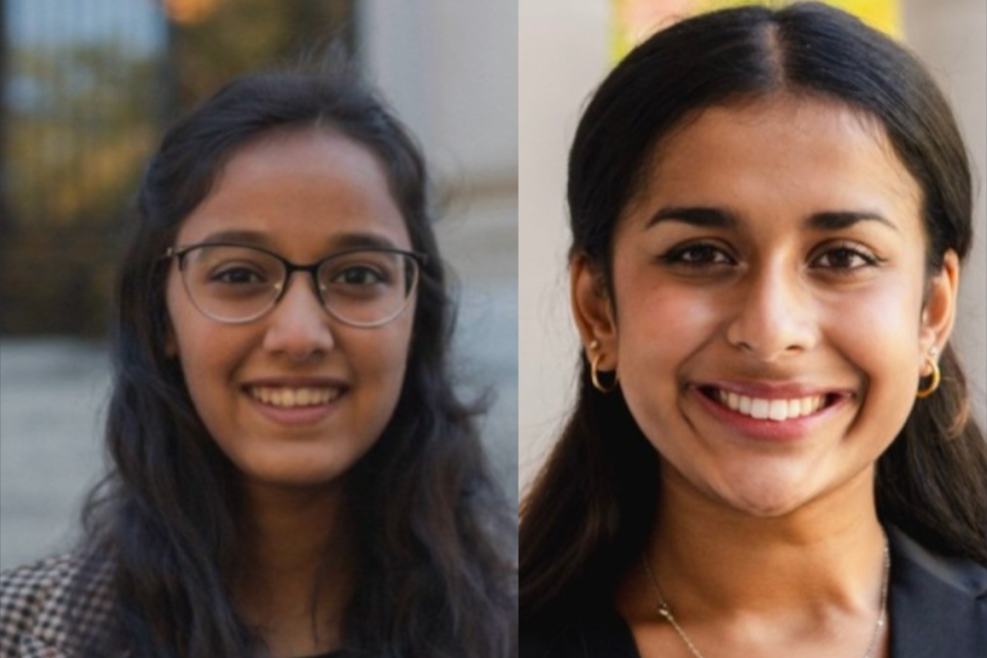
Four Indian American Harvard students — Sandhya Kumar, Ashini Modi, Arundhati Oommen, and Gauri A. Sood — have won the 2026 Thomas Temple Hoopes Prize for excellence in undergraduate work and in the art of teaching.
They are among 71 Harvard students and faculty members awarded the Hoopes Prize, which recognizes outstanding undergraduate scholarly work, most often senior theses.
Sandhya Kumar from Tallahassee, Florida was awarded for her submission entitled “Enteric Neurons Rapidly Prime Systemic Immunity in Response to Mucosal Infection,” supervised and nominated by Dr. Ruaidhri Jackson
Read: Four Indian American academics cleared for Stanford jobs
Ashini Modi from Louisiana was awarded for her submission entitled “Finding the Right Match Fast: Factors Influencing the Speed-Stringency-Stability Tradeoff in RecA-Mediated Homology Recognition During Double Strand Break Repair,” supervised and nominated by Professor Mara Prentiss.
Arundhati Oommen from Salt Lake City, Utah, was selected for her submission entitled “When Luck Becomes the Arbiter: Responsibility, Risk, and the Limits of Outcome-Based Judgment,” supervised and nominated by Professor Edward Hall and Professor Xiao-Li Meng.
Gauri A. Sood from Rochester, Minnesota won for her submission entitled “Who Is Human? Biases in Frontier Image Generation Models,” supervised and nominated by Professor Mahzarin Banaji and Dr. Lindsey Davis.
Student winners of the prize, funded by the estate of Thomas T. Hoopes, class of 1919, receive $5,000 to support future studies, while faculty nominators of winning projects receive $2,000.
Read: Two Indian American students win 2026 Truman Scholarships
Copies of winning projects are placed in the University Archives, and written projects are made available in Lamont Library for at least two years. The selection process begins with a faculty nomination and a two-paragraph evaluation of the student’s project.
Kashish Bastola, a Nepalese American from McKinney, Texas, also won the prize for his submission entitled “The CIA’s ‘Young Turks’: Tibetan Nationalists in the Cold War University,” supervised and nominated by Professor Erika Lee.
Bastola, whose thesis examined Tibetan nationalists in American higher education during the Cold War, said his family did not really understand the concept of his thesis, so it was very special to be able to share that with them.
He wrote that the support he received from friends and mentors was central to his thesis-writing process, particularly the guidance of his adviser, History professor Erika Lee.
“I really could not have written this thesis without the support of my friends and mentors,” he wrote. “My thesis advisor has been an extraordinary source of guidance and inspiration.”
Editor’s note: This story has been corrected from a previous version that misidentified one of the prize winners as Indian American. Kashish Bastola is Nepalese American.