



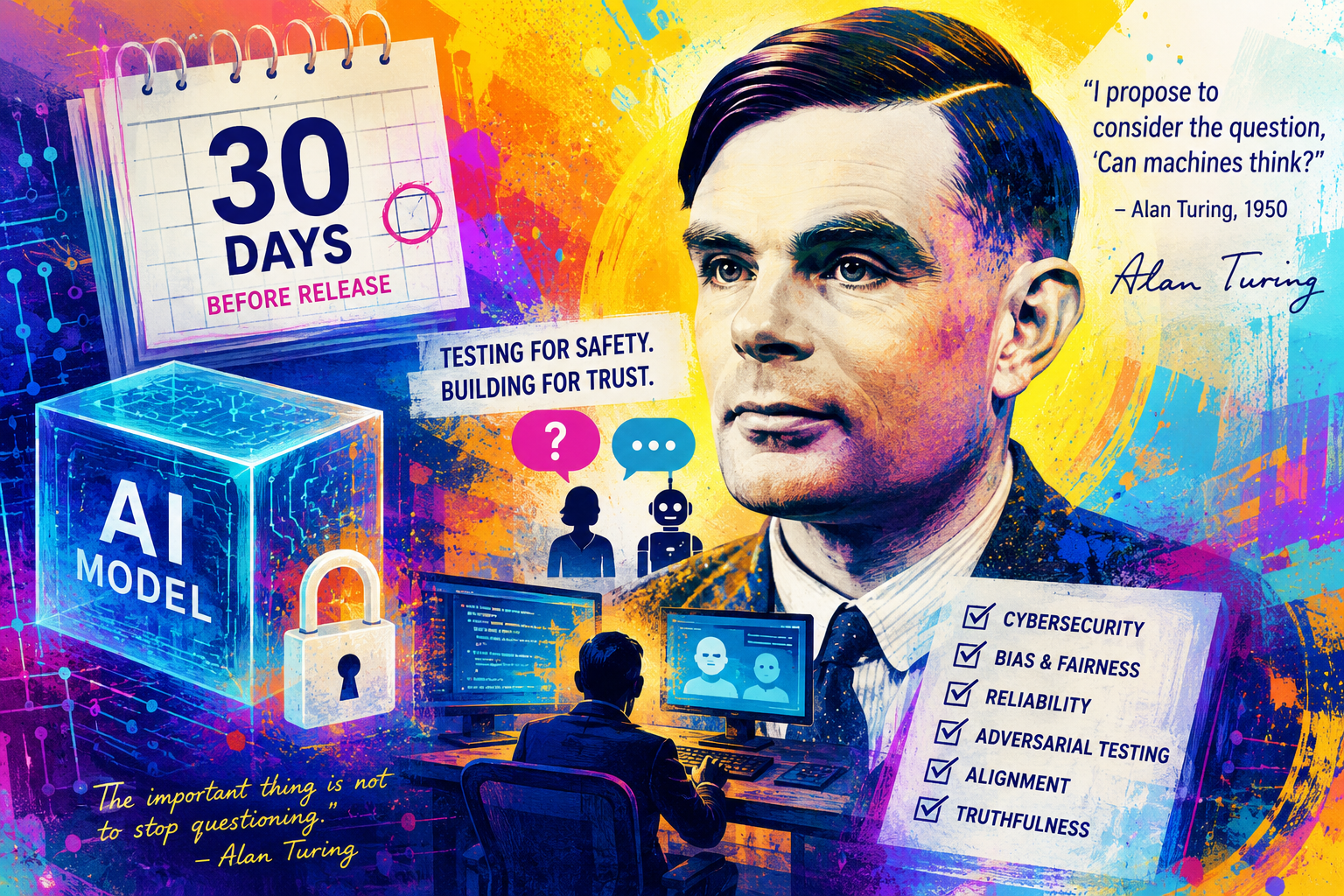
President Trump signed an executive order requiring advanced artificial intelligence companies to provide the federal government access to certain frontier models up to 30 days before public release has been presented as a pragmatic compromise between innovation and safety.
Supporters argue that it allows the government to identify cybersecurity vulnerabilities, national security risks, and dangerous capabilities before these systems reach the public. Critics argue that it represents unnecessary government intrusion into a rapidly evolving industry. Both sides, however, may be missing a more fundamental question: what exactly can be meaningfully tested in 30 days?
The challenge with artificial intelligence is that it does not behave like traditional software. A conventional software application can be tested against a finite set of requirements. An AI model, particularly a frontier model developed by companies such as OpenAI or Anthropic, is a probabilistic system whose behavior emerges from billions or trillions of parameters interacting across an almost limitless number of potential use cases. The notion that a government agency can conduct a comprehensive assessment of such a system in thirty days raises difficult practical questions.
Thirty days may sound substantial in a policy document, but in the lifecycle of modern AI development it is remarkably brief. Testing these systems is not analogous to inspecting a bridge before opening it to traffic. The behavior of large language models emerges through interactions with users, environments, prompts, adversarial attacks, external tools, and downstream applications that often cannot be fully anticipated before deployment. Many of the most important weaknesses in advanced systems are discovered only after thousands or millions of real-world interactions.
This creates a paradox. Superficial testing risks missing subtle but consequential flaws. Yet overly cautious interpretation of isolated failures could result in regulators delaying or discouraging legitimate innovation. The result is a double-edged sword. Regulators may miss genuine risks while simultaneously creating false alarms that impede progress.
More importantly, evaluating an AI model is not simply a matter of asking it questions and examining its answers. The quality of any model is inseparable from the quality of the data used to train it. Understanding model behavior requires examining data provenance, sampling methods, bias mitigation techniques, reinforcement learning processes, evaluation methodologies, and statistical weighting mechanisms. The question is not whether testing should occur. The question is who possesses the expertise necessary to perform such testing. Artificial intelligence evaluation is fundamentally multidisciplinary. A cybersecurity expert may identify vulnerabilities that a statistician overlooks. A physician may identify dangerous hallucinations in clinical reasoning that would be invisible to a software engineer. A behavioral scientist may recognize manipulation risks that neither group detects. Even if access to the models is granted, the question remains whether the evaluators possess the technical depth necessary to interpret what they are seeing.
Read more by Potarazu: 3 Reasons why AI solved a math problem humans could not for 80 years (May 31, 2026)
For decades, the most famous benchmark in artificial intelligence has been the Turing Test, proposed by Alan Turing in 1950. Turing replaced the philosophical question of “Can machines think?” with a more practical challenge. If a human evaluator could not reliably distinguish a machine from a human during conversation, the machine could be considered intelligent.
A model may pass a Turing Test and still produce inaccurate information. It may generate convincing misinformation, reveal cybersecurity vulnerabilities, facilitate fraud, or exhibit dangerous reasoning patterns. Conversely, a model may fail a Turing Test while still being extraordinarily useful and safe.
The Turing Test measures human-like conversational performance. It does not measure truthfulness. It does not measure cybersecurity risk. It does not measure alignment. It does not measure reliability. It does not measure robustness against adversarial attacks. Most importantly, it does not measure whether a model behaves safely when integrated into critical infrastructure systems.
In reality, evaluating modern AI requires an entire battery of tests. Researchers examine hallucination rates, benchmark performance, adversarial robustness, cybersecurity capabilities, bias metrics, reasoning consistency, calibration, interpretability, and domain-specific safety evaluations. Each of these dimensions requires specialized methodologies and expertise. There is no single test analogous to a vehicle crash test or a pharmaceutical clinical trial.
The administration is correct that some degree of oversight is necessary. Companies developing frontier models are attracting unprecedented amounts of capital and wielding increasing influence over economic, social, and national security systems. The consequences of failure are potentially significant. Voluntary transparency and structured evaluation frameworks are therefore reasonable objectives.
Read more by Potarazu: What would the great Hindu sages say about AI? (May 26, 2026)
The central question is not whether thirty days is enough. The central question is whether we have developed the scientific, statistical, and institutional capacity to understand what we are testing in the first place.
Artificial intelligence is rapidly becoming one of the most consequential technologies in human history. Oversight is necessary. Accountability is necessary. Transparency is necessary.
But meaningful governance requires more than access to a model. It requires expertise, methodology, and discipline. Without those foundations, a 30-day review period risks becoming little more than a symbolic gesture—one that creates the appearance of oversight while leaving the harder work of understanding artificial intelligence largely unfinished.