



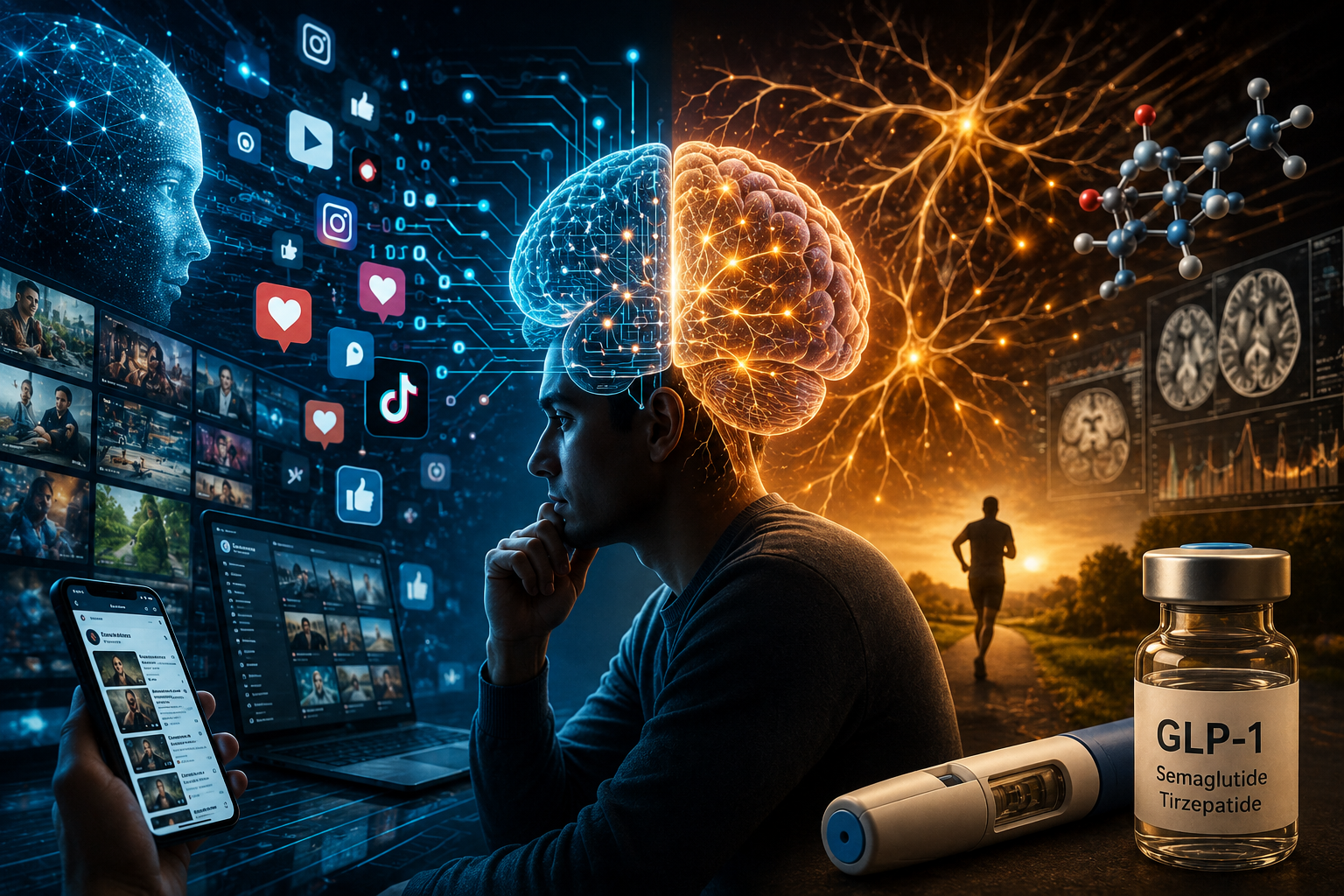
Artificial intelligence was created by trying to imitate the human brain but ironically in that process we have given up some of our attention and thinking capacity along the way . At the same time another innovation that millions of people are taking,, GLP-1, like Ozempic for diabetes and weight loss might actually improve our attention by acting on the brain, ultimately reducing the cravings and addiction to drugs, alcohol – perhaps even AI and social media .
Neural networks, the foundation of modern AI systems, were loosely modeled after the way neurons in the brain communicate, strengthen connections, recognize patterns, and adapt through repetition and feedback. We now rely on algorithms to navigate our lives and increasingly shape our decisions, while many of the same technologies are designed around exploiting the very reward pathways in the brain they were originally modeled after.
With advances in AI and social media our attention spans are shorter, sustained concentration feels harder, boredom has become intolerable,. Social media platforms, short-form video apps, recommendation engines, notifications, and now generative AI systems all compete aggressively for cognitive attention.
Read more by Potarazu: Anthropic wants to hit the brakes while stepping on the accelerator (June 6, 2026)
Recent research involving GLP-1 receptor agonists such as semaglutide and tirzepatide — (marketed as Ozempic, Wegovy, and Mounjaro )— suggests these drugs may influence far more than appetite and blood sugar regulation. These medications actually affect brain regions involved in craving, impulsivity, reward processing, attention, and executive control.
Interestingly , compulsive behaviors involving food, alcohol, nicotine, gambling, and possibly even social media and AI may share overlapping reward pathways in the brain.
Many patients taking GLP-1 and GIP agonists describe more than reduced appetite. They frequently report diminished cravings, fewer intrusive thoughts, reduced impulsivity, less compulsive behavior, and what some describe as a “quieting” of persistent mental noise. Originally these observations were discussed mainly in relation to food cravings, but the broader implications may extend into how the brain processes reinforcement, attention, and behavioral compulsion itself.
Human attention behaves very much like an addictive system. Endless scrolling feeds, intermittent notifications, algorithmically amplified outrage, social validation loops, and personalized recommendation systems continuously exploit the brain’s attraction to novelty and unpredictability. The nervous system evolved to prioritize emotionally important or rewarding stimuli because those mechanisms once served survival purposes.
The result is a population increasingly conditioned toward distraction, fragmented attention, compulsive checking behavior, and difficulty tolerating delayed gratification. Many people now instinctively reach for their phones during moments of silence, uncertainty, discomfort, or boredom because the brain has gradually adapted to continuous external stimulation.
Artificial intelligence may accelerate this process even further because generative AI systems increasingly reduce the cognitive friction historically associated with thinking itself. Although these technologies clearly offer enormous benefits, they may also gradually weaken some of the mental processes strengthened through effort, repetition, uncertainty, and intellectual struggle.
READ: 3 Reasons why AI solved a math problem humans could not for 80 years (May 31, 2026)
This is where the neuroscience surrounding GLP-1 therapies becomes especially important because it suggests that many modern compulsive behaviors may share common biological foundations
Modern algorithms continuously learn human preferences, emotional triggers, attentional vulnerabilities, and behavioral patterns with extraordinary precision. Recommendation systems optimize engagement in real time by adapting dynamically to psychological behavior, often shaping attention more effectively than individuals consciously regulate it themselves. In many respects, technology companies now understand how to manipulate attention at scale,
This creates a conflict because human beings generally assume that conscious choice governs behavior, while neuroscience increasingly suggests external systems like AI and social media capable of continuously exploiting these vulnerabilities and shaping human behavior in ways people barely recognize.
Researchers increasingly suspect these medications influence dopaminergic reward pathways and executive control systems involved in assigning importance to different behaviors and stimuli. This raises an uncomfortable but important question about the future relationship between technology and medicine.
If digital environments increasingly dysregulate attention and reward systems through constant behavioral reinforcement, while pharmacologic therapies emerge that may recalibrate those same systems, society may eventually attempt to medically manage vulnerabilities technology itself helped intensify.
At the center of this discussion is a basic scientific reality that neither neuroscience nor artificial intelligence has fully figured out: we still do not completely understand how the human brain creates thought, attention, craving, consciousness, or decision making.
AI can imitate parts of human thinking without actually being conscious, while neuroscience can observe brain activity without fully explaining why certain thoughts become compulsive, why cravings overpower rational thinking, or why our attention repeatedly gets pulled toward certain behaviors and stimuli.
That may be why the overlap between AI and GLP-1 research feels so important. One field is trying to recreate intelligence artificially, while the other is revealing how vulnerable and easily influenced human intelligence and behavior may actually be. Together, they expose an uncomfortable truth: human thinking and behavior may be far less independent and stable than we once believed.
The greatest irony may be that humanity built artificial neural networks by studying the human brain while simultaneously creating digital environments that increasingly disrupt the very biological systems those technologies were designed to imitate. Now medicine may eventually be used to restore balance to cognitive systems that technology itself helped destabilize.
The debate surrounding Ozempic, Mounjaro, and related therapies therefore extends far beyond obesity or diabetes because it ultimately raises a much larger question about the future of human agency, attention, and independent thinking in a world increasingly shaped by algorithms, AI systems, and engineered digital stimulation.