



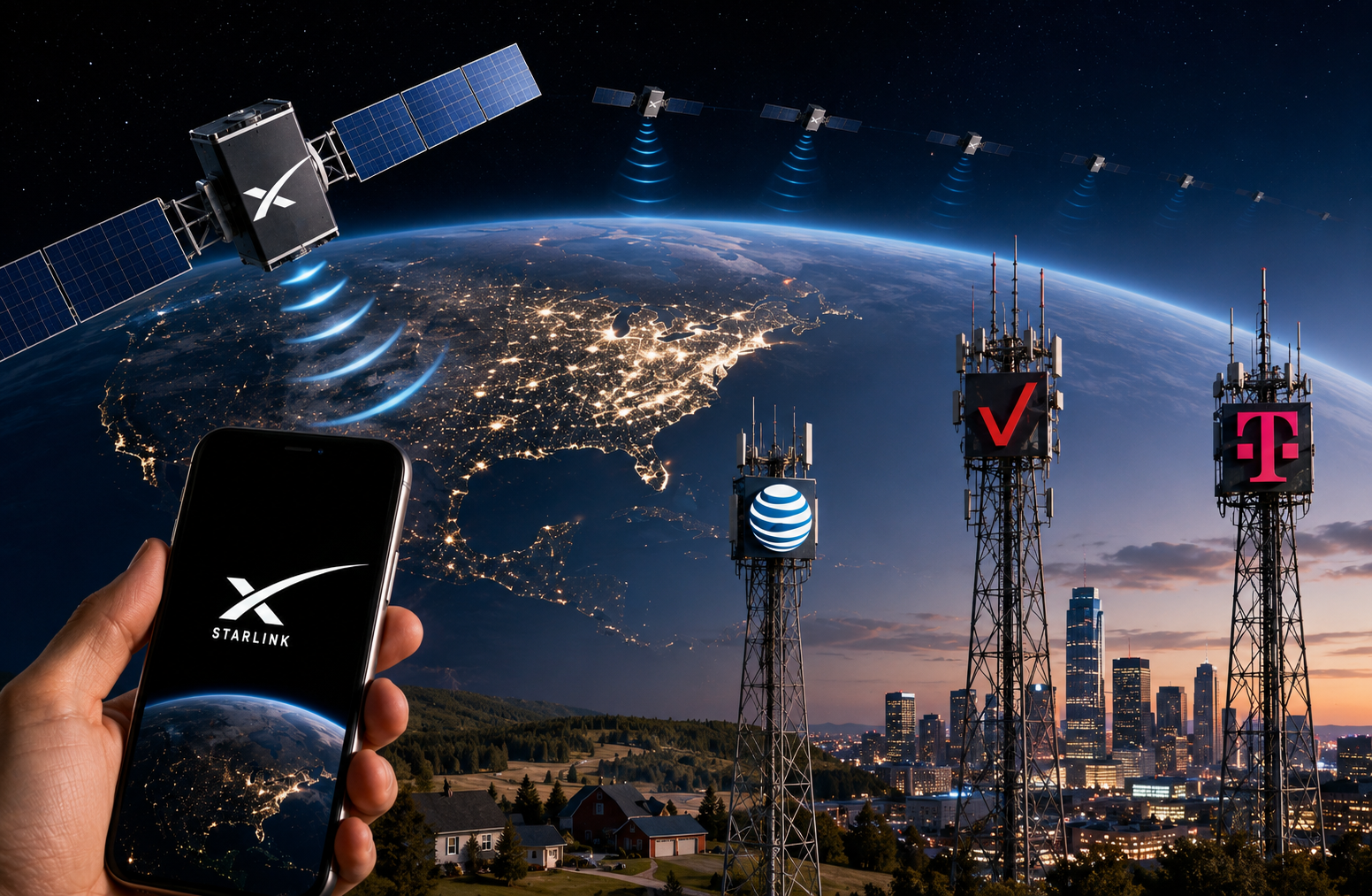
SpaceX is preparing to take Starlink beyond its role as a satellite connectivity provider and expand into the U.S. mobile market, potentially putting Elon Musk’s company in direct competition with AT&T, Verizon and T-Mobile.
The move would represent a significant expansion of Starlink’s business. Rather than relying primarily on partnerships with existing wireless operators, SpaceX is planning a mobile service that could eventually offer consumers connectivity directly through Starlink’s satellite network and a complementary terrestrial network.
SpaceX executives outlined the broader ambitions during the company’s first earnings call as a public company, according to reports. President and Chief Operating Officer Gwynne Shotwell said the company plans to launch next-generation Starlink satellites in 2027 that would substantially increase the capacity of Starlink Mobile.
The upgraded system is expected to use spectrum acquired from EchoStar, including about 65 MHz of spectrum, giving SpaceX an important piece of the infrastructure needed to build a more conventional mobile network. The company also plans to develop a terrestrial component alongside its satellite system.
READ: Starlink extends lead over Amazon in battle for airline Wi-Fi market (June 9, 2026)
Shotwell said SpaceX could deploy relatively small cellular base stations using equipment associated with Starlink broadband installations. That would allow the company to combine satellite coverage with ground-based infrastructure rather than depending entirely on satellites.
The strategy differs from Starlink’s existing Direct to Cell service, which has primarily been positioned as a way to extend mobile coverage into areas where traditional cellular networks are unavailable.
Starlink currently works with T-Mobile in the United States through its satellite-to-phone service. T-Mobile’s service allows compatible phones to connect to Starlink satellites when terrestrial cellular coverage is unavailable.
SpaceX’s own Starlink Mobile materials say the next generation of satellites is intended to provide broadband directly to mobile phones, eventually supporting applications such as video calls, streaming, email and other data-intensive services.
The company already has mobile partnerships in several markets, including Australia, Canada, Japan, New Zealand and the Philippines.
READ: SpaceX backs Nvidia exclusively for future AI infrastructure (August 5, 2026)
The expansion could nevertheless create a new competitive challenge for U.S. carriers.
Starlink’s satellite network gives SpaceX an advantage in reaching remote areas where conventional cell towers can be expensive or impractical to deploy. But building a full mobile network would require considerably more infrastructure, spectrum, regulatory approvals and investment.
T-Mobile CEO Srini Gopalan recently downplayed the threat from Starlink, arguing that satellite connectivity is more likely to complement terrestrial networks than replace them. He questioned what significant market gap a standalone Starlink mobile service would fill for consumers already served by conventional operators.
T-Mobile has also said satellite connectivity currently represents only a tiny share of its overall network usage, reinforcing its argument that satellite services are primarily useful for extending coverage rather than replacing cellular networks.
For SpaceX, however, the potential market is considerably larger than the current satellite-to-phone niche.
Starlink’s next-generation satellites are designed to provide substantially greater capacity, while SpaceX’s planned terrestrial network could help address areas where satellite capacity alone would be insufficient.
The company has not disclosed the full capital expenditure required for the planned mobile network.
The timing is significant for the U.S. telecommunications industry. AT&T, Verizon and T-Mobile collectively serve hundreds of millions of wireless connections, while Starlink currently has a much smaller customer base. The challenge for SpaceX will therefore be converting its satellite advantage into a service that can compete on price, capacity, reliability and coverage.
Starlink’s expansion also comes as satellite-to-phone technology is becoming more widely adopted. Other satellite companies, including AST SpaceMobile, are pursuing partnerships with conventional wireless operators to provide direct-to-device connectivity.
SpaceX is now signaling that it may pursue a more ambitious model.
If the planned 2027 satellite upgrades and terrestrial infrastructure are deployed successfully, Starlink could evolve from a service that helps mobile carriers fill coverage gaps into a competitor seeking customers from the carriers themselves.
That would mark a major shift in the relationship between satellite networks and traditional telecommunications companies and could reshape the U.S. wireless market in the years ahead.