



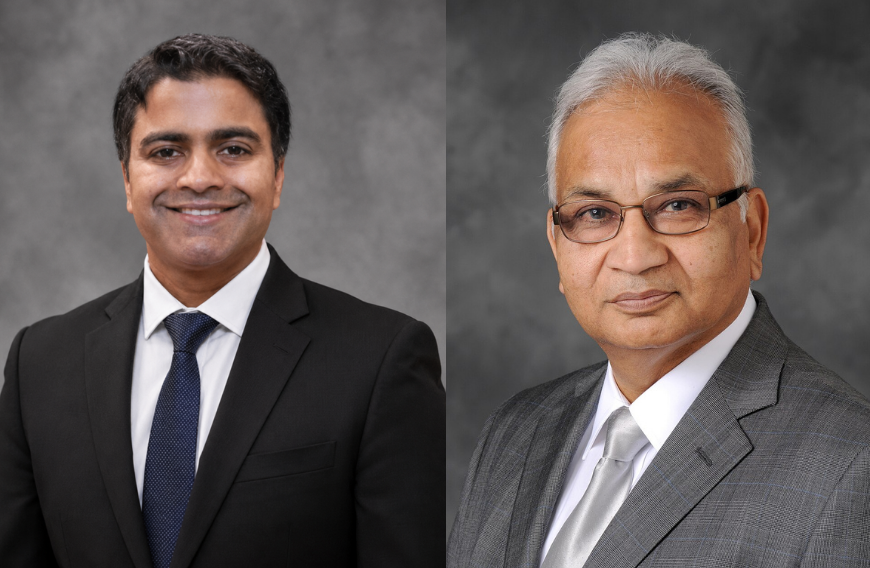
“If I’m using a model to operate on a real-time patient, the harm may be irreversible in the next second.” For Dr. Mahendra Bhandari, that is the line separating the promise of artificial intelligence in surgery from its most consequential risks.
Bhandari, a urologist who witnessed the development of robotic surgery at Henry Ford Health System in Detroit and later helped expand the technology in India, says the closer AI gets to directly influencing a patient’s treatment, the greater the responsibility.
“Surgical automation would take a lot of time,” Bhandari said.

That caution is central to “The Surgeon’s Machine,” a new book co-authored by Bhandari and Siddharth Siva that examines how robotic surgery moved from an experimental idea to an established medical technology.
Siva, who supported robotic surgery research at Henry Ford Health System before working in finance and strategy roles at companies including Amazon and Meta, said the book grew out of a desire to connect parts of the story that had usually been examined separately.
“The story of robotic surgery itself has been told in fragments,” Siva said.
The clinical history, technology development and investment story existed independently, he said. The authors wanted to connect them and explain how an invention became mainstream medicine.
Keeping the surgeon in the loop
Today’s surgeon-controlled robotic systems do not independently decide where to cut. Instead, they translate a surgeon’s movements into precise instrument movements inside the patient’s body.
That relationship could become more sophisticated as AI systems analyze images, reconstruct anatomy, identify patterns and assist with specific tasks.
Siva believes surgeons will remain central. “We’re super excited about AI. Surgeon[s] will continue to play an important role in helping develop the application of AI within bounded tasks,” he said.
He added that the surgeon would remain “the decision maker in the loop.”
That idea explains the book’s title. “The surgeon is the one who’s going to be orchestrating this variety of applications of AI,” Siva said.
The concept is different from the popular image of an autonomous robot surgeon. Instead, the operating room could eventually contain several AI-enabled tools, each performing a limited function under a surgeon’s supervision.
READ: A 15-minute call changed everything: Indian immigrant’s US layoff inspired debut novel ‘Rerouted’ (August 17, 2026)
Bhandari sees a similar distinction in terms of risk.
AI used for administrative workflows presents a different level of danger from an algorithm directly involved in treating a patient. A mistake in the latter setting could have immediate consequences.
Bhandari said some newer systems can already assist surgeons by producing three-dimensional reconstructions of target areas, helping physicians understand anatomy before or during a procedure. But he does not see fully automated surgery as imminent.
A technology built from many threads
The two authors’ story is also deliberately broader than the history of a single robotic platform. Siva said robotic surgery was not created by one person or one community. Its development involved American military research, Silicon Valley investors, engineers and surgeons among others, and in its most decisive chapters, Indian Americans.
Those efforts sought to extend surgical capabilities through robotics and telepresence. As the technology moved into minimally invasive surgery, features such as three-dimensional visualization, articulated instruments and motion scaling became increasingly important.

For Bhandari, the machine’s value lies in what it allows the surgeon to do. That distinction remains important as AI enters the field.
The machine does not necessarily replace human expertise. It can augment it.
From skepticism to AI
The transition is striking because robotic surgery itself faced skepticism.
Bhandari recalled surgeons questioning why hospitals needed expensive robotic systems when skilled doctors were already achieving good results using conventional methods.
Scientific evidence, rather than technological excitement, eventually became critical to acceptance.
“Until we produced the results and compared them, it took 15 years to publish our biochemical recurrence data on prostate cancer because in science, it takes a lot of time before you can scientifically convince people that it’s a better way to do it.”
That lesson may become increasingly relevant to AI. An algorithm can demonstrate impressive capabilities in a laboratory or simulated environment. But medicine ultimately has to establish whether those capabilities improve care safely and consistently.
READ: Isheeta Ganguly reimagines Tagore’s heroines in new graphic novel ‘Three Women’ (June 6, 2026)
The question is therefore not simply whether AI can perform a task. It is whether that task should be delegated to AI, under what circumstances and with what level of human oversight.
The next surgeon’s machine
Siva said the final chapter of “The Surgeon’s Machine” is called The Surgeon’s Agents, reflecting the possibility of multiple AI applications working under a surgeon’s direction.
That vision places the surgeon at the center of an increasingly complex technological system. Bhandari’s warning provides the counterweight. “If I’m using a model to operate on a real-time patient, the harm may be irreversible in the next second.”
The future of surgery may therefore be less about choosing between humans and machines and more about deciding where responsibility should sit between them. For now, both authors see the surgeon remaining firmly in the loop.
The machine may become more intelligent. But the person deciding when, where and how that intelligence is used remains the surgeon.
“The Surgeon’s Machine” is available to order on Amazon in the United States, India, and UK.
More insights from Siddharth Siva and Dr. Mahendra Bhandari: How India built a new model for robotic surgery (September 2, 2026)