



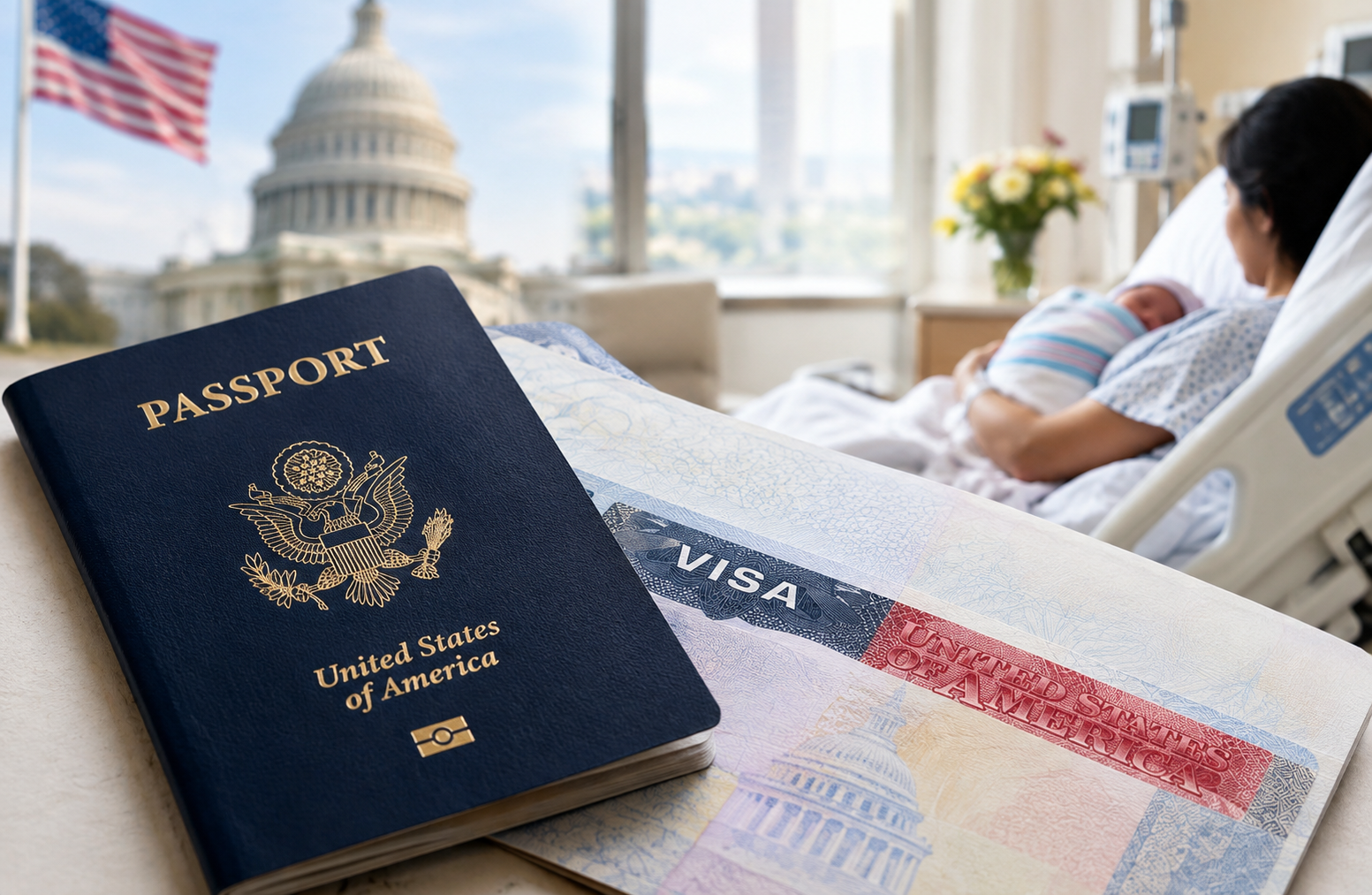
The United States has announced new visa restrictions targeting foreign nationals who knowingly engage in or facilitate commercial “birth tourism,” including operators of birth tourism networks, visa “fixers” and foreign medical providers accused of helping arrange such travel.
Secretary of State Marco Rubio announced the policy on Wednesday under Section 212(a)(3)(C) of the Immigration and Nationality Act, expanding the Trump administration’s ongoing efforts to target what it describes as organized birth tourism and visa fraud.
The policy applies to individuals who “knowingly engage in, have engaged in, or facilitate” birth tourism to the United States. The State Department specifically identified owners, operators, and managers of commercial birth tourism facilitation networks, visa intermediaries who coach applicants to commit fraud, foreign medical providers who knowingly facilitate such travel and alleged fraudulent use of Medicaid. They also identified others who support or enable commercial birth tourism.
READ: Trump administration’s new move could deny birthright citizenship to many (August 7, 2026)
Rubio said foreign commercial birth tourism networks have been used to arrange travel and births in the United States for foreign nationals seeking U.S. citizenship for their children.
“By restricting visa issuance of those who both engage in and profit from this fraud, we are sending a clear message,” Rubio said in the statement, adding that the administration would not allow foreigners to exploit the U.S. immigration system.
What the new visa policy means
Section 212(a)(3)(C) is a foreign-policy provision of the immigration law. It allows the Secretary of State to determine that an alien is inadmissible when the secretary has reasonable grounds to believe the person’s entry or proposed activities could have potentially serious adverse foreign-policy consequences for the United States.
The State Department said certain family members of individuals covered by the new policy may also be subject to the restrictions.
The announcement does not create a blanket prohibition on pregnant foreign nationals traveling to the United States. Instead, it specifically targets people whom the administration determines are knowingly participating in or facilitating commercial birth tourism.
The State Department already says birth tourism, when the primary purpose of a trip is to give birth in the United States so that the child obtains U.S. citizenship, is not a permissible purpose for a visitor visa.
New restrictions follow earlier visa revocations
The latest announcement follows a broader State Department crackdown that began earlier this year.
In August, Rubio said a newly established Birth Tourism Prevention Task Force had revoked more than 600 visas in one month as officials examined activities of visa holders and alleged birth tourism networks. The task force was established to coordinate information from the State Department, the Department of Homeland Security and other federal agencies.
The State Department said the task force examines travel histories and other information to identify cases involving alleged birth tourism and visa violations.
The administration’s actions come after President Donald Trump signed executive orders on August 6 concerning birthright citizenship and birth tourism. The broader policy has generated legal and constitutional debate, including litigation over the scope of birthright citizenship under the 14th Amendment.
What Indian travelers should know
The new policy is relevant to Indian travelers because the State Department’s existing visitor-visa rules apply to applicants regardless of nationality.
A B-1/B-2 visitor visa can be used for purposes including tourism, visiting family and friends and qualifying medical treatment. However, the State Department explicitly says that traveling primarily to give birth in the United States to obtain citizenship for a child is not a permissible basis for a visitor visa.
READ: Supreme Court birthright citizenship ruling leaves Trump administration exploring legal avenues (August 4, 2026)
Being pregnant does not, by itself, establish that an applicant is seeking a visa for birth tourism. The key issue under the existing rules is the stated and actual purpose of the trip.
Indian applicants therefore face a distinction between legitimate travel to the United States and travel arranged primarily for childbirth and acquisition of citizenship, particularly where authorities believe visa information was deliberately misrepresented.
The latest policy is directed primarily at facilitators and commercial networks, rather than creating a nationality-specific restriction on Indian citizens.
Rubio’s broader visa enforcement push
The birth tourism announcement is part of a wider expansion of visa screening and enforcement under the Trump administration.
The State Department said in September that it would expand online presence reviews beginning October 1 to additional categories of nonimmigrant visa applicants, including foreign media representatives and USMCA professionals. The department has also emphasized that visa issuance remains discretionary and that applicants must demonstrate eligibility and genuine intent to comply with the terms of admission.
Rubio’s latest action specifically uses Section 212(a)(3)(C), rather than imposing a nationality-based restriction. The statutory provision concerns foreign-policy grounds for inadmissibility.
The State Department said the objective of the new policy is to disrupt commercial networks that profit from birth tourism, particularly where officials identify alleged fraud or facilitation.
The announcement does not itself change the constitutional text governing U.S. citizenship at birth. It instead establishes a new visa restriction policy aimed at people whom the administration says participate in or facilitate commercial birth tourism.