



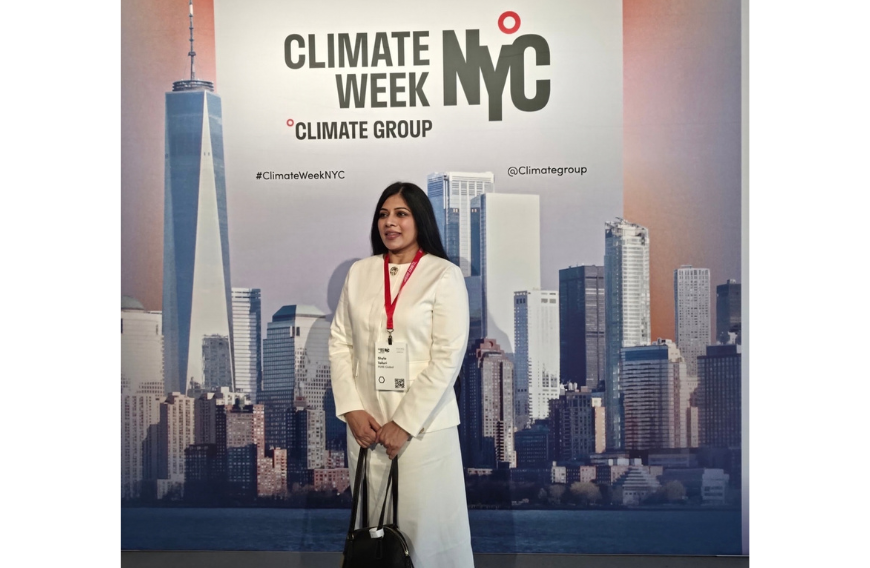
PURE Global CEO Shyla Talluri explains why AI access alone is not enough and why young people need literacy, guidance, participation and real opportunities to shape the AI future.
PURE Global, an Indian American-led education and youth-development nonprofit, is taking the conversation around artificial intelligence beyond basic access, asking what young people need to turn technology into meaningful opportunities, leadership and agency.
Speaking exclusively to The American Bazaar, Dr. Shyla Talluri, founder and CEO of PURE Global, discussed the organization’s work at the intersection of education, AI readiness, youth agency and institutional capacity.
A TEDx speaker and social-impact leader, Talluri leads PURE across 10 countries and 300 chapters. The organization has mobilized more than 1,000 volunteers and reached more than one million people through initiatives focused on education, youth leadership, girls’ health, well-being and community development.
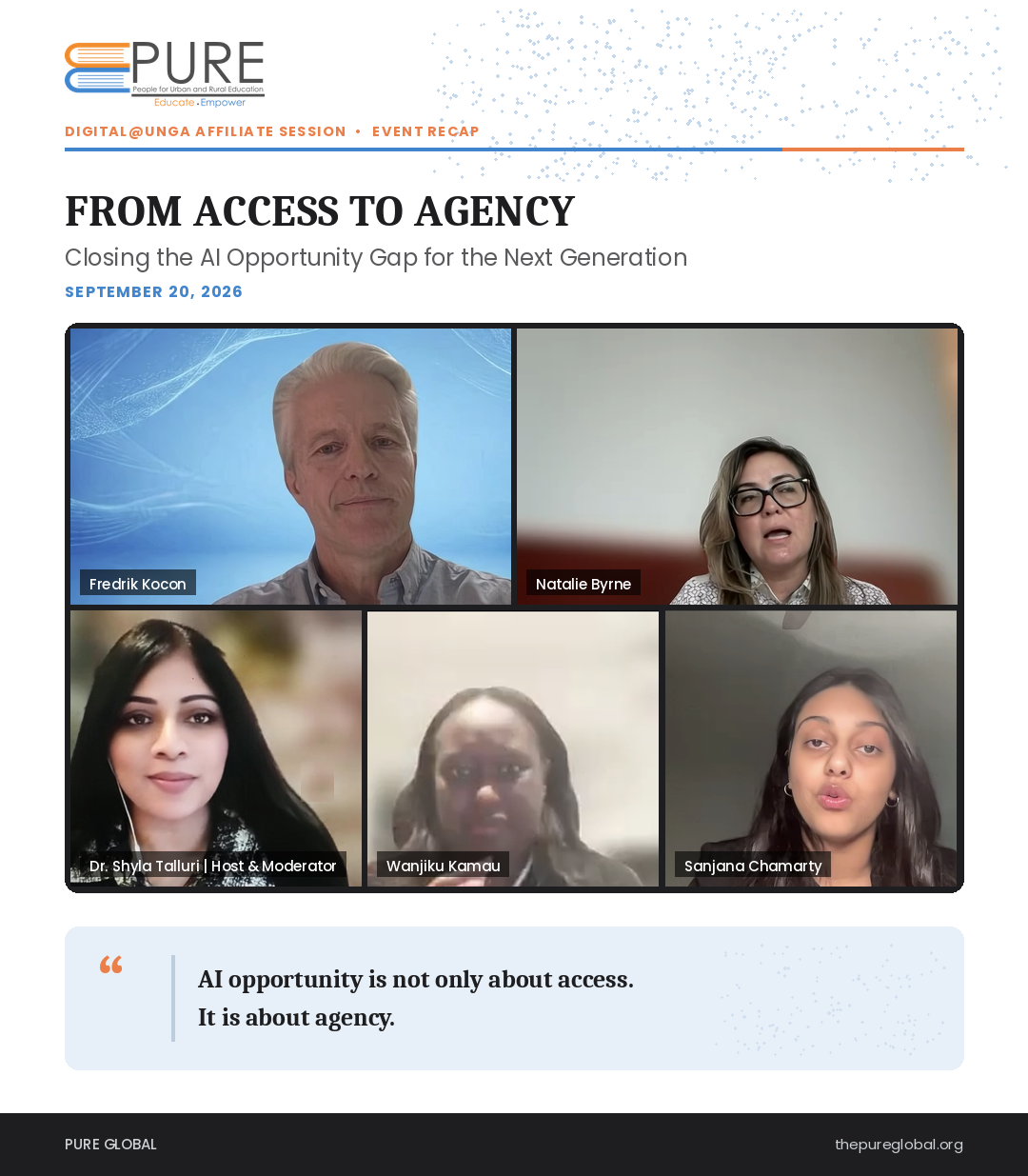
The organization brought that question to the global stage on Sept. 20 through its official Digital@UNGA Affiliate Session, titled “From Access to Agency: Closing the AI Opportunity Gap for the Next Generation.”
READ: AI won’t fix education on its own. Chaula Gupta explains what schools need (September 19, 2026)
The virtual session brought together young people and practitioners from the United States, India, Europe and Africa to examine the growing gap between having access to AI tools and having the knowledge, support and opportunities to use them effectively. The discussion focused on AI literacy, guidance, youth participation and the pathways needed for young people to use technology critically while having a say in the systems that will shape their education, careers and futures.
The session was hosted and moderated by Dr. Talluri. Speakers included Wanjiku Kamau, Founder of TealBridge and author of “Out of the Loop, Into the Algorithm”; Fredrik Kocon, Founder of Comptelligence Foundation; Natalie Byrne, Founder and CEO of blank space; and Sanjana Chamarty, National Student Director of PURE Youth.
“Access is not agency. A young person may be able to open an AI tool and still lack the literacy, guidance, voice and opportunity needed to benefit from it,” said Dr. Talluri. “If young people are present only as users or participants, but not as decision makers, the opportunity gap remains. Our responsibility is to build the institutional and human support that allows them to question, create and lead.”
PURE Global defines the AI Opportunity Gap through five interconnected areas: access, literacy, guidance, participation and opportunity. The organization also highlights the importance of institutional preparedness, including teacher training, regional-language resources, protected training time and practical support within schools and communities.
The organization will continue the conversation during its official Climate Week NYC virtual session, “AI, Education and Youth Leadership for Climate Action,” scheduled for Saturday, Sept. 26, from 11 a.m. to 12 p.m. Eastern Time.
The session will explore the connection between AI-enabled learning, climate solutions and youth leadership, bringing together expert and youth perspectives from India and the international community.
Registration is available through the event page.
The two September sessions are part of PURE Global’s broader effort to connect international policy discussions with the realities faced by schools, educators and communities.
The organization currently works across 10 countries and 300 chapters. It has mobilized more than 1,000 volunteers and reports reaching more than one million people through initiatives focused on education, youth leadership, girls’ health, wellbeing and community development.
For Dr. Talluri, the focus is not simply on getting more people to use emerging technologies. It is also about ensuring that educators, institutions and young people have the skills and support needed to use those technologies responsibly and turn them into meaningful opportunities, particularly in underserved urban and rural communities.
The American Bazaar: What inspired PURE Global to focus on moving the conversation from access to AI to meaningful opportunity and agency for young people?
Dr. Shyla Talluri: Our work in schools and communities showed us that access alone can create the appearance of progress without changing a young person’s actual options. A student may have a device or open an AI tool, but still lack the guidance to use it critically, the confidence to question its output, or a pathway to turn that knowledge into education, employment or leadership opportunities.
That is why we frame the AI Opportunity Gap across five dimensions: access, literacy, guidance, participation and opportunity. The shift from access to agency means ensuring that young people are not simply consuming technology. They must be able to understand it, challenge it, create with it and influence the decisions shaping how it is used.
What are some of the biggest gaps young people face today when it comes to AI literacy, guidance and opportunities to participate?
The most visible gap is access, but the deeper gaps are often institutional. Many educators have not been given the training time, regional-language resources, in-school support or practical guidance needed to help students navigate AI responsibly. Young people may know how to prompt a tool, yet not how to verify its claims, recognize bias, protect their data or understand how AI may affect their future education and work.
READ: The $4,200 IVF option: What Indian Americans may overlook when leaving the US for fertility care (September 16, 2026)
There is also a participation gap. Youth are frequently invited to attend programs or share opinions, but they are rarely included when priorities, safeguards or success measures are being designed. Without guidance, representation and real pathways to opportunity, access can widen existing inequalities instead of closing them.
Why is it important to give young people a meaningful role in discussions around AI, education and climate action, rather than simply including them as participants?
Participation is not the same as power. Young people will live longest with the consequences of today’s decisions on technology, education and climate, so their role cannot begin after the agenda has already been set.
Meaningful youth leadership means involving young people in identifying problems, designing solutions, evaluating outcomes and shaping governance. They bring direct knowledge of how technology is being used in classrooms and communities, as well as urgency and creativity that institutions often lack. When youth are treated only as beneficiaries or audiences, we lose both valuable insight and accountability.
As an Indian American-led organization working across 10 countries, what perspective does PURE Global bring to the global conversation on education, youth leadership and technology?
PURE Global brings a bridge perspective. As an Indian American-led organization, we engage with innovation, philanthropy and policy conversations in the United States while remaining deeply grounded in schools and communities across India and the Global South.
Our work across 10 countries and 300 chapters, supported by more than 1,000 volunteers and reaching over one million people, helps us see where global frameworks meet local realities. We ask not only whether a technology is available, but whether a teacher can use it, whether a student can question it, whether language or geography creates barriers, and whether the resulting opportunity is distributed fairly. Our goal is to connect global ambition with practical institutional readiness and local agency.