



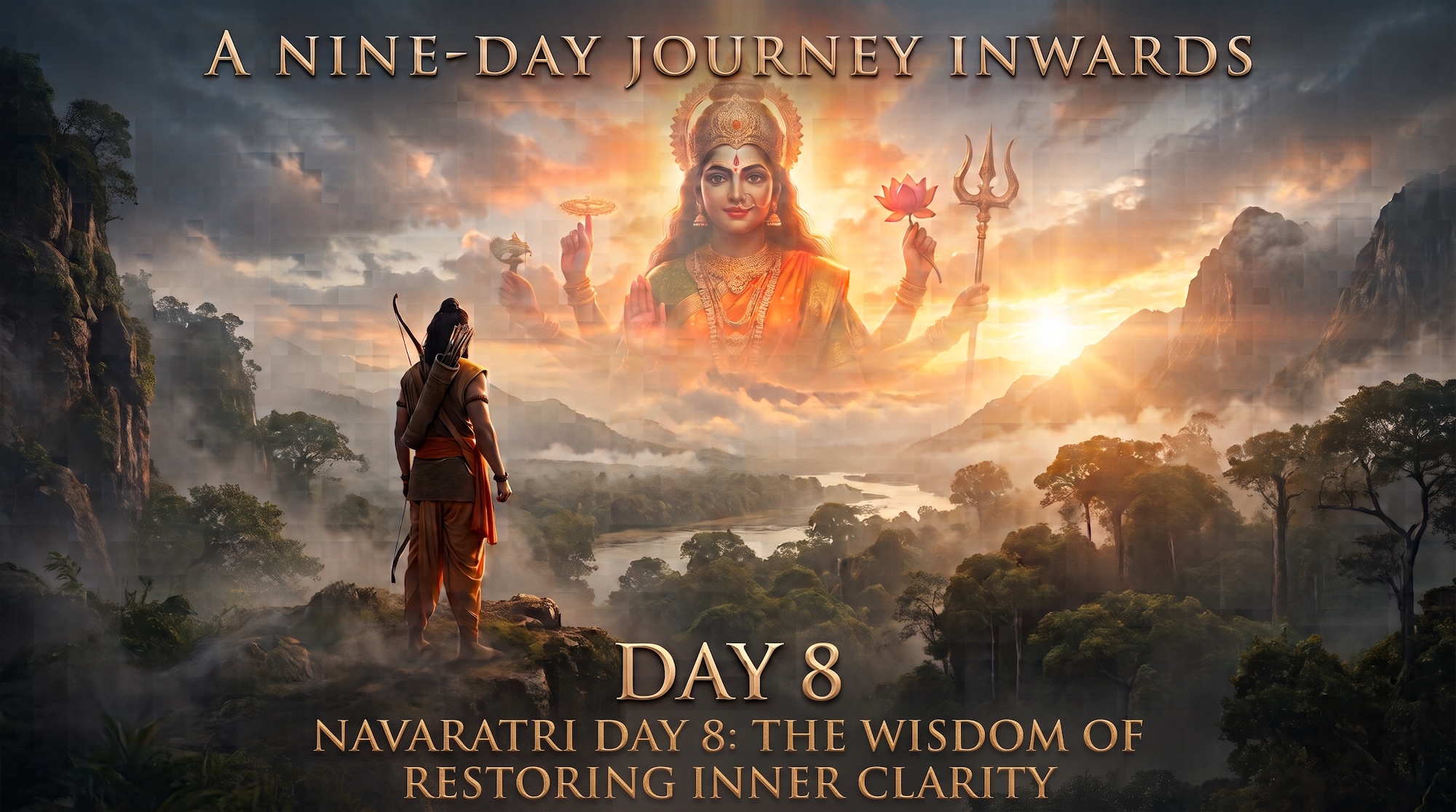
Navaratri is a journey inward, with each form of Durga offering a different way to understand ourselves and our relationships with others. On the eighth day, we honor Goddess Mahagauri, the radiant and serene form of the divine feminine associated with purity, peace, and the removal of suffering. Her name is commonly understood to mean the supremely radiant or fair one. Her traditional imagery, often depicting her dressed in white and riding a bull, evokes tranquility and clarity. These qualities invite us to consider an important question: after life’s difficulties have left their mark on us, how do we recover the clarity to see ourselves and others without being governed by the pain we have experienced?
READ: Navaratri Day 7: The strength to face our fears (October 17, 2026)
In one traditional account, Parvati undertakes intense austerities in her devotion to Shiva. Through these austerities, her complexion becomes darkened, and Shiva later restores her radiant appearance. In this form, she becomes known as Mahagauri. Although traditions differ in how they explain the goddess’s origins and symbolism, the story offers a way to reflect on the human experience. We endure difficult circumstances, carry the impressions they leave behind, and sometimes allow those experiences to obscure the qualities that once brought us peace. Mahagauri’s radiance can symbolize the restoration of clarity after suffering, a return to the ability to see beyond the accumulated weight of our experiences.
Life inevitably brings disappointment. People misunderstand us, relationships change, expectations go unmet, and decisions sometimes produce consequences we never intended. These experiences shape how we see the world. Remembering them can help us learn, recognize patterns, and protect ourselves from repeating mistakes. But remembering an experience is not the same as allowing it to define every experience that follows.
Letting go does not mean denying what happened, excusing harmful behavior, or pretending that the consequences no longer matter. Nor does it require reconciliation with someone who has caused us harm. It means recognizing that we cannot change the past by repeatedly reliving it. We can acknowledge an injustice, seek accountability where appropriate, establish boundaries, and still decide that the experience will not have unlimited authority over the rest of our lives. Inner peace does not depend on declaring that everything was acceptable. It depends on recovering the ability to choose how we respond to what happened.
The Ramayana offers a meaningful reflection through Bharata, Rama’s younger brother. When Kaikeyi’s actions lead to Rama’s exile and Bharata is positioned to inherit the kingdom, he refuses to accept a throne obtained through circumstances he considers unjust. He seeks Rama’s return and, when Rama insists on honoring his father’s command, Bharata agrees to govern as a caretaker. He places Rama’s sandals on the throne as a symbol of his brother’s rightful place. Bharata’s response demonstrates that disappointment and injustice need not become the foundation of our identity. He recognizes what has gone wrong without allowing personal advantage or resentment to determine his actions. His example is not a story of ignoring wrongdoing, but of refusing to let it compromise his principles.
Mahagauri’s symbolism also invites us to examine the judgments we carry about ourselves. Sometimes the hardest thing to release is not anger toward another person but shame about our own past. We remember a failure and begin to see ourselves as failures. We regret a decision and allow that regret to diminish our confidence in every decision that follows. Accountability requires us to recognize our mistakes and learn from them. It does not require us to remain permanently defined by them. Just as Mahagauri’s radiance represents the restoration of purity and serenity, we can work toward a state in which regret becomes a source of understanding rather than a permanent judgment on our worth.
READ: Navaratri Day 6: The strength to stand up for what is right(October 16, 2026)
This distinction is especially relevant to young people navigating a world in which mistakes can be recorded, shared, and judged long after the circumstances have changed. A careless remark, a failed examination, or a poor decision may become part of a public narrative that feels impossible to escape. Yet people grow through experience. The capacity to learn depends on being able to acknowledge a mistake without treating it as the complete measure of one’s worth. We should hold ourselves responsible for our actions while allowing ourselves the possibility of becoming wiser.
The same principle applies to how we see others. When we reduce a person to the worst thing they have done, we stop paying attention to the complexity of human behavior. This does not mean abandoning judgment or removing consequences. It means distinguishing between holding someone accountable and allowing our anger to become the only story we tell about them. Clarity requires us to see the harm that occurred without assuming that it tells us everything about a person, just as self-awareness requires us to acknowledge our own mistakes without believing they define all that we are.
The eighth day of Navaratri reminds us that inner peace is not achieved by making the past disappear. It comes from changing our relationship with it. Mahagauri’s radiance offers a symbol of the clarity that can emerge when resentment, shame, and the need to rewrite history no longer obscure our view of the present. We cannot always choose what happens to us, but we can gradually reclaim the freedom to decide what those experiences will mean for the life ahead.
We honor what the past has taught us, but we do not have to carry its every burden into tomorrow.