



This is the second of seven essays measuring the distance between the decades of my life and the world we live in now.
If the seventies, my first decade, planted the seeds, the eighties were when the first shoots came up, and when I was replanted in new soil.
The Eighties
I arrived from India in 1983, just as America was reinventing itself. I didn’t speak English. I didn’t know anyone outside my family. I didn’t know how anything worked: not the money, not the schools, not the jokes. What I did know, even as a boy, was that I’d landed somewhere that felt like tomorrow.
I’ve written before about how that America welcomed my family. I want to say it again, because it’s the foundation of everything I’ve done since. People didn’t care much that we were foreign. They cared whether we worked hard and whether we were decent. That was the deal, and it was a good one.
What I didn’t know then, and only learned much later, was that 1983 was also a birth year for the modern world.
The Year 1983
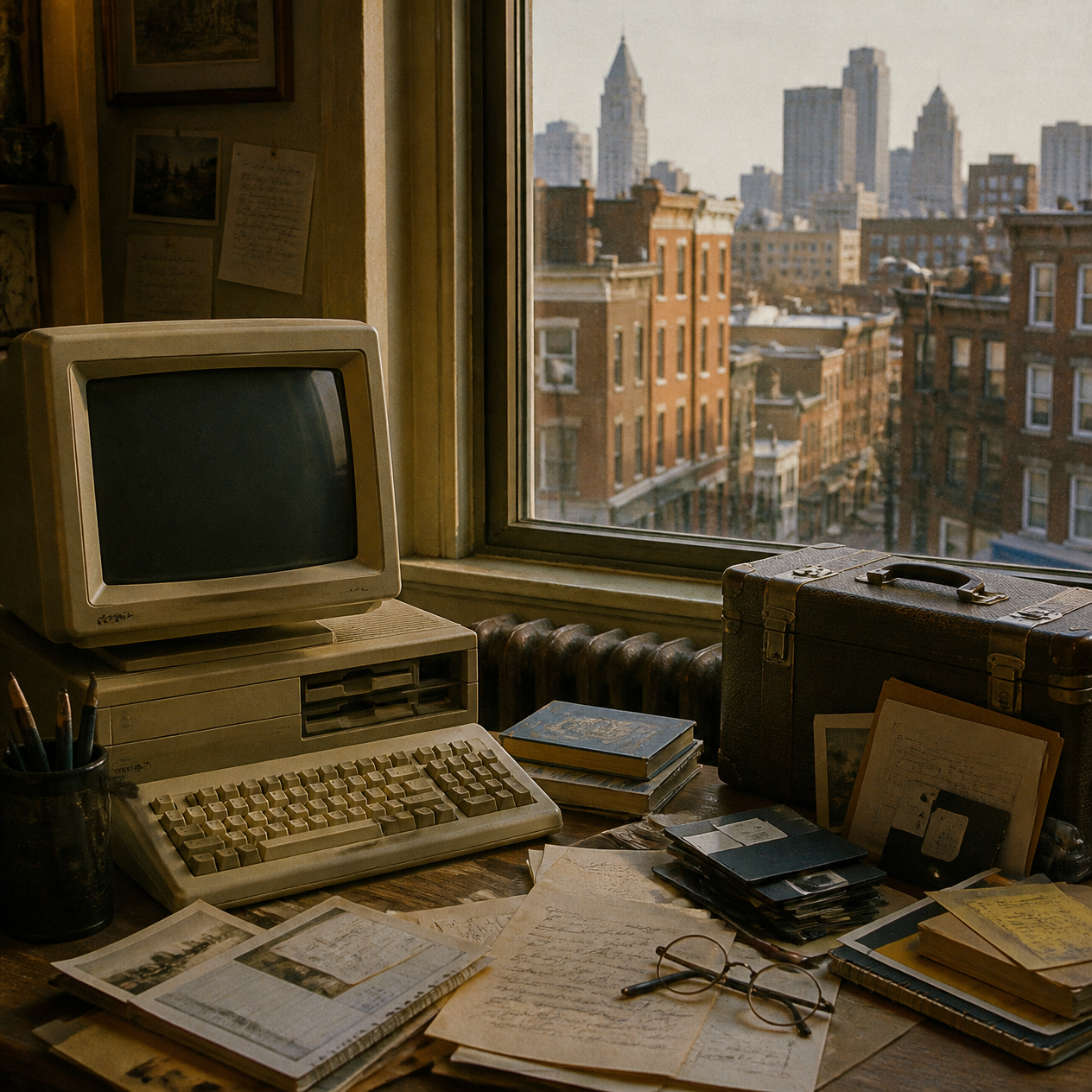
On January 1, 1983, the network that would become the internet switched over to a common language that let different computers talk to each other, called TCP/IP. Engineers sometimes call that day the internet’s real birthday. Around the same time, Time magazine’s first issue of the year broke with tradition. Instead of a Man of the Year, it named the personal computer its “Machine of the Year.”
On January 4, President Reagan signed the Orphan Drug Act, which gave companies a reason to develop medicines for rare diseases that affect too few people to be profitable. In the decade before that law, fewer than ten such drugs reached the market. Since then, the FDA has approved hundreds, and in recent years orphan drugs have made up roughly half of the new medicines it approves. A law almost nobody noticed became one of the engines of modern biotech.
In October, a man sitting in his car near Soldier Field in Chicago placed the first commercial cellular phone call. That September, the government had approved Motorola’s first handheld cell phone, and when it went on sale the following spring, it cost $3,995 and was nicknamed “the brick.” And on a winding road in Northern California, a chemist named Kary Mullis, driving one night, came up with a way to copy tiny bits of DNA millions of times over. It was called PCR. Ten years later, it won him the Nobel Prize.
If you took a PCR test for COVID in 2020, you used Mullis’s idea. If you sent a text today, you used the grandchildren of that brick. If you’re reading this online, you’re using that common language from January 1983.
READ: The Review by Ajay Raju | Fifty-six trips around the sun: First of 7 essays (October 19, 2026)
Two other things happened that year that I only connected much later. On May 31, the Philadelphia 76ers, led by Moses Malone and Julius Erving, finished a four-game sweep of the Lakers to win the NBA championship. A few weeks later, on June 25, India’s cricket team, written off by almost everyone, beat the mighty West Indies at Lord’s to win the World Cup. When Kapil Dev lifted that trophy, a whole generation of Indians learned that the old order could be beaten. The country I was leaving and the city I would come to call home were both champions in 1983.
I thought I was arriving at the future, but it turns out the future was arriving with me.
The Mall, the Music, and Pamela
I was a teenager in the eighties, and I loved it. I graduated high school in 1988 and met Pamela at a New Year’s Eve party I hosted. We went to movies and hung out at the mall, because that’s where American teenagers went to see and be seen. We watched MTV, listened to Howard Stern, and watched action movies where the heroes had impossible muscles and simple morals.
In July 1985, the most ambitious concert the world had ever seen came to Philadelphia. Live Aid filled JFK Stadium in South Philadelphia while a twin show played at Wembley Stadium in London, and satellites carried it to an estimated audience of well over a billion people. Rock stars, television, and ordinary people’s money joined hands to fight a famine in Ethiopia. It was the eighties at their most idealistic.
I watched it as a newcomer still learning the city. I had no idea that one of the people who made the Philadelphia show happen would one day become a dear friend. Some of the seeds the eighties planted in my life took thirty years to come up. Larry Magid, a producer of Live Aid, was one of them. On a beautiful sunny day in February 2015, Larry and I drove down to Longport, New Jersey, to see his beach house. A few hours later, we drove over to a property a few blocks away that was for sale, and I bought it on the spot. A concert I watched as a teenager became a friendship, and the friendship became a house by the sea.
But in 1985, all of that was still far ahead of me. I was a kid trying to figure out where I fit. Back in high school, the hierarchy was clear. Football players and cheerleaders on top. Nerds on the bottom. Wall Street was the dream. “Greed is good” was a line from a movie meant as a warning, and a lot of people took it as advice.
The timing of that movie was almost too perfect. Wall Street opened in December 1987, less than two months after Black Monday, when the Dow Jones Industrial Average fell 22.6 percent in a single day. It is still the largest one-day percentage drop in the index’s history. And yet the real market story of the decade was the climb. To break inflation, Paul Volcker’s Federal Reserve had pushed interest rates to painful heights; the prime rate banks charged their best customers peaked at 21.5 percent in December 1980. Once inflation broke, the long bull market began. In August 1982, the Dow sat below 800. It finished the decade above 2,700, crash and all.
I was lucky to be an immigrant kid in the eighties because the decade was easy to read. The rules were visible. If you learned them, you could play. Nobody handed me a map, but at least the roads had signs.
The Seeds of the Computer in Every Home
In 1981, IBM released its personal computer. In 1984, Apple introduced the Macintosh with a famous Super Bowl ad promising that 1984 wouldn’t be like George Orwell’s 1984. For the first time, computers weren’t just for governments and giant corporations, but were for families, for kids, for small businesses.
Still, the revolution started small. When the Census Bureau first asked the question in 1984, only 8.2 percent of American households owned a computer. By 1989, the number was 15 percent. The machine Time had crowned was still, for most families, something you saw at school or in a store window.
In 1980, a man named Ted Turner launched CNN, the first 24-hour news channel. People laughed at the idea. Who needs news all day? Today we carry the 24-hour news cycle in our pockets, and it never sleeps. Some days I think Ted Turner gave us the greatest gift in the history of information. Other days I think he opened a door we’ve never been able to close.
The Seeds of Philadelphia’s Future
Here’s a seed almost nobody remembers. In 1980, Congress passed a law called the Bayh-Dole Act. It sounds boring, but it changed things. It let universities keep the patents on discoveries made with government research money, and license those discoveries to companies.
Before that, many government-funded discoveries sat on shelves. After it, universities like Penn could turn laboratory breakthroughs into real companies and real medicines.
In fact, 1980 was the year modern biotechnology was born. In June, the Supreme Court ruled in Diamond v. Chakrabarty that a genetically engineered microorganism could be patented. In October, Genentech, a four-year-old company with no product on the market, went public at $35 a share; within an hour, the stock had touched $88. In December, Bayh-Dole became law. The legal right, the capital, and the science all arrived in the same year. Two years later, human insulin made by genetically engineered bacteria, developed by Genentech and sold by Eli Lilly as Humulin, became the first genetically engineered drug approved by the FDA.
The biotech corridor around Philadelphia, the one I invest in and care deeply about, grew from that soil. When you walk through a lab at Penn Medicine today and see a therapy that started as a scientist’s idea and is now saving lives, think about that dull piece of 1980 legislation that made it possible.
In 1984, Congress passed another unglamorous law, the Hatch-Waxman Act, which made the modern generic drug industry possible. That year, generics filled about 19 percent of American prescriptions. Today they fill more than 90 percent. And here is the part that would have amazed the boy who got off the plane in 1983: Indian companies now supply nearly half of all generic prescriptions filled in the United States. The country I left has become, in a very real way, the medicine cabinet of the country I joined.
A City Reaching Up, and Falling Down
Philadelphia’s eighties looked a lot like the decade itself. In November 1983, the city elected W. Wilson Goode as its first Black mayor. Eighteen months later, on May 13, 1985, during a standoff with the radical group MOVE, a police helicopter dropped a bomb on a rowhouse on Osage Avenue in West Philadelphia. Eleven people died, five of them children, and the fire that was allowed to burn destroyed 61 homes. A city commission later called the decision to drop the bomb unconscionable. City Council did not formally apologize until 2020.
In 1987, One Liberty Place, the building where I would later have an office, rose above the statue of William Penn on top of City Hall, breaking an old gentlemen’s agreement that no building would stand taller. The skyline finally reached up. Superstitious fans blamed what followed on the “Curse of Billy Penn.” After that 1983 Sixers title, no major Philadelphia team won a championship again until 2008, the year after ironworkers placed a small statue of Penn on top of the new Comcast Center.
Ambition and tragedy, on the same streets, in the same decade.
A Nation in Mourning
On the morning of January 28, 1986, the space shuttle Challenger broke apart 73 seconds after liftoff, killing all seven people on board. One of them was Christa McAuliffe, a high school social studies teacher from Concord, New Hampshire, chosen to be the first teacher in space. Because of her, millions of schoolchildren were watching.
I was at home watching the news with my father. He seemed especially moved by the loss. I think he saw in that crew what he had seen in America when he brought us here: people reaching for something bigger than themselves, and a country willing to let them try.
That evening, President Reagan was supposed to deliver his State of the Union address. He postponed it and spoke to the country from the Oval Office instead. He talked directly to the children who had watched, telling them that painful things happen on the way to discovery, and that the future belongs to the brave. He closed with words from a poem by a young pilot killed in World War II. My father, my younger brother Vijay, and I remember Reagan that night as a father to a nation that mourned in unison.
The investigation that followed was its own lesson. A presidential commission found that rubber seals in one of the rocket boosters had failed in the unusually cold weather, and that engineers had warned about exactly that danger the night before the launch. Their warnings were overruled. At one televised hearing, the physicist Richard Feynman dropped a piece of the seal material into a glass of ice water to show, in seconds, what the paperwork had obscured.
It was the eighties at their most hopeful and their most humbling, on the same morning. We had built machines that could carry a schoolteacher into space. We had not yet learned to listen to the people who knew where those machines could fail.
The Other Home
In 1984, the country I had left was shaken twice in barely a month. On October 31, Prime Minister Indira Gandhi was assassinated by two of her own bodyguards. Then, on the night of December 2, a storage tank at the Union Carbide pesticide plant in Bhopal, the city where I spent my boyhood, began releasing methyl isocyanate gas over the sleeping neighborhoods around it. More than half a million people were exposed. The state government has confirmed 3,787 deaths; other estimates run far higher. It is widely considered the world’s worst industrial disaster.
I was a teenager in America when the news came, too young to understand what a corporate environmental disaster even was. I understood it later, as a lawyer. Most of the people the gas reached were poor, crowded into the settlements that pressed up against the plant’s walls. When lawsuits were filed against Union Carbide in American courts, a federal judge in New York sent them back to India in 1986, to a legal system whose tort law offered nothing like the remedies I would go on to study in America. In 1989, Union Carbide settled with the Indian government for $470 million, a fraction of the $3.3 billion India had sought, and victims waited years for their share. How much of it ever reached the people it was meant for is a question I still ask. I suspect too much of it disappeared among the very officials who were supposed to be clearing the fog.
Seventeen months after Bhopal, and three months after Challenger, it happened again on the other side of the world. In the early hours of April 26, 1986, during a safety test, Reactor No. 4 at the Chernobyl nuclear plant in Soviet Ukraine exploded and burned, throwing radioactive material across Europe. The Soviet government said nothing. The world found out two days later, when workers at a nuclear plant in Sweden, roughly a thousand kilometers away, detected radiation on their own clothes and traced it back east. The nearby city of Pripyat, home to nearly 50,000 people, was evacuated about 36 hours after the blast; over the years that followed, more than 300,000 people were moved from their homes. The official count of early deaths was 31. The long-term toll is still argued over.
One disaster came from an American multinational’s plant in a democracy, the other from a superpower’s state-run reactor. The systems could not have been more different, and the failures looked remarkably alike: warnings ignored, safety treated as a cost, and the truth held back from the people most at risk. Chernobyl also exposed how brittle the Soviet system had become. Years later, Mikhail Gorbachev wrote that the disaster may have been the real cause of the Soviet Union’s collapse, more even than his own reforms.
Bhopal and Chernobyl taught a lesson the optimism of the eighties didn’t want to hear. The same global economy that carried technology and capital across borders also carried risk, and the risk landed hardest on the people with the least power to refuse it. Radiation, like poison gas, does not stop at a border or ask for a passport.
The Hardest Lesson of the Eighties
In 1981, doctors reported the first cases of what would become known as AIDS. For most of that decade, a diagnosis meant death. By August 1989, the CDC had counted 100,000 cases in America. And for too long, the country looked away, because the people dying were people many preferred not to see.
READ: The Review by Ajay Raju | Philadelphia discovers. Boston profits. That can change. (October 12, 2026)
But the people who were dying refused to be quiet. In March 1987, the FDA approved AZT, the first drug for HIV. That same month, activists in New York founded ACT UP. In October 1988, more than a thousand of them surrounded FDA headquarters in Rockville, Maryland, demanding faster access to experimental drugs. They were loud and angry, and they were right. Their pressure helped change how America approves new medicines, creating faster paths for drugs that treat deadly diseases. Many of the rapid approvals we celebrate today owe something to those protesters.
Sometimes progress doesn’t come from the lab, but from people who refuse to wait.
The Wall Comes Down
The eighties ended with a scene we will never forget. In November 1989, ordinary Germans climbed on top of the Berlin Wall with hammers and chisels. The Cold War, which had hung over every day of my life, was ending, not with a bomb but with a party.
Earlier that year, near Tiananmen Square, a young man had stood alone in front of a line of tanks. That story ended differently. The eighties gave us both pictures, freedom winning and freedom crushed, and we’re still living with both. Much of today’s rivalry between America and China can be traced back to the choices made in 1989, in Berlin and in Beijing.
Then and Now
What did the eighties give us that we’ve lost? A shared story. Most Americans watched the same shows, heard the same songs, and read the same few newspapers. When Challenger fell, we grieved together, in the same hour, in front of the same pictures. We argued, but we argued about the same facts. Today, each of us lives in our own feed. We have more choice than ever and less common ground.
We also lost some of that easy welcome. The America I landed in wasn’t perfect, but it saw newcomers as an asset. In 1986, President Reagan signed a law that gave legal status to about 2.7 million immigrants. Whatever you think of that policy, it’s hard to imagine today’s Washington agreeing on anything like it.
When my family arrived, the 1980 census had counted about 206,000 people born in India living in the United States. By 1990, that number had more than doubled, to about 450,000. Today it is nearly 3 million, the second-largest immigrant group in the country. We were among the first shoots of a very large planting.
And what did we gain? The computer the eighties put in the den is now in billions of hands. The brick became a smartphone. AIDS, once a death sentence, became for millions a manageable condition. The Wall is gone.
Arriving Together
In 1983, three things came into the world at the same moment as my family arrived in America: a language for computers, a phone you could carry, and a way to copy the code of life. None of them knew what they would become. Neither did I.
That’s the thing about arriving. You never really know what you’re arriving into. You only find out by living there.
Next: The Nineties.