



By Soumoshree Mukherjee
After a series of delays, the Axiom-4 (Ax-4) mission successfully launched on June 25 at 12:01 p.m. IST from NASA’s Kennedy Space Center, carrying Indian astronaut Group Captain Shubhanshu Shukla and three crew members to the International Space Station (ISS). The launch marks a historic moment for India, as Shukla becomes the first Indian to reach the ISS and the first to venture into space since Rakesh Sharma’s 1984 mission aboard the Soviet Soyuz.
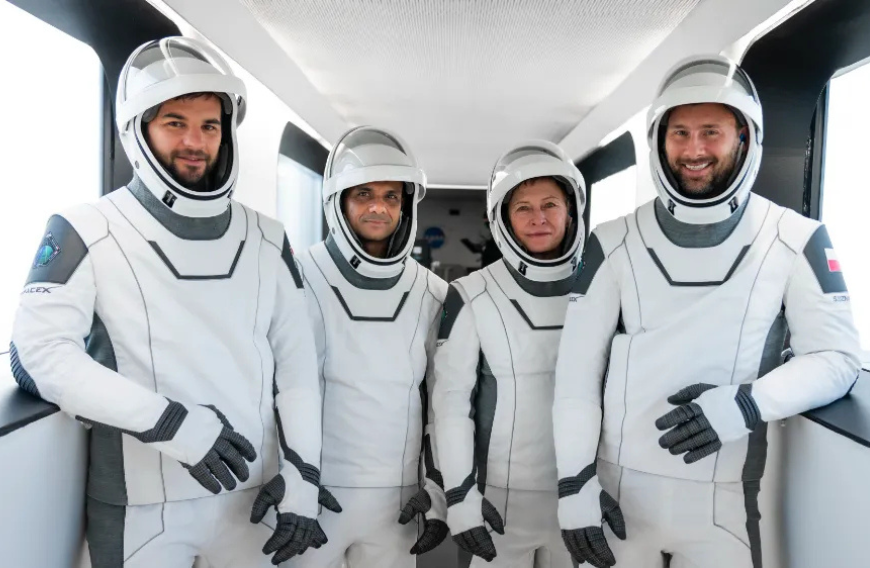
Shukla, the Ax-4 pilot, is part of a four-member international crew led by Commander Peggy Whitson from the United States, with mission specialists Sławosz Uznański-Wiśniewski of Poland and Tibor Kapu of Hungary.
The team is expected to dock at the ISS on June 26 around 4:30 p.m. IST and will spend 14 days aboard the ISS, conducting over 60 scientific experiments and activities representing 31 countries, including India, the U.S., Poland, Hungary, and others. ISRO has selected seven microgravity experiments proposed by Indian researchers, while NASA and ISRO will jointly conduct five science investigations and two STEM demonstrations.
In his first message from space, an emotional Shukla addressed the nation, “Namaskar my dear countrymen. What a ride. After 40 years, we have once again reached space. On my shoulders, I have my tri-colour which is telling me that I am not alone and that you are all with me. This is not the start of my journey to the ISS but the start of India’s human space programme. Jai Hind, Jai Bharat.”
READ: Shubhanshu Shukla-led Axiom Mission 4 (Ax-4) delayed to June 19 (June 17, 2025)
The mission’s significance for India is immense. Shukla is the first Indian astronaut to visit the ISS and the first Indian in space since Rakesh Sharma flew aboard the Soviet Soyuz in 1984. His journey signals the dawn of India’s collaboration with commercial spaceflight and its readiness to re-enter the arena of human space exploration.
Aboard the SpaceX Dragon spacecraft, the Ax-4 crew is on a 28-hour flight to the ISS. After separation from the Falcon 9’s second stage about 10 minutes post-launch, the Dragon spacecraft initiated orbital manoeuvres to approach the station. Once docked, the astronauts will begin an intensive research schedule.
The Ax-4 mission involves over 60 scientific investigations across 31 countries. Significantly, the Indian Space Research Organisation (ISRO) has contributed seven microgravity research experiments developed by Indian scientists, which Shukla will conduct during his stay. These include studies in fluid dynamics, biomedical monitoring, and material science.
READ: Abu Dhabi-based Burjeel teams up with Axiom Space for first-ever diabetes study in orbit (June 9, 2025)
Additionally, ISRO and NASA will collaborate on five joint scientific experiments and two STEM outreach demonstrations in orbit, a major step in Indo-American space partnership.
Originally slated for May 29, the mission was delayed repeatedly due to technical issues, including anomalies in Crew Dragon’s electrical harness, a liquid oxygen leak, weather concerns, and a problem with the ISS’s Zvezda service module. The crew had been under quarantine since May 25 in preparation for the flight.
The Axiom-4 mission, a collaboration between NASA, Axiom Space, SpaceX, and ISRO, is also being seen as a testbed for future commercial spaceflights and India’s upcoming Gaganyaan mission.
With millions watching the livestream on NASA, Axiom, and SpaceX platforms, the historic launch marked a milestone not only for Indian space ambitions but also for international cooperation in space science. For Shubhanshu Shukla and for India, today was not just a personal triumph; it was a new beginning.