



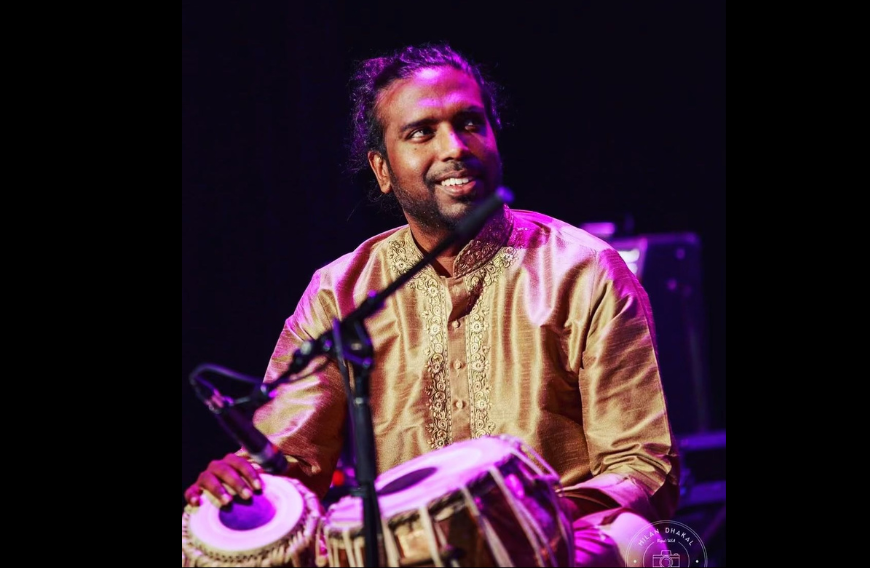
In a milestone moment for Indian American artists, tabla virtuoso Avirodh Sharma has just been inducted as a Voting Member of the Recording Academy — the body that determines the prestigious Grammy Awards.
Sharma’s achievement marks a rare breakthrough: He is the first Indo-Caribbean American tabla artist to gain voting rights in the Academy’s history, putting him in the same decision-making rooms as legends like John Legend, Quincy Jones, and Beyoncé. His induction into the Recording Academy isn’t just symbolic, it gives Sharma unprecedented strategic access within the $28 billion U.S. music industry.
Sharma views this platform as more than personal prestige but a leverage for elevating Indian classical artists onto global platforms, not as exotic “world music” acts, but as commercially viable global brands.
Indian classical music in America: Is there a business potential?
Sharma began learning music under the aegis of his parents who founded the famous East Indian Music Academy Inc. in New York. Over the years, he has carved out a niche not only as a global music virtuoso but also as a trailblazer who reshaped the economics of world music.
With Grammy-nominated albums and collaborations with legends like Vikku Vinayakram and Mira Nair, Sharma has not just performed music; he has turned a traditional Indian percussion instrument into a globally scalable, digitally native business. In an era where cultural authenticity often clashes with commercial viability, Sharma’s model offers a blueprint: preserving heritage while unlocking new revenue streams across the global music economy.
READ: Chandrika Tandon’s new album reconnects to childhood (October 28, 2023)
He shares his thoughts on how Indian classical music is evolving in the American market — and where he sees untapped business potential that others may be overlooking: “Classical Indian music in the American market is still an untapped potential. We continue to see magical virtuosic performances and representation of the classical artists; however, it’s not just entertainment as it is widely seen as. The potential of classical Indian music will be understood once the West realizes how enriching it is for the mind and soul at different levels.”
Trying to make classical India music accessible to musicians across genres and cultures remains to be one of the aims of the East Indian Music Academy Inc. which was founded by Sharma’s parents 30 years ago. He says, “For instance, we have done studies with universities showing the scientific benefits of learning Indian classical music. We have had students with averaging C+ to B- academically coming in to learn music and after several months their grades have improved to B+ to A-.” Sharma stresses that “it is this untapped benefit of Indian music that needs to be first translated into Western sensibilities.
“The awareness of Indian Classical music through social media and other channels, music therapy, and presenting it in a more relatable way is now becoming more accessible. There was a time, Indian music was just considered exotic but now it’s become global genre,” he says. The changes are subtle but noticeable.
He adds, “Now artists like me, are attracting sponsors at the local and national level because we’re beginning to bring our music to newer audiences.” But despite these shifts, he paints a realistic picture by saying, “From a business point of view, I would say, Indian Classical music is still in its infancy in America.”
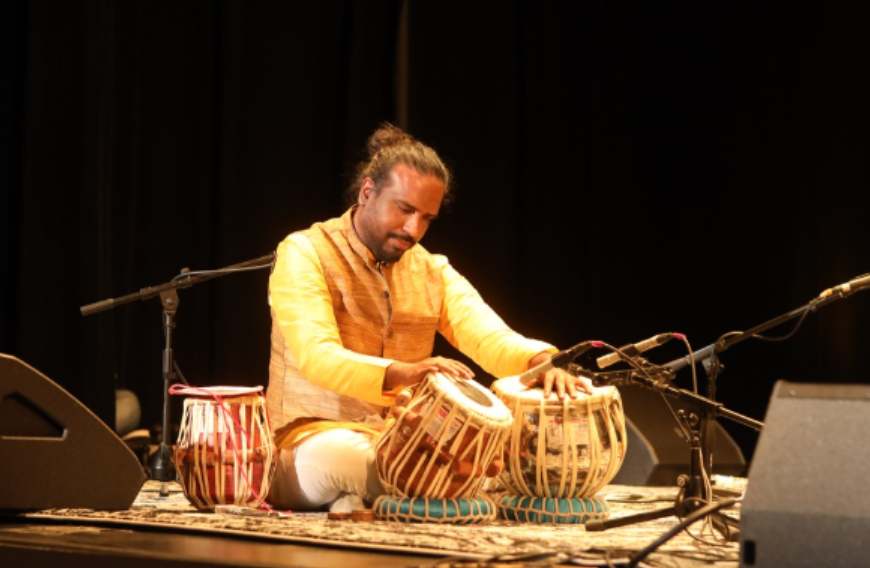
From tabla solos to tech-enabled music enterprise
Sharma’s rise is not simply about performances in iconic venues from Lincoln Center to the Taj Mahal or collaborations with Grammy-winning artists. It’s also about building an IP-forward, tech-driven business model that could disrupt how world music is monetized. Through his venture Globalstan Records, Sharma is challenging the conventional economics of Indian classical music.
“For too long, Indian percussion has been trapped in a niche,” Sharma tells The American Bazaar. “The potential is there, but artists need to think beyond tradition. Today’s musician must also be a producer, technologist, and entrepreneur.” He says, “I am focused on the fusion of traditional cultural music from around the world and subtly using electronic elements to make it sound fresh.”
On the gap in the music ecosystem he hopes to fill, Sharma says “with a focus on innovation, we are exploring immersive audio (3D/spatial sounds) and interactive content formats to push the boundaries of how cultural music can be consumed in a digital-first world. We also embrace licensing-tech, smart contracts and digital-rights management platforms to ensure transparent monetization for artists and stakeholders.”
Globalstan Records is a digitally native record label redefining how world music is produced, experienced, and distributed. Sharma revealed that the goal is to fuse traditional cultural sounds with modern electronic production, using cutting-edge digital tools to create boundary-pushing audio for global listeners. The production house is also introducing and restructuring digital rights innovation.
READ: Celebrating Indian American soprano Tiara Thankam Abraham (March 14, 2025)
Sharma adds, “At the core, we try to function as a tech-enabled music enterprise, leveraging cloud-based production workflows, high-fidelity streaming optimization, and algorithmic distribution strategies to scale globally. The label integrates digital marketing automation, cross perform analytics and content performance tracking to guide artist development and audience growth.”
When asked whether royalty structures need rethinking to better support artists in niche genres, Sharma answers in affirmative and adds, “Globalstan Records is not just a label but a cultural tech-incubator that empowers creators, preserves musical traditions, and brings them into future through scalable, data-informed and globally accessible infrastructure.”
Redefining ‘World Music’ for a streaming era
While Sharma draws from his Caribbean-Indian roots and classical training under tabla legends, his sonic approach is globally contemporary. His albums like “Crossing Continents,” feature collaborations spanning electronic, Caribbean, and classical Indian sounds. Yet, streaming revenue alone isn’t Sharma’s focus. “Streaming builds reach, not wealth,” he says.
On challenges of monetizing traditional Indian percussion instruments like the tabla, Sharma notes, “music education, corporate events, concert tours are some avenues to monetize. Today’s artist has to be multi-dimensional. A recording artist, performing artist, content creator (to some extent), music producer, composer, etc. You have to diversify your portfolio.”
Sharma also reflected on the growing influence of emerging technologies like AI in both his creative and business practices. “AI is a tool—like money—it’s an instrument for change,” he says. “It’s a resource to enhance the creative process and not a replacement.” He cautioned against overreliance on AI, warning that when creators let it handle 100% of the work, “it’s no longer your work.”
READ: Chandrika Tandon’s Grammy-winning journey: Uniting the world through mantras (February 12, 2025)
Sharma extended the conversation to the broader implications of AI in education. “Today, America’s K–12 education system is under threat. If students are simply copying and pasting responses from ChatGPT, they’re not [actually] learning. Teachers are already seeing the deterioration of comprehension and problem-solving skills,” he says. Like any tool, AI needs to be taught and used responsibly, he adds.
Still, Sharma sees immense potential in AI when used thoughtfully — “You can build beautiful compositions or use it to destroy industries.” He pointed to real-world examples, such as AI tools that analyze emotional tone in music or perform live sound checks ahead of a concert. “These applications can expedite workflows and sometimes, improve them,” he says. “It’s up to us—and the younger generations— to learn how to use AI responsibly.”
Lastly, “the key,” he adds, “is to enrich the composition tastefully. Striking that balance is key. It is like cooking; the recipe has to be just right for the dish to be tasty. If I’m featuring a traditional piece of work, I don’t want to lose the essence of it by adding too much masala. In today’s music, there’s too much masala in everything!”